@ai-sdk/tui 1.0.138 Released: A Dependency-Driven Patch Update

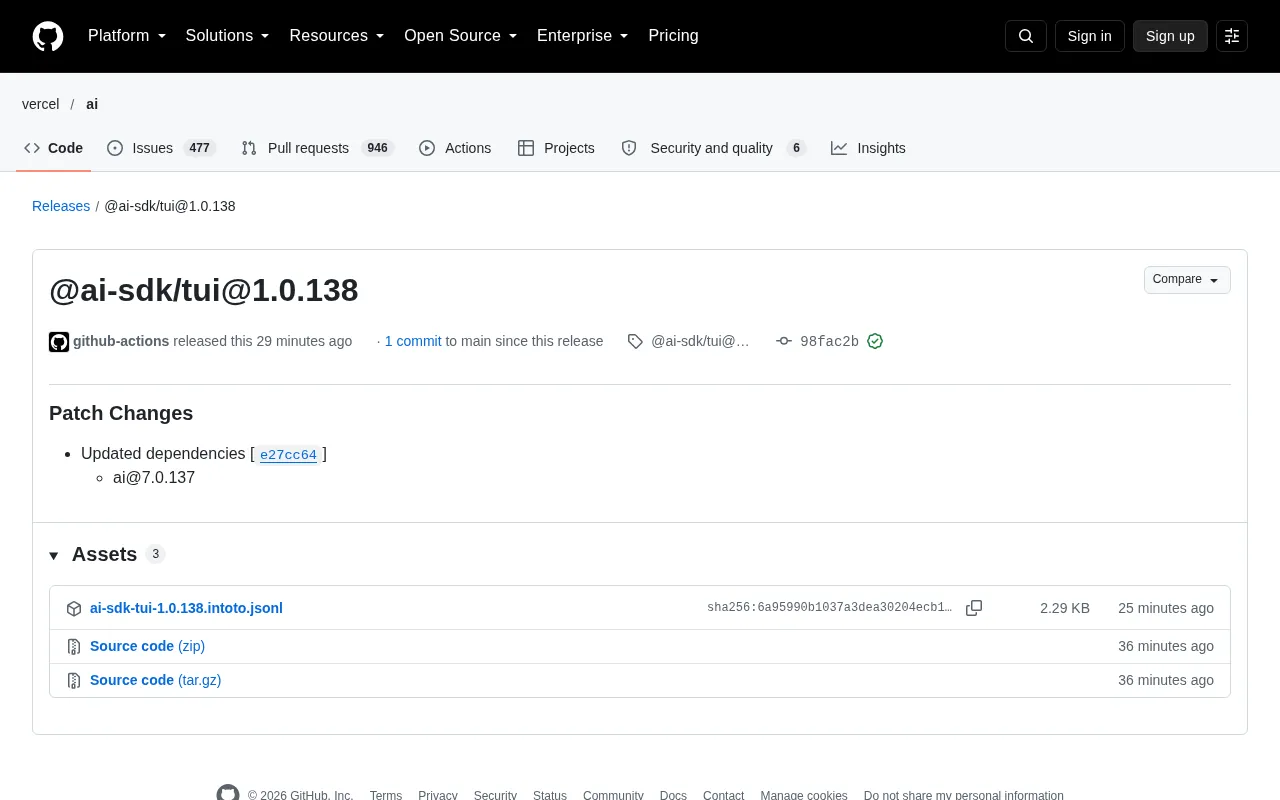
@ai-sdk/tui 1.0.138 is a routine patch release syncing the ai@7.0.137 dependency.
`@ai-sdk/tui@1.0.138` is a routine patch release triggered by an upstream dependency upgrade, with the sole change being a bump of the `ai` dependency to `7.0.137`. The package is part of the Vercel AI SDK ecosystem, providing AI interaction capabilities in Terminal User Interface (TUI) environments. Published automatically via GitHub Actions with a verified signature, this is a low-risk maintenance update. Developers already using the library are encouraged to upgrade to stay aligned with the AI SDK core, and should review the `ai@7.0.137` changelog for any project-relevant changes beforehand.
Overview
@ai-sdk/tui has released version 1.0.138, published on GitHub via an automated process (github-actions) and signed with GitHub's verified signature. Based on the release notes, this is a patch update primarily driven by a dependency upgrade.
Given the limited information available in the source material, this article can only provide an objective summary of the release record without in-depth feature analysis.
What Changed in This Version
According to the release notes, version 1.0.138 is a Patch Change, with the core update being a dependency bump:
- Updated dependency
ai@7.0.137 - Corresponds to commit
98fac2b, triggered by dependency updatee27cc64
Patch versions typically indicate no breaking changes — they're used for bug fixes or syncing upstream dependency upgrades. For developers using @ai-sdk/tui, upgrading to this version is generally safe and recommended, as it keeps your project aligned with the core ai library.
Semantic Versioning (SemVer) divides version numbers into three segments: MAJOR.MINOR.PATCH. A Patch increment (rightmost digit) is, by convention, reserved for backwards-compatible bug fixes — no new features, no breaking changes. In the modern JavaScript ecosystem, many projects use tools like Changesets to automate change categorization and release workflows. Developers attach changeset description files when submitting PRs, and the tooling automatically aggregates them, generates a CHANGELOG, and triggers the appropriate version bump upon merge. In this case, @ai-sdk/tui was passively triggered into a Patch release solely because its upstream dependency ai was upgraded — a classic cascade release scenario in this model.
About @ai-sdk/tui
Based on its name, @ai-sdk/tui belongs to the AI SDK ecosystem, where tui typically stands for Terminal User Interface. This package likely provides support for building AI-powered interactive experiences in command-line environments, working in tandem with the core ai library.
Since this release only includes dependency update information with no new features or UI improvements disclosed, developers looking for a full picture of its capabilities should refer to the official repository documentation and changelog.
The AI SDK (i.e., Vercel AI SDK) is an open-source toolkit led by Vercel, designed to help developers seamlessly integrate large language model (LLM) capabilities into JavaScript/TypeScript projects. It supports major model providers including OpenAI, Anthropic, Google, and more. The ecosystem is centered around the ai core package, with a range of sub-packages tailored for different runtimes and frameworks — such as @ai-sdk/react for React and @ai-sdk/vue for Vue. As the terminal-focused sub-package, @ai-sdk/tui fills the gap for AI interactions in command-line contexts, enabling developers to implement streaming conversations, progress displays, and other interactive experiences in CLI tools, scripts, or server-side environments — all without building a web frontend. Common underlying rendering libraries in the TUI space include ink (React-based) and blessed; @ai-sdk/tui likely wraps these with purpose-built components optimized for AI streaming output.
What This Means for Developers
Frequent minor version releases are the norm in the modern JavaScript/TypeScript ecosystem, especially in the fast-moving AI toolchain. Keeping dependencies up to date helps you:
- Benefit from bug fixes and performance improvements in underlying libraries
- Avoid compatibility issues caused by version drift
- Stay in sync with the broader AI SDK ecosystem's release cadence
Before upgrading, it's worth reviewing the specific changes in ai@7.0.137 to confirm whether any updates are relevant to your project.
Summary
@ai-sdk/tui@1.0.138 is a routine dependency-sync patch update, primarily tracking ai@7.0.137. For teams already using this library, it's a low-risk, standard upgrade. Due to the limited information in the release notes, this article cannot provide deeper feature-level analysis — please refer to the official repository for authoritative details.
Related articles

DeepSeek Open-Sources DeepInfer: What Is an Inference Framework Actually For?
DeepSeek open-sources its inference framework DeepInfer under Apache 2.0, supporting DeepSeek V4.1 Flash offline inference. This article explains its request scheduling, FlashMLA/DeepGEMM compute optimization, DSPark speculative verification acceleration, and what it means for developers and ordinary users.

Open-Source AI Learning Agent: A Full Workflow Experience from Topology Graphs to Exam Generation
Explore an open-source AI learning agent: built on DeepSeek API, it constructs knowledge systems via topology graphs, with automatic document generation, notes, super documents, and exams. Learn about its Agent workflow and design highlights.

DeepSeek Whale Girl Open-Source MV Meme: AI Industry Coded Slang About Pivoting to Closed Source
Bilibili's DeepSeek Whale Girl rap MV uses fictional memes to tease the AI open-source vs. closed-source debate, with lyrics full of industry slang. This article explains the meme culture, the Whale Girl symbol, and the open/closed tension.