@ai-sdk/tui 1.0.153 Released: Minor Update to the TUI Toolchain

@ai-sdk/tui releases 1.0.153, only syncing the ai core package to 7.0.152—a low-risk routine update.
@ai-sdk/tui has released version 1.0.153, a typical patch-level maintenance update. According to the GitHub Release, it was auto-published by the github-actions bot on October 23 with commit hash 2deca8c and GPG signature verification. The changelog contains just one line—bumping the dependent ai core package to 7.0.152—indicating no new TUI features or behavioral changes. The core purpose is to keep the TUI layer in sync with the main SDK. For developers building terminal AI chat and streaming output applications with this toolkit, upgrade risk is low, but regression testing of rendering and event handling is still recommended, along with cross-checking the ai package release notes for the same version.
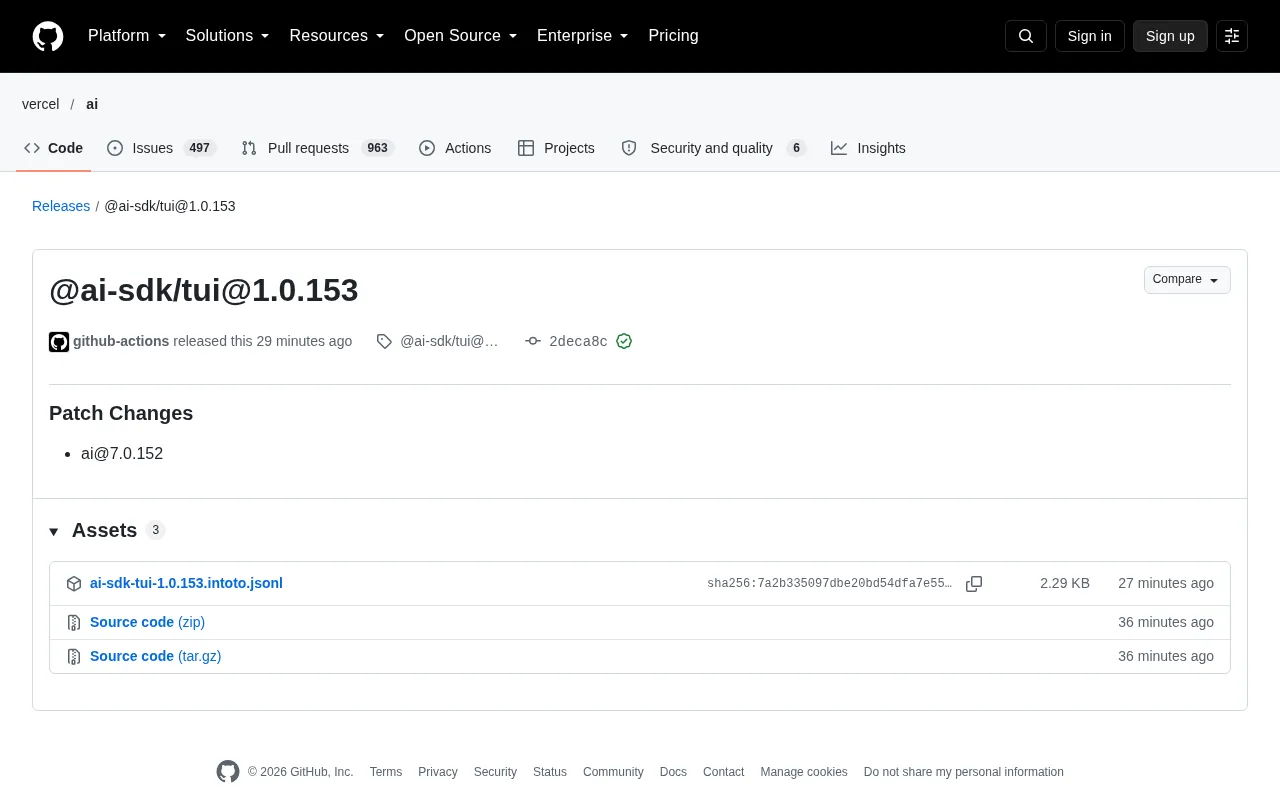
The terminal user interface (TUI) toolkit @ai-sdk/tui in the AI SDK ecosystem has released version 1.0.153. This is a typical patch-level update, primarily aimed at syncing the upstream ai core package to version 7.0.152, ensuring consistency at the dependency level between the TUI layer and the main SDK.
Update Content and Release Background
According to the GitHub Release page, @ai-sdk/tui@1.0.153 was automatically published by the github-actions bot on October 23 at 19:40, with commit hash 2deca8c and a GitHub-verified signature (GPG key ID: B5690EEEBB952194).
The changelog for this release contains only one line: ai@7.0.152. This means the version introduces no new features or behavioral changes to the TUI itself, but instead bumps the dependent ai package version to 7.0.152. For developers using @ai-sdk/tui to build terminal interactive interfaces, this update is a routine dependency alignment with low upgrade risk.
Patch Versions and Semantic Versioning (SemVer)
The third digit in 1.0.153 represents the patch level. According to semantic versioning conventions, patch releases should only contain backward-compatible bug fixes or internal dependency adjustments, and should not introduce breaking changes. Therefore, packages like @ai-sdk/tui that frequently increment patch numbers often indicate a highly automated release process—each time the upstream ai package releases a version, a CI bot triggers a dependency sync and tags a release. This also explains why the changelog for this release contains only a single line of dependency declaration with no feature description. For dependents, such updates can be safely received automatically through version ranges (e.g., ^1.0.153).
The Role of GPG Signatures and Commit Hashes
The commit hash (2deca8c) and GPG key ID included on the Release page are basic elements of software supply chain verifiability. The commit hash uniquely identifies the source snapshot that produced the release, and developers can use git show 2deca8c to locate the specific changes in the repository; the GPG signature proves that the tag was indeed signed by the publisher holding the corresponding private key (in this case, the GitHub Actions bot identity) and has not been tampered with in transit. For automated release processes, signature verification helps downstream users confirm the trustworthiness of artifact sources when pulling dependencies, a practice increasingly valued in the npm ecosystem.
Practical Impact on Developers
@ai-sdk/tui is the AI SDK's interface-layer wrapper for command-line scenarios, commonly used to build local AI chat tools, streaming output terminal applications, and more. Such patch versions typically do not break existing APIs, but developers are advised to run their existing tests after upgrading to confirm that internal adjustments from the ai core package 7.0.152 do not affect the TUI's rendering or event handling logic.
Since the changelog does not list the specific changes in ai@7.0.152, if your project is sensitive to core package behavior, you can cross-check against the release notes for the same version of the ai package.
TUI (Terminal User Interface) and Streaming Rendering
TUI refers to a program form that draws interactive interfaces with characters in the terminal, distinct from pure command-line tools (one-shot input/output) and GUIs. It typically needs to handle cursor positioning, partial redrawing, keyboard event loops, and similar capabilities. In AI scenarios, the challenge of TUI lies in streaming output: tokens returned by the model arrive chunk by chunk, and the interface must incrementally append text without flickering or corrupting existing content. @ai-sdk/tui encapsulates this rendering and event handling logic so that developers only need to focus on conversation state. Precisely because the rendering pipeline depends on the data stream format of the core package, any minor adjustment to the chunk structure within the upstream ai package could manifest at the TUI layer as rendering misalignment or lost events—which is why regression testing is recommended.
Summary
This is a routine maintenance update, whose core value lies in keeping @ai-sdk/tui in sync with the ai main package version. Teams focused on AI SDK terminal-side capabilities can follow up with the upgrade at their regular cadence.
Related articles

DeepSeek Open-Sources DeepInfer: What Is an Inference Framework Actually For?
DeepSeek open-sources its inference framework DeepInfer under Apache 2.0, supporting DeepSeek V4.1 Flash offline inference. This article explains its request scheduling, FlashMLA/DeepGEMM compute optimization, DSPark speculative verification acceleration, and what it means for developers and ordinary users.

Open-Source AI Learning Agent: A Full Workflow Experience from Topology Graphs to Exam Generation
Explore an open-source AI learning agent: built on DeepSeek API, it constructs knowledge systems via topology graphs, with automatic document generation, notes, super documents, and exams. Learn about its Agent workflow and design highlights.

DeepSeek Whale Girl Open-Source MV Meme: AI Industry Coded Slang About Pivoting to Closed Source
Bilibili's DeepSeek Whale Girl rap MV uses fictional memes to tease the AI open-source vs. closed-source debate, with lyrics full of industry slang. This article explains the meme culture, the Whale Girl symbol, and the open/closed tension.