@ai-sdk/valibot 3.0.72 Patch Released: Dependency Updates

@ai-sdk/valibot releases 3.0.72 patch, syncing only low-level dependencies with no API changes.
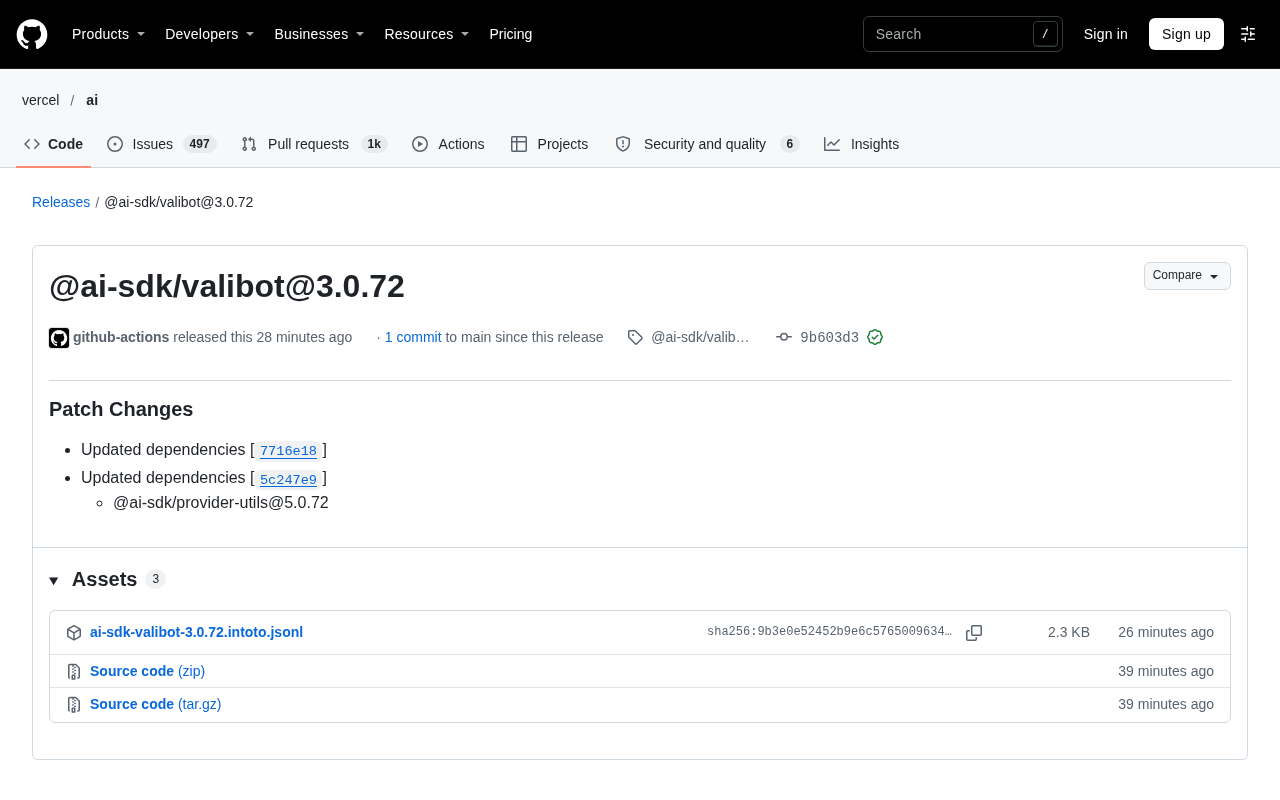
@ai-sdk/valibot released patch 3.0.72, automatically published by github-actions, containing just 1 commit since the last version—a typical automated maintenance cadence. The release notes show only dependency updates, syncing the shared low-level toolkit @ai-sdk/provider-utils to 5.0.72, involving commits 7716e18 and 5c247e9. This release makes no changes to @ai-sdk/valibot's own source code and has no breaking changes, so upgrade risk is low for projects locked to older versions. The package lets developers define tool parameters and structured output with Valibot schemas for type safety and runtime validation, suitable for bundle-size-sensitive Web apps and edge runtimes. Such patches bring no new capabilities but maintain the version health of the AI SDK and Valibot combination, and serve as a window into the upstream provider-utils iteration cadence.
A Small but Polished Patch
In Vercel's AI SDK ecosystem, @ai-sdk/valibot is a relatively low-key but practical package: it brings Valibot into AI SDK's structured output and tool parameter validation pipeline. According to the GitHub Release page, the package has released a 3.0.72 patch version, automatically published by github-actions, containing only 1 commit—a typical small-version maintenance cadence.
What the Version Number and Release Method Signal
The 3.0.72 version number is worth noting. Valibot-related packages maintain a similar patch-number cadence with the AI SDK main package, and @ai-sdk/provider-utils@5.0.72 also appears in this release's dependency update list, indicating that the entire AI SDK family is advancing patch iterations in sync.
The release was completed by the github-actions bot, the commit carries a GitHub verified signature (GPG key ID: B5690EEEBB952194), and there is only 1 commit since the previous version. These details indicate this is an automated dependency-sync release, not one containing new features or behavioral changes. For users, such versions typically mean security and compatibility maintenance rather than new features requiring immediate attention.
Patch Contents: Dependencies Updated, Not the API
The Release Notes body is very concise. The Patch Changes section has only two entries, both "Updated dependencies," pointing to commits 7716e18 and 5c247e9 respectively, followed by the affected dependency @ai-sdk/provider-utils@5.0.72.
The Cascading Upgrade of provider-utils
@ai-sdk/provider-utils is the shared low-level utility package used by all providers in the AI SDK, handling request wrapping, streaming, and response parsing. @ai-sdk/valibot depends on it to complete the validation chain related to model output. Therefore, patch updates to provider-utils cascade downstream, and the valibot package republishes to lock in the new dependency version, ensuring version consistency at install time.
In @ai-sdk/provider-utils, "provider" refers to model service providers such as OpenAI, Anthropic, and Google. The AI SDK uses a layered architecture: at the top is the developer-facing ai core package, in the middle are adapter packages for each provider, and at the bottom is the shared provider-utils. provider-utils encapsulates the low-level mechanisms shared by all providers, including request construction and header handling, parsing and incremental assembly of SSE streaming responses, accumulation of tool call parameters, error normalization, and schema serialization and validation helpers. Because these logics are reused by all providers, its patch updates often trigger republishing of multiple packages across the ecosystem simultaneously to lock in consistent dependency versions—which explains why @ai-sdk/valibot releases a new version even when its own code is unchanged.
Practical Impact on Users
From the changelog, this release does not involve source code changes to @ai-sdk/valibot itself, nor does it declare any breaking changes. For projects locked to older versions, upgrading to 3.0.72 is a low-risk operation; if a project uses multiple AI SDK-related packages simultaneously, unifying to the same patch number helps reduce duplicate versions in the dependency tree.
Its Position in the AI SDK Ecosystem
The AI SDK provides adapter packages for multiple schema validation solutions. Valibot is the smaller, tree-shaking-friendly choice, suitable for Web applications and edge runtimes sensitive to bundle size. The responsibility of @ai-sdk/valibot is to let developers define tool parameters and structured output with Valibot schemas, thereby gaining type safety and runtime validation when calling models.
Such adapter packages are not complex in logic themselves; their value lies more in synchronized maintenance with the AI SDK main version. A patch release frequency like 3.0.72 shows that the maintenance team continues to follow up on fixes in low-level dependencies rather than leaving the adapter package aside.
Valibot is a schema validation library for modern JavaScript/TypeScript, with core design goals of extreme tree-shaking and bundle size control. Unlike similar libraries such as Zod, Valibot splits validation logic into a large number of small functions that can be imported independently, and composes these functions via pipelines to describe data structures—only the validators actually used are bundled into the final output. This on-demand import pattern is clearly advantageous in edge runtimes, Serverless functions, and frontend scenarios sensitive to bundle size. Valibot supports synchronous and asynchronous validation, type inference, and interoperability with standard schemas, so it can be directly used as a schema layer by frameworks like the AI SDK that need runtime validation of model output.
Structured output refers to having a language model return data conforming to a pre-given schema rather than free text. The AI SDK's approach is to convert the schema into a JSON Schema or tool definition that the model can understand, then validate the model's response at runtime using the same schema, triggering a retry or error on failure. The Valibot adapter package is precisely the bridge connecting these two ends: developers write Valibot schemas, and the AI SDK handles serialization to the model and validation on the response side, thereby achieving both TypeScript type safety and runtime data integrity.
Summary
@ai-sdk/valibot@3.0.72 is a standard dependency-sync patch: single commit, automated release, signature verification, no API changes. It brings no new capabilities but maintains the version health of the AI SDK and Valibot combination. For teams using this adapter package, it can be handled through the regular dependency update process; for developers watching the AI SDK ecosystem, such releases can serve as a window into the iteration cadence of the upstream provider-utils.
Related articles

DeepSeek Open-Sources DeepInfer: What Is an Inference Framework Actually For?
DeepSeek open-sources its inference framework DeepInfer under Apache 2.0, supporting DeepSeek V4.1 Flash offline inference. This article explains its request scheduling, FlashMLA/DeepGEMM compute optimization, DSPark speculative verification acceleration, and what it means for developers and ordinary users.

Open-Source AI Learning Agent: A Full Workflow Experience from Topology Graphs to Exam Generation
Explore an open-source AI learning agent: built on DeepSeek API, it constructs knowledge systems via topology graphs, with automatic document generation, notes, super documents, and exams. Learn about its Agent workflow and design highlights.

DeepSeek Whale Girl Open-Source MV Meme: AI Industry Coded Slang About Pivoting to Closed Source
Bilibili's DeepSeek Whale Girl rap MV uses fictional memes to tease the AI open-source vs. closed-source debate, with lyrics full of industry slang. This article explains the meme culture, the Whale Girl symbol, and the open/closed tension.