AI SDK Voyage 2.0.64 Update Analysis: The Maintenance Signal Behind Dependency Upgrades

@ai-sdk/voyage 2.0.64 is a patch update that only synchronizes underlying provider dependency versions.
The article analyzes the seemingly unremarkable patch update @ai-sdk/voyage 2.0.64. This version was automatically published by github-actions and contains two commits. The core content is dependency synchronization: @ai-sdk/provider upgraded to 4.0.31 and @ai-sdk/provider-utils upgraded to 5.0.64. The commits carry GitHub verified signatures. The article points out that in the layered architecture of the Vercel AI SDK, the voyage package is responsible for encapsulating Voyage AI's embedding model calls, affecting downstream applications such as RAG and vector retrieval. Fixes upstream in the dependency chain are passed to users through version synchronization, allowing them to benefit without changing code, while automated publishing also standardizes version numbers and signing processes. The article recommends that production teams verify the return structure of the embedding interface in a test environment before upgrading, and check the release notes of upstream provider packages to assess the impact.
An Apparently Unremarkable Patch Update
The @ai-sdk/voyage package in the AI SDK ecosystem has released version 2.0.64. Judging from the GitHub Releases page, this is a standard patch update with no new features and no breaking changes.
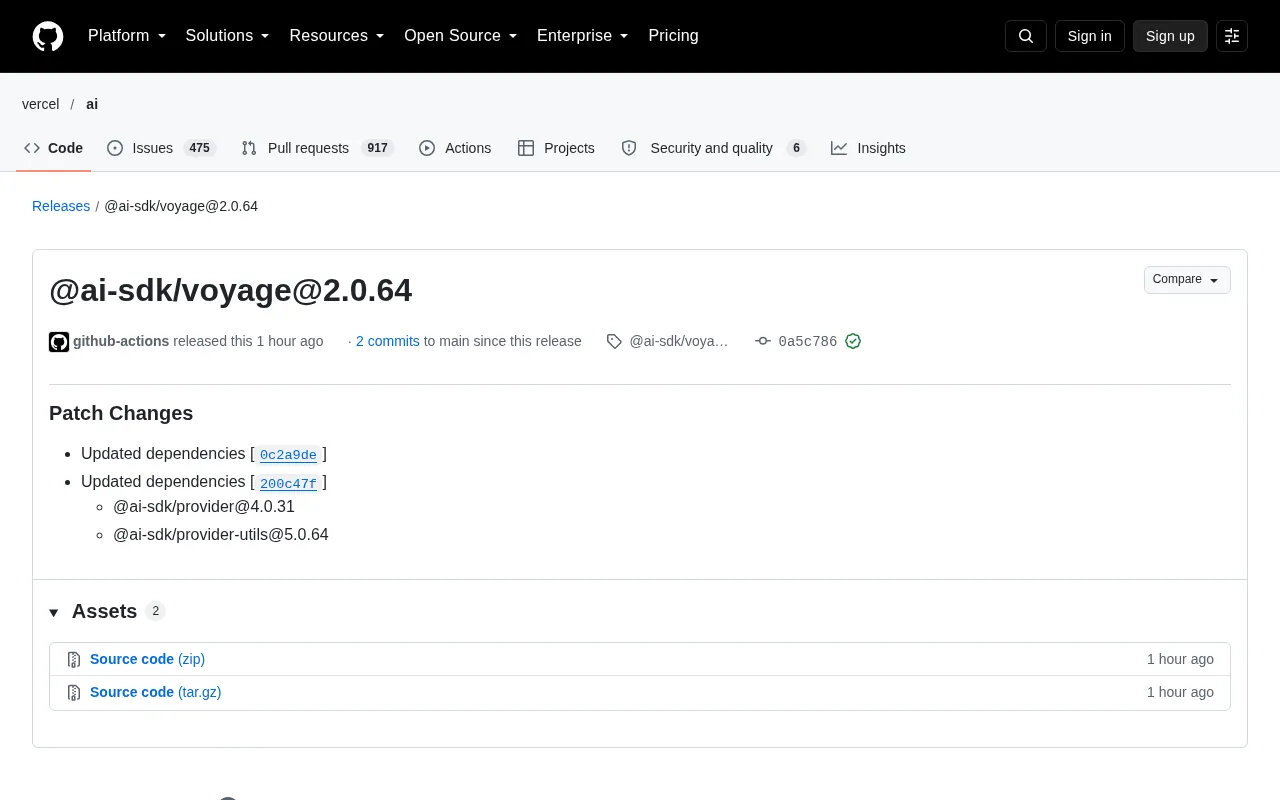
The release record shows that this version was automatically published by github-actions and contains two commits. The core content is updating dependencies: @ai-sdk/provider to 4.0.31 and @ai-sdk/provider-utils to 5.0.64. The commits carry GitHub verified signatures, indicating that the release process has basic integrity guarantees.
For ordinary developers, this kind of update usually goes unnoticed. But in the AI SDK's modular architecture, the voyage package is responsible for interfacing with Voyage AI embedding models, and the stability of the dependency chain directly affects the reliability of downstream applications such as vector retrieval and RAG.
The Position of the Voyage Package in the AI SDK
The AI SDK led by Vercel uses a layered design: provider defines a unified model interface, provider-utils provides shared utility functions, and each provider package (such as voyage, openai, anthropic) encapsulates API calls for a specific vendor.
The value of this design is that developers can switch between multiple model providers using a consistent API. The existence of @ai-sdk/voyage means projects that need text embedding capabilities do not have to maintain their own HTTP request and error handling logic.
In this update, two foundational packages were upgraded at the same time, which is a routine synchronization of the dependency tree. Judging from the version numbers, provider is at 4.x and provider-utils is at 5.x, still in active maintenance rather than a stalled project.
Text embedding is the process of mapping text into dense vectors, where the distance between vectors reflects semantic similarity. In the RAG (Retrieval-Augmented Generation) workflow, the embedding model is responsible for encoding the document library and user queries into vectors, then performing approximate nearest neighbor retrieval through a vector database to recall relevant fragments as context for the large model. Voyage AI is a vendor focused on embedding models, offering series such as voyage-3 and voyage-code, with an emphasis on retrieval quality and multilingual capabilities. The role of the @ai-sdk/voyage package is to wrap Voyage's HTTP API into the AI SDK's unified embedding interface (embed, embedMany), allowing developers to call Voyage models in the same way as OpenAI and Cohere, and to switch between different providers.
The Real Significance of Dependency Updates
Dependency updates may look trivial, but they have a practical impact on long-cycle projects. Small version iterations of the provider package often include bug fixes, type definition corrections, or edge case handling. These changes propagate through the dependency chain to the voyage package, and users can benefit without changing code.
On the other hand, automated dependency synchronization also reduces the burden on maintainers. Unified publishing by github-actions means that version numbers, changelogs, and signing processes are standardized, reducing the possibility of human error.
As a supplement, this release record only lists the updated dependency version numbers and corresponding commit hashes, without explaining what specific problems were fixed. For teams that want to assess the impact of the upgrade, it is recommended to check the respective release notes of @ai-sdk/provider and @ai-sdk/provider-utils before deciding whether to follow up immediately.
Semantic Versioning (SemVer) stipulates that version numbers follow the format major.minor.patch: a major version change indicates incompatible API changes, a minor version indicates backward-compatible new features, and a patch version indicates backward-compatible bug fixes. The 2.0.64 in this article is an increment in the patch position and, by convention, should not introduce breaking changes. This is also the basis for the advice that "patch versions can usually be upgraded safely." It should be noted that SemVer is only a convention, not mandatory. Minor version upgrades of underlying provider packages (such as fixes within the patch position from 4.0.x to 4.0.31) can still change the details of type definitions or error handling behavior. Therefore, verifying the return structure of the embedding interface in a test environment before upgrading in production is still a prudent practice.
The transitivity of the dependency chain is key to understanding this kind of update. In the npm ecosystem, @ai-sdk/voyage itself does not directly implement HTTP requests and parameter validation. Instead, it relies on the interface conventions provided by @ai-sdk/provider and the shared utilities provided by @ai-sdk/provider-utils. When these two foundational packages release fixes, the voyage package only needs to raise the version range of its own dependencies and republish. Downstream users can indirectly obtain the fixes by running npm update or reinstalling. This also explains why a release record that only changed two version numbers is still worth paying attention to: the actual content of the fix is not in the voyage package itself, but upstream. Only by checking the upstream release notes can you know which behavioral changes were brought in by this synchronization.
Practical Advice for Developers
For teams already using @ai-sdk/voyage in production, patch versions can usually be upgraded safely, but it is still recommended to verify in a test environment whether the return structure of the embedding interface remains consistent. For projects that have not yet integrated it, this update itself is not a reason for selection. What is more worth paying attention to is the performance of Voyage models in terms of embedding quality and cost.
Dependency management habits are also worth emphasizing: locking major version numbers, regularly checking security advisories in the dependency chain, and paying attention to changelogs at the provider layer. These practices are more valuable than chasing individual patches.
Conclusion
@ai-sdk/voyage@2.0.64 is not an update worth writing about at length; it is more like a normal beat in the maintenance rhythm of the AI SDK. Understanding the position of this kind of update in the dependency chain is more meaningful than focusing on the version number itself. Stable underlying synchronization is precisely the prerequisite for upper-layer AI applications to continue iterating.
Related articles

T3 Code: The Open-Source AI Coding Assistant's Comeback Story
T3 Code is an open-source AI coding assistant that unifies subscriptions like Codex and Claude, with powerful remote control and parallel task management.

Never Elected, Yet Ruled New York for 30 Years: The Ultimate Case Study in the Mechanics of Power
Robert Caro's biographies reveal how unelected Robert Moses ruled New York for 30 years through legal drafting and public authorities, and how Lyndon Johnson built leverage as a "powerless" Senate Majority Leader. Unpacking the underlying logic of accumulating and sustaining power.

The CPython 3.10 Recursion Trap and Synthetic Recovery in TokenGuard, an LLM Circuit Breaker
TokenGuard's author recounts a recursion crash caused by OrderedDict.pop in CPython 3.10 and introduces v0.3.0's Loop Nudge synthetic recovery, inline DLP scanning, and other new LLM agent circuit-breaker capabilities.