AI SDK Voyage 2.0.69 Patch Update: The Maintenance Signal Behind a Dependency Bump

Voyage provider releases patch 2.0.69, only syncing the shared toolkit provider-utils.
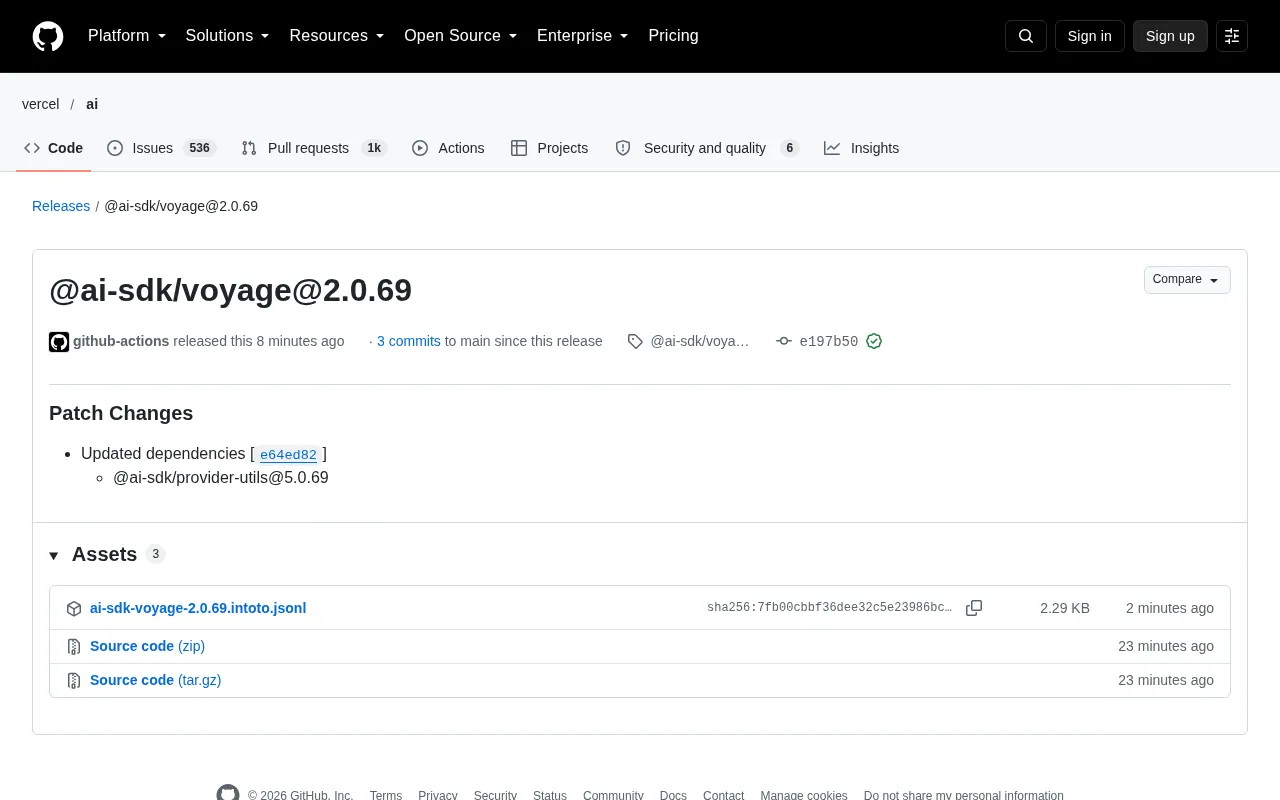
The Voyage provider in the AI SDK ecosystem has released version 2.0.69, a patch-level update whose only change is syncing the dependency @ai-sdk/provider-utils to 5.0.69. provider-utils is a shared toolkit for model providers, handling request construction, response parsing, and error mapping, and its version alignment directly affects invocation stability and type compatibility. Since neither the major nor minor version changed, this update contains no breaking changes or new features, so upgrade risk is low. For projects using Voyage, the direct benefit is dependency tree convergence, avoiding type conflicts from multiple provider-utils versions in the same monorepo. The article characterizes this release as a purely maintenance-oriented update.
A Low-Key Patch Release
The Voyage provider in the AI SDK ecosystem has released version 2.0.69. The increment of the third digit in the version number indicates this is a patch-level update rather than a feature iteration. According to the release notes, there is only one change: the dependency @ai-sdk/provider-utils was updated to version 5.0.69.
This kind of dependency sync update may look unremarkable, but for developers building applications on the AI SDK, it reflects the maintenance team's ongoing effort to keep the upstream toolchain consistent.
The Role of provider-utils in the AI SDK
The Significance of a Unified Adapter Layer
@ai-sdk/provider-utils is a shared toolkit for the various model providers in the AI SDK, handling common logic such as request construction, response parsing, and error mapping. As a provider focused on embeddings, Voyage's version alignment with the core toolkit directly affects the stability of invocation behavior.
When provider-utils releases a new version, downstream providers upgrading in sync usually means two things: first, maintaining type and interface compatibility with the core package; second, inheriting any fixes or behavioral adjustments that may be included upstream. The release notes do not list specific change details, so the impact of this upgrade needs to be assessed in conjunction with the contents of provider-utils' own 5.0.69 version.
The AI SDK is an open-source TypeScript toolkit led by Vercel, designed to call large models and AI services from different vendors through a unified interface. Its architecture uses a layered "core + provider" design: the core package defines common abstractions, while each provider (such as OpenAI, Anthropic, Voyage, etc.) implements vendor-specific protocol adaptation as an independent npm package. @ai-sdk/provider-utils sits between these layers. It is not aimed at business code but provides reusable low-level capabilities for provider authors, such as serialization of request parameters, chunked parsing of streaming responses, and mapping of HTTP errors to unified error types. Because of this, its version changes affect all downstream providers simultaneously, and keeping versions aligned is a key means of maintaining ecosystem consistency.
Patch Cadence and Semantic Versioning
From a version number like 2.0.69, it can be inferred that this package is in a state of high-frequency, small-step iteration. In semantic versioning, the major version number is unchanged, indicating no breaking changes; the minor version number is also unchanged, indicating no new features. For production users, such patches can usually be adopted with relatively low risk, but it is still recommended to verify after upgrading that the return structure of the embedding interface meets expectations.
Semantic Versioning (SemVer) specifies that a version number consists of three parts: "major.minor.patch." An increment in the major version indicates incompatible breaking changes, an increment in the minor version indicates new functionality added in a backward-compatible manner, and an increment in the patch number contains only backward-compatible bug fixes. Therefore, the jump from 2.0.68 to 2.0.69 theoretically means callers can upgrade without modifying any code. It should be noted that SemVer only makes commitments about a package's public API. If a project indirectly depends on internal implementation details, a patch upgrade may still bring unexpected behavior, which is why the article recommends verifying the return structure after upgrading.
Practical Impact on Developers
This update introduces no new APIs, makes no adjustments to public interfaces, and involves no configuration changes. The published commit record shows only a single commit, and it has been verified and signed by GitHub, following a standard automated release path.
For projects currently using the Voyage provider, the direct benefit of upgrading to 2.0.69 is dependency tree convergence—avoiding type conflicts caused by multiple versions of provider-utils coexisting within the same monorepo. If a project has pinned an older version of provider-utils, this is an opportunity to unify the version.
From a broader perspective, providers in the AI SDK ecosystem adopt a synchronized versioning strategy, allowing developers to quickly judge compatibility through a single minor version number. This engineering convention reduces the cognitive burden when mixing multiple providers.
Dependency tree convergence is a common governance goal in monorepos and multi-package projects. When different versions of the same package exist simultaneously in the dependency tree, package managers such as npm will install multiple copies separately, which not only increases size but may also cause TypeScript to treat identically named types from different copies as incompatible types, resulting in difficult-to-troubleshoot errors. Unifying provider-utils to 5.0.69 can eliminate such duplicate copies. Developers can check whether multiple versions coexist in the current dependency tree using npm ls @ai-sdk/provider-utils or pnpm why @ai-sdk/provider-utils.
Conclusion
Voyage 2.0.69 is a purely maintenance-oriented release. Its value lies not in new features but in keeping the toolchain consistent. Developers following the AI SDK ecosystem can treat it as a routine patch and adopt it as needed.
Related articles

Why Does Self-Play AI Always Get Crushed by Cheap Units? An RTS Developer's Account of the Dilemma
An independent developer trained an RTS commander AI with pure self-play, only to find it dominated historical versions but was crushed by human players using cheap tier-1 units. This article analyzes the causes of self-play strategy collapse, explores solutions such as exploiters, diversity rewards, and reward design, and introduces the open Bot Kit and AI league plan.
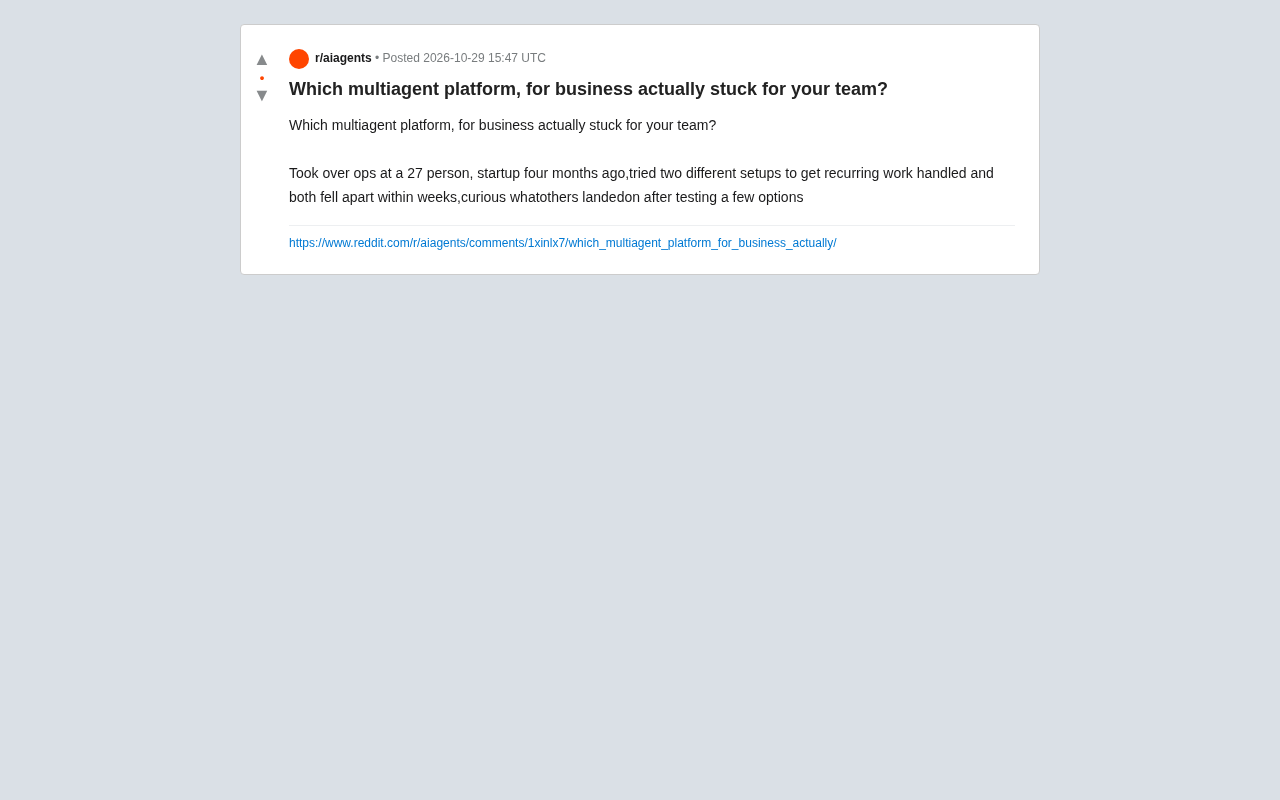
Which Multi-Agent Platform Wins? A Small Team's Battle Scars and Selection Considerations
A 27-person startup's ops lead tried two multi-agent platforms in four months and both failed. This article analyzes why small-team deployments break down, and offers selection guidance on integration depth, observability, and progressive rollout.

Thrive Holdings Takes ADT Private in $7.6 Billion Deal
Thrive Holdings acquires ADT for $7.6 billion in an all-cash take-private deal expected to close in Q1 2027. Analysis of the deal structure, ADT's asset value, and impact on the smart home security industry.