AI SDK Vue 2.0.282 Patch Released: Synced with ai@5.0.282

@ai-sdk/vue releases patch 2.0.282, whose core value is syncing with ai@5.0.282.
The AI SDK's Vue adapter package @ai-sdk/vue has released patch version 2.0.282, published by the GitHub Actions automation workflow with commit hash e91421e and GPG signature verification. The only change item listed in the release notes is ai@5.0.282, indicating minimal changes to the Vue package itself—its value lies mainly in syncing with the core ai package. The article analyzes the AI SDK's design of separating the core layer from framework adapters, noting that the synchronized release mechanism reduces version mismatch risks, and developers only need to keep the adapter package at the latest patch to indirectly receive core fixes. For Vue developers, upgrade risk is low, but it's recommended to verify critical paths like streaming output and tool calls in a test environment. The article also observes that the project has merged 4,925 commits into the main branch, showing an active iteration pace, and recommends developers pin versions and batch upgrade according to their own cycles.
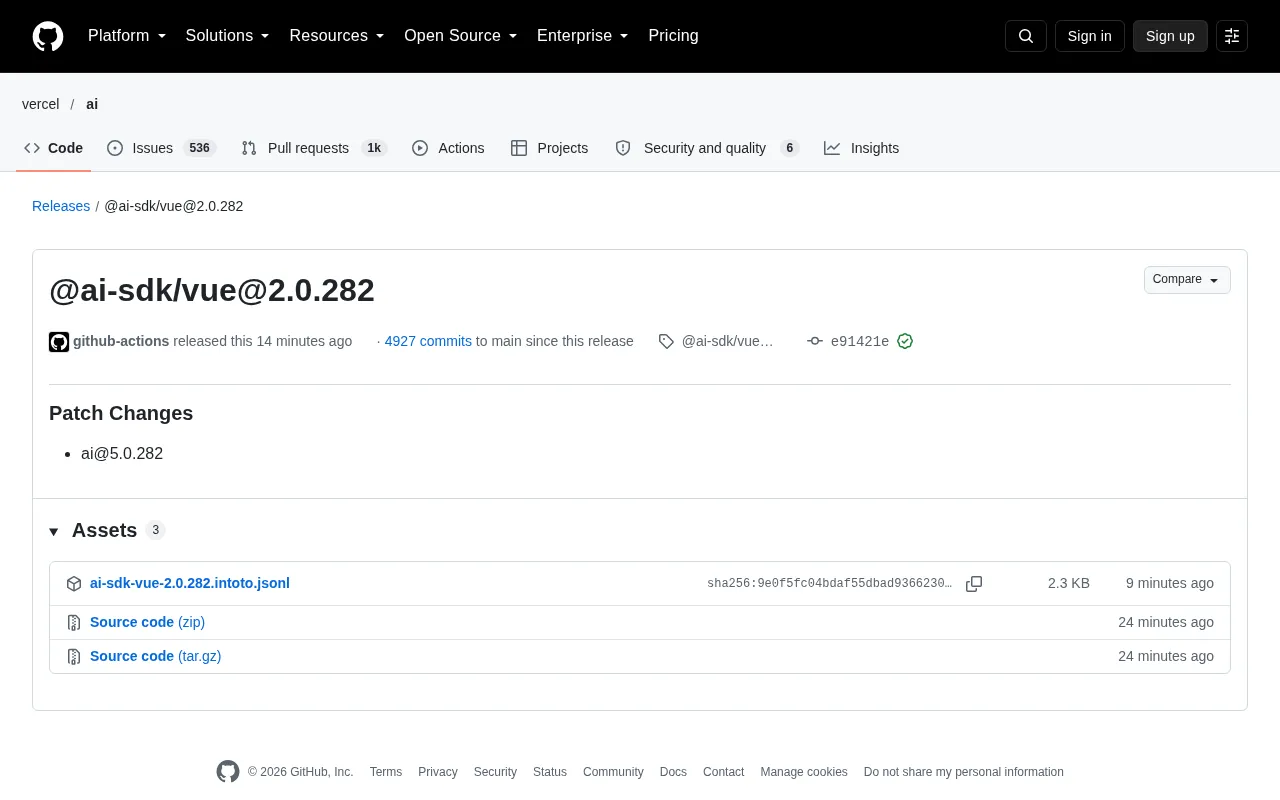
The AI SDK's Vue package has released version 2.0.282. It's a patch release, but what's more interesting than the version number is the synchronized ai@5.0.282 update—that's the part really worth paying attention to.
The Basics of This Patch Release
According to the release record on GitHub, this version was published by the github-actions automation workflow, with commit hash e91421e and a verified GitHub signature (GPG key ID: B5690EEEBB952194). From the commit history, this is the 4,925th commit merged into the main branch.
The "2.0.282" in the version number indicates that the AI SDK's Vue adapter layer is still iterating at high frequency. Such three-digit minor version numbers are not uncommon in fast-evolving AI toolchains—it usually means the team adopts a continuous delivery strategy, pushing fixes and new features to users in smaller increments.
A detail worth noting: the release notes list only one change item—ai@5.0.282. This suggests that changes to the Vue package itself are likely minimal, or that its changes depend entirely on updates to the core ai package.
Semantic versioning (SemVer) defines a three-part structure of major.minor.patch, where the patch number (282 in this case) should strictly increment only for backward-compatible bug fixes. However, in projects employing continuous delivery and automated publishing, the patch number is often used as a build pipeline incrementing value, so a three-digit number doesn't mean the API has undergone 282 breaking changes. To judge the real impact of an upgrade, you should look at changelog entries, version constraints of core dependencies, and commit history—not the number of digits in the version number itself. This also explains why the article emphasizes that "the version number looks more notable than the actual content": the growth in numbers mainly reflects release frequency, not feature scale.
Why the Synchronized ai@5.0.282 Update Matters
The AI SDK's design philosophy is to separate core logic from framework adapter layers. The ai package handles underlying capabilities like model invocation, streaming responses, and tool calls, while @ai-sdk/vue provides a wrapper for Vue's Composition API, letting Vue developers integrate AI capabilities in a way that better fits the framework's conventions.
When the Vue package releases a patch and references ai@5.0.282, it usually means the core package has fixes or small improvements that need to be passed on to Vue users. For projects already using this SDK, this update is unlikely to introduce breaking changes at the API level, but it's recommended to verify that critical paths like streaming output and tool calls work properly after upgrading.
From an engineering perspective, this synchronized release mechanism reduces the risk of version mismatches between the adapter layer and the core layer. Developers only need to keep @ai-sdk/vue at the latest patch version to indirectly receive fixes from the core package.
A monorepo (managing multiple packages in a single code repository) is a common engineering organization for this kind of SDK: the ai core package and adapters like @ai-sdk/vue and @ai-sdk/react live in the same repository, sharing build and release workflows. During publishing, tools like changesets or lerna are typically used to bump versions uniformly and write internal dependencies as workspace:* or exact versions, ensuring the core package and adapter layers stay in sync. The cost of this approach is that the adapter package's own changelog often contains only a single line referencing the core package; the benefit is that it fundamentally eliminates the mismatch problem of "adapter layer calling old APIs of the core package." Understanding this makes it clear why the Vue package's update entry only lists ai@5.0.282.
Practical Impact for Vue Developers
If you're integrating AI capabilities into a Vue project, the direct action for this update is simple: upgrade @ai-sdk/vue to 2.0.282. Since it's a patch version, upgrade risk is low, but it's still recommended to run your existing AI interaction flows in a test environment first.
It's worth noting that this release record doesn't list specific feature changes or fix details, so it's impossible to determine exactly what changed in ai@5.0.282. In real projects, you can follow subsequent commits and issue discussions in the official repository for more context.
Observing the Version Iteration Cadence
From the figure of 4,925 commits merged into the main branch, it's clear that the AI SDK project maintains a fairly active development pace. For teams depending on this SDK, establishing a habit of periodically checking patch versions is reasonable—patch versions don't introduce new APIs, but they may contain fixes that affect stability.
At the same time, avoid chasing every patch too frequently. A more pragmatic approach: pin versions in your project lockfile, batch upgrades according to your own release cycle, and pay attention to the core package's change notes with each upgrade.
Summary
@ai-sdk/vue@2.0.282 is itself a quiet patch release, whose value lies mainly in its synchronization with ai@5.0.282. For developers using the AI SDK in the Vue ecosystem, this is a low-cost update point to keep versions healthy; for those observing the evolution of AI toolchains, it reflects that the SDK layer is being continuously refined at high frequency and in small steps.
Related articles

T3 Code: The Open-Source AI Coding Assistant's Comeback Story
T3 Code is an open-source AI coding assistant that unifies subscriptions like Codex and Claude, with powerful remote control and parallel task management.

Never Elected, Yet Ruled New York for 30 Years: The Ultimate Case Study in the Mechanics of Power
Robert Caro's biographies reveal how unelected Robert Moses ruled New York for 30 years through legal drafting and public authorities, and how Lyndon Johnson built leverage as a "powerless" Senate Majority Leader. Unpacking the underlying logic of accumulating and sustaining power.

The CPython 3.10 Recursion Trap and Synthetic Recovery in TokenGuard, an LLM Circuit Breaker
TokenGuard's author recounts a recursion crash caused by OrderedDict.pop in CPython 3.10 and introduces v0.3.0's Loop Nudge synthetic recovery, inline DLP scanning, and other new LLM agent circuit-breaker capabilities.