@ai-sdk/vue@4.0.130 Released: Dependency Update Patch Version
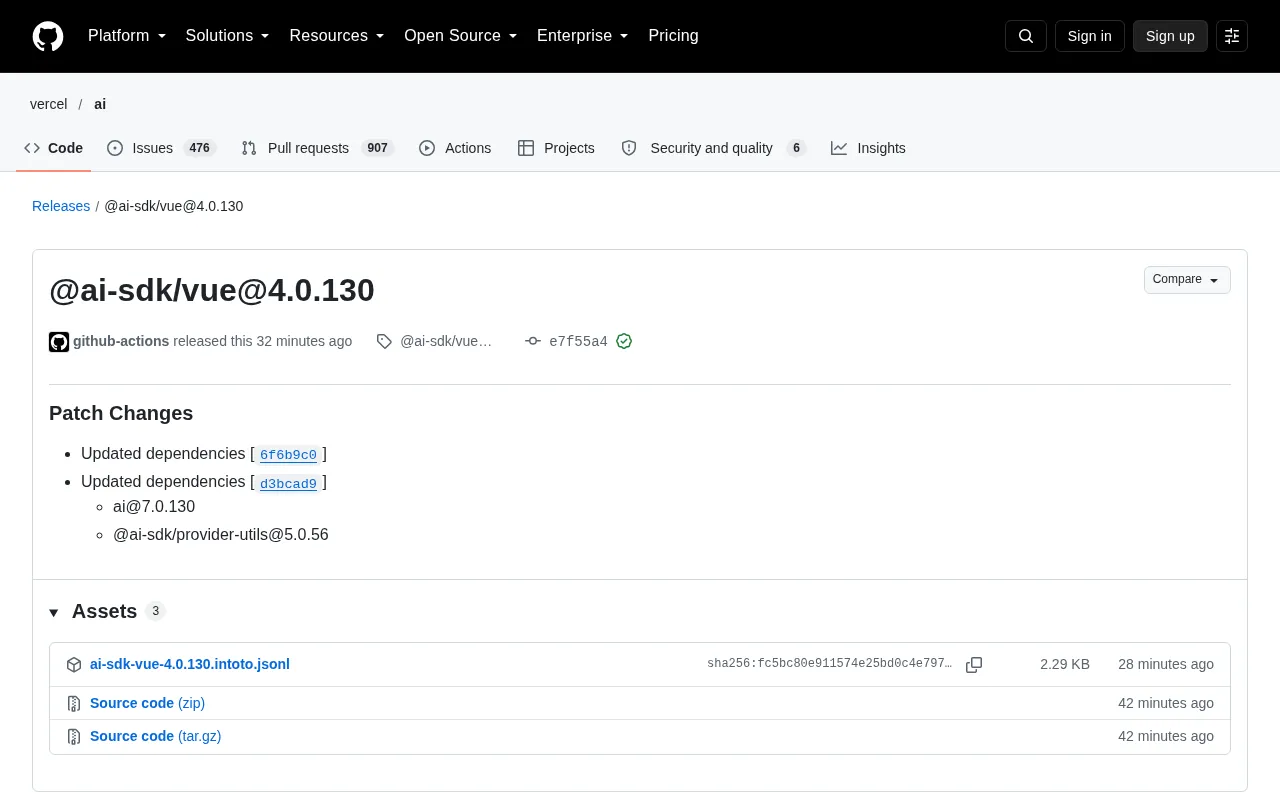
Vercel AI SDK's Vue adapter releases patch 4.0.130, syncing core dependency versions.
`@ai-sdk/vue` 4.0.130 is a pure dependency-sync patch update with no new features or API changes. The key updates are bumping related dependencies to `ai@7.0.130` and `@ai-sdk/provider-utils@5.0.56`. Published automatically via GitHub Actions with GPG signature verification. The upgrade carries low risk for Vue 3 developers building AI-powered apps, though reviewing core package changelogs for relevant bug fixes or compatibility changes is still recommended.
Vercel AI SDK's Vue adapter package @ai-sdk/vue has released version 4.0.130. This is a patch-level update focused on syncing underlying dependency versions, with no new developer-facing features introduced.
What's in This Update
According to the GitHub Release notes, @ai-sdk/vue@4.0.130 falls under Patch Changes. The core changes are updates to two associated dependencies:
ai@7.0.130@ai-sdk/provider-utils@5.0.56
In other words, this version contains no independent feature additions or API modifications — it was published alongside updates to the AI SDK core package and the provider utilities library. For developers integrating AI capabilities using the Vue framework, patch updates like this typically bring bug fixes, compatibility adjustments, or internal optimizations from the underlying layers into the Vue adapter.
This version was automatically published via GitHub Actions and passed GitHub's signature verification (Verified), with a GPG key ID of B5690EEEBB952194, ensuring the trustworthiness of the release artifact.
What Is @ai-sdk/vue
@ai-sdk/vue is the Vue-specific adapter package within the Vercel AI SDK ecosystem. The AI SDK is a TypeScript toolkit for building AI-powered applications, providing a unified interface to connect with various large language model providers (such as OpenAI, Anthropic, etc.), and encapsulating common capabilities like streaming responses, tool calling, and chat state management.
For different frontend frameworks, the AI SDK provides corresponding binding packages — the Vue version is one of them, enabling Vue 3 projects to conveniently access the underlying capabilities using the Composition API. This includes managing chat message streams and handling streaming text output, among other use cases.
The Composition API is the core programming paradigm introduced in Vue 3. Through the
setup()function or<script setup>syntax, it organizes logic by feature rather than lifecycle, used alongside reactive primitives likeref,reactive, andcomputed. Compared to Vue 2's Options API, the Composition API is better suited for logic reuse — related state and behavior can be encapsulated into custom "composables" for external use.@ai-sdk/vuedelivers its capabilities in exactly this form, exposing composables likeuseChat()anduseCompletion(). Once called inside a component, developers get reactive message lists, streaming output states, and message-sending methods — without needing to manually manage SSE connections or streaming parse logic.
Impact on Developers
Since this is a pure dependency-update patch release, the upgrade risk is generally low. Per Semantic Versioning (SemVer) conventions, Patch versions should not contain breaking changes, so developers can upgrade with reasonable confidence.
That said, since this update essentially follows the changes in ai@7.0.130 and @ai-sdk/provider-utils@5.0.56, it's worth reviewing the changelogs for those core packages to confirm whether any fixes are relevant to your use case. Keeping dependencies in sync helps ensure you benefit from the latest compatibility support and stability improvements.
Teams currently using the AI SDK Vue package can upgrade @ai-sdk/vue to 4.0.130 via their package manager (npm/pnpm/yarn) and update related dependencies at the same time to maintain version consistency.
Semantic Versioning (SemVer) is the standard specification for software version numbers, formatted as
MAJOR.MINOR.PATCH. The core convention is: PATCH includes only backward-compatible bug fixes; MINOR may add backward-compatible new features; MAJOR indicates breaking changes. In ecosystems that follow SemVer, upgrading a patch version theoretically won't break existing code — which is why the 4.0.130 update is considered low risk. That said, "theoretically safe" doesn't mean "absolutely no impact": behavior corrections in underlying dependencies can sometimes indirectly affect behavior at higher layers, so reviewing related changelogs remains a good practice.
Related articles

world2vec: Building Mechanistic World Models with Latent Dynamics Learning
world2vec proposes a reward-free method for learning mechanistic world models via latent dynamics, faithfully reproducing systems over long horizons with at least an order of magnitude fewer parameters than DreamerV3, TD-MPC2, and LeWM, and achieving accurate system identification on 71 attractor benchmarks.

A New KL-DRO Paradigm: Adaptive Scenario Generation Around a Learned Density Model
KL-DRO research proposes centering the KL ball on a learned density model instead of the empirical distribution, with adaptive scenario generation guiding sampling toward the worst case. Experiments show lower cost under distribution shift when records are scarce and the model can extrapolate, with comparable in-distribution cost.

ODE Samplers for Discrete Diffusion Models: Exponential Residual Flows Accelerate Generation
Discrete diffusion models lack deterministic ODE sampling? This article introduces Exponential Residual Flows (ERFs), which introduce continuous residual variables per token to construct piecewise ODEs for deterministic sampling and support consistency distillation acceleration. Superior to prior methods on code and text generation tasks.