AI SDK Vue 4.0.152 Patch Released: Synced Upgrade of the ai Package

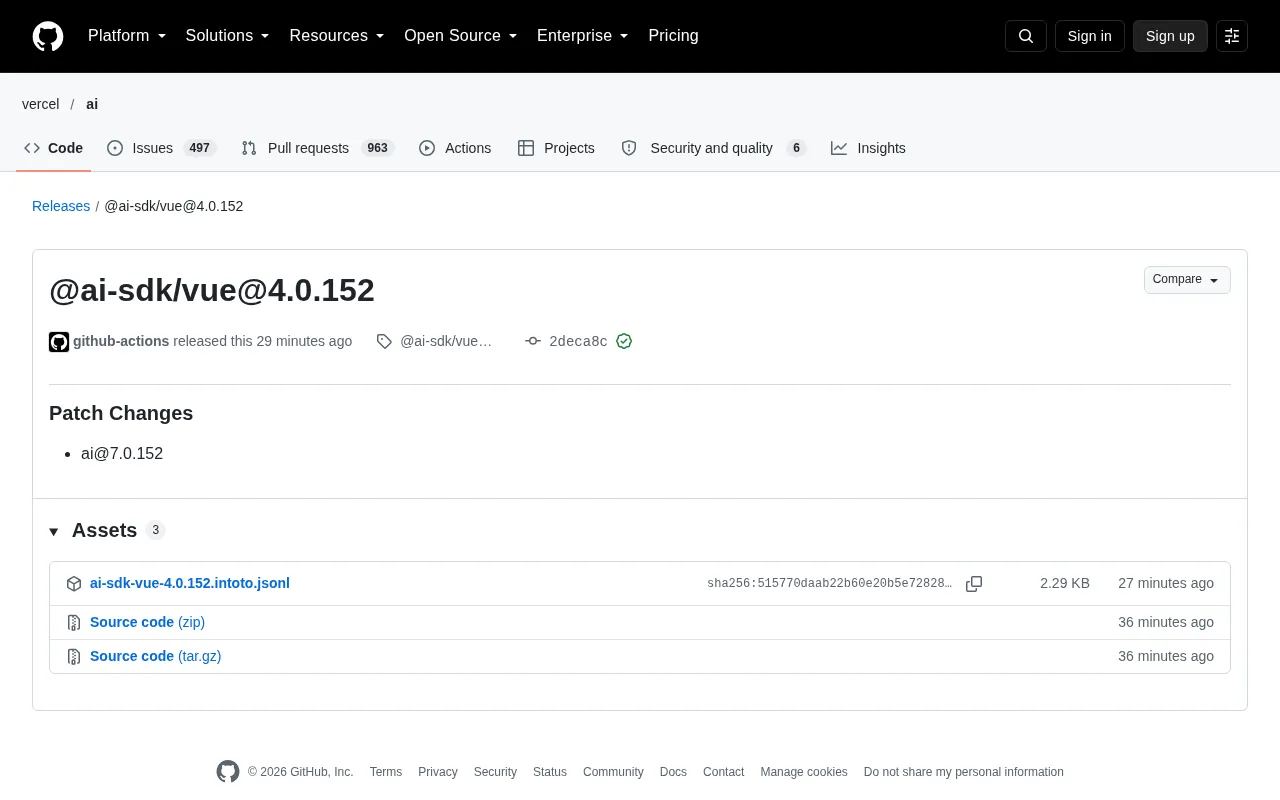
@ai-sdk/vue releases 4.0.152 patch, synchronously upgrading the core ai package to 7.0.152.
The Vercel AI SDK team released @ai-sdk/vue 4.0.152, a patch-level update whose core action is synchronizing the underlying ai package to 7.0.152, with no new APIs or breaking changes. The article notes that while such patches are small, they may include model provider response format compatibility fixes, streaming parsing edge case handling, and type fine-tuning, from which Vue applications benefit indirectly through composables like useChat. Since the framework binding layer and core package are released with unified version numbers, the cost for developers to assess compatibility is low. The upgrade recommendation is a standard package manager update, with focus on verifying streaming chat scenarios; it is also essential to ensure the minor version numbers of @ai-sdk/vue and the ai package match to avoid duplicate dependencies and type conflicts. Overall, this release reflects the AI SDK's high-frequency, automated maintenance cadence.
Vercel's AI SDK team recently released version 4.0.152 of @ai-sdk/vue. This is a minor release iteration, with the core change being the synchronized update of the underlying ai package dependency. For developers using Vue to integrate AI capabilities, understanding the background and impact of this update helps determine whether to follow up with an upgrade.
Core Changes in the Patch Release
According to the GitHub release notes, @ai-sdk/vue@4.0.152 is classified as a Patch Change, with the main action being upgrading the ai package to 7.0.152. In the AI SDK's monorepo structure, @ai-sdk/vue is the binding layer for the Vue framework, while the ai package provides core streaming response, tool calling, and model abstraction capabilities. The version numbers of both are kept in sync, indicating that this update is a routine synchronized release with no new APIs or breaking changes introduced.
From the release process perspective, this version was automatically built and signed by GitHub Actions, with commit hash 2deca8c. This automated release pattern has become standard in the AI SDK project, meaning patch releases typically contain only bug fixes, dependency alignment, or minor documentation tweaks rather than feature iterations.
Monorepo and Version Synchronization Mechanism
The AI SDK uses a monorepo (single code repository) structure to manage multiple npm packages, with Vercel using tools like Changesets to centrally manage versions and releases. In this model, framework binding packages such as @ai-sdk/vue and @ai-sdk/react share the same release pipeline with the core ai package, and version numbers are often kept aligned. Framework binding packages are essentially lightweight adaptation layers that do not carry model invocation logic themselves—they only map the core package's capabilities into framework-idiomatic API forms (such as Vue composables). Therefore, when the core package releases a patch, the binding package typically only needs to sync the dependency version number to publish. This is also why patch releases appear frequently. Understanding this helps developers distinguish between "binding package logic changes" and "merely following core package synchronization" types of updates, avoiding misjudgments about seemingly frequent version numbers.
Why Patch Releases Are Worth Paying Attention To
At first glance, a patch release may not seem worth dedicated discussion. But for teams building production applications on the AI SDK, the value of patch releases often lies in the details. Each minor version update of the ai package may include compatibility fixes for specific model providers' (such as OpenAI, Anthropic, Google) response formats, edge case handling in streaming parsing, or fine-tuning of type definitions.
As the Vue-side wrapper, @ai-sdk/vue primarily exposes composables such as useChat and useCompletion. When the underlying ai package fixes streaming data parsing issues, Vue applications benefit directly without needing to modify business code. This is also why the official recommendation is to keep versions in sync—misalignment between framework binding layer and core package versions can easily lead to hard-to-troubleshoot behavioral differences in edge cases.
How useChat and useCompletion Work
useChat and useCompletion are composables provided by the AI SDK for frontend frameworks, encapsulating the complete lifecycle of communicating with backend streaming interfaces. Taking useChat as an example, it internally maintains a message array, loading state, and error state, and reads server-returned text increments chunk by chunk through ReadableStream, triggering reactive updates to achieve typewriter-style rendering. These functions depend on the streaming protocol parser provided by the underlying ai package. Once the protocol format is slightly adjusted (for example, adding new data chunk types or changing delimiters), the binding layer must also adapt accordingly. Therefore, when the ai package fixes edge cases in streaming parsing, the incremental rendering stability of useChat improves directly without any changes to business code—this is precisely the practical significance of keeping framework binding layer and core package versions in sync.
Upgrade Recommendations and Considerations
For projects using @ai-sdk/vue, upgrading to 4.0.152 is low-cost. Simply run the standard package manager update command, such as npm install @ai-sdk/vue@4.0.152. After upgrading, it is recommended to focus on verifying streaming chat scenarios, confirming that useChat's incremental rendering and error handling meet expectations.
It's worth noting that the AI SDK's versioning scheme is fairly tight, and the minor version numbers of @ai-sdk/vue and the ai package need to match. If the project also explicitly installs the ai package, ensure both are updated to 7.0.152 to avoid duplicate dependencies or type conflicts. For production environments with locked versions, you can check the commit records associated with this version on the GitHub Releases page to confirm whether it includes fixes relevant to your business.
Minor Version Matching and Dependency Deduplication
In the npm ecosystem, different versions of the same package may be installed simultaneously at different levels of the dependency tree, creating duplicate dependencies. AI SDK packages are interconnected through peer or direct dependency relationships. If the minor version numbers of @ai-sdk/vue and ai are inconsistent, two instances of the ai package may exist, leading to incompatible type definitions or runtime state fragmentation (for example, streaming context objects cannot be recognized across instances). Use npm ls ai or pnpm why ai to check whether multiple versions coexist in the dependency tree. Additionally, TypeScript projects are particularly sensitive to version misalignment—type mismatches often only surface at compile time. Therefore, production environments with locked versions should update related packages simultaneously when upgrading and regenerate the lockfile to ensure the entire dependency graph points to the same version.
Routine Iteration from an Ecosystem Perspective
The AI SDK project maintains a high-frequency patch release cadence, reflecting a maintenance strategy oriented toward rapid response. The Vue binding layer and core package being released with the same version number also reduces the cognitive burden on developers in understanding version compatibility. This 4.0.152 update comes without additional release note details, making it a typical dependency-synchronization patch.
For teams in the technology selection phase, such release records can serve as reference signals for observing project activity: stable automated releases, clear version alignment, and continuous patch maintenance are all practical indicators for evaluating the maturity of an open-source SDK.
References:
- GitHub Releases: @ai-sdk/vue@4.0.152
One-line Summary
@ai-sdk/vue releases 4.0.152 patch, synchronously upgrading the core ai package to 7.0.152.
Paragraph Summary
The Vercel AI SDK team released @ai-sdk/vue 4.0.152, a patch-level update whose core action is synchronizing the underlying ai package to 7.0.152, with no new APIs or breaking changes. The article notes that while such patches are small, they may include compatibility fixes for model provider response formats, edge case handling in streaming parsing, and type fine-tuning, from which Vue applications benefit indirectly through composables like useChat. Since the framework binding layer and core package are released with unified version numbers, the cost for developers to assess compatibility is low. The upgrade recommendation is a standard package manager update, with focus on verifying streaming chat scenarios; it is also essential to ensure the minor version numbers of @ai-sdk/vue and the ai package match to avoid duplicate dependencies and type conflicts. Overall, this release reflects the AI SDK's high-frequency, automated maintenance cadence.
Related articles
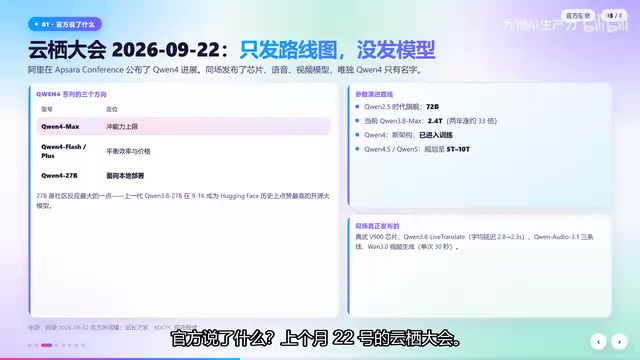
Qwen4 Architecture Preview Open-Sourced: 125B Parameters, 512 Experts, Designed for VRAM-Constrained Hardware
Qwen4 isn't released yet, but its architecture is previewed via open-source Qwen3.8 Flash Next: 125B params, 6B activated per token, 512 experts, 262K context, built for VRAM-limited hardware. This article covers official confirmations, key config.json metrics, and local deployment tests on 24G memory.
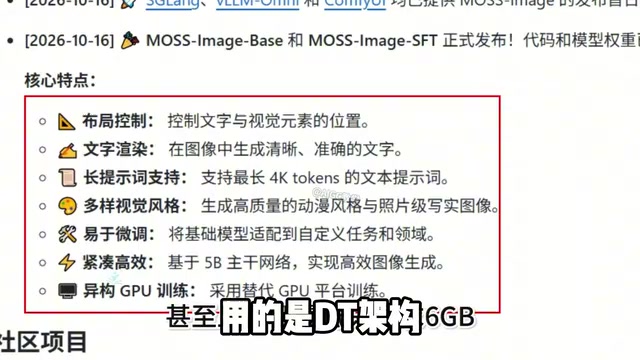
Run 8K Images on 6GB VRAM! Hands-On Test of Fudan's Open-Source MOSS-Image Model
Fudan OpenMouse team and Shanghai MOSS Intelligence open-source MOSS-Image, a 500M-parameter DT architecture text-to-image model that runs locally on 6GB VRAM with precise text rendering, structured layout control, and 4K Token prompt support—ideal for e-commerce posters and local deployment by individual creators.
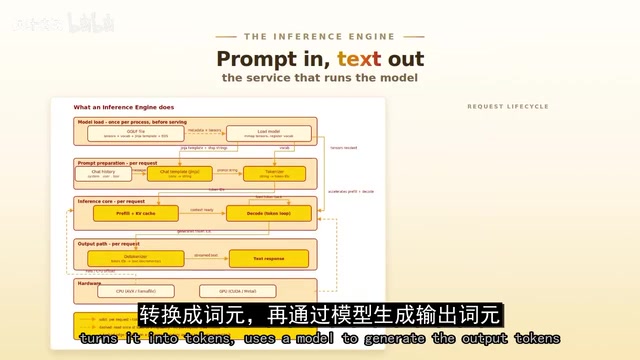
Overseas Blogger Tests Local Deployment of 100B-Parameter MoE Model: Key Lessons on Quantization and Tool Calling
Overseas blogger tests local deployment of Alibaba's Qwen 3.8 Flash Next 100B MoE model on a Strix Halo mini PC and CUDA workstation, revealing how quantization precision affects tool-calling success and the real-world performance of the Strata and GUFO inference engines.