@ai-sdk/vue 4.0.158 Patch Release: Dependencies Synced

@ai-sdk/vue 4.0.158 released with only dependency sync upgrades, no new APIs or breaking changes.
@ai-sdk/vue has released patch version 4.0.158, whose core content is a synchronized upgrade of dependencies, involving @ai-sdk/provider-utils 5.0.72 and the ai core package 7.0.158, without introducing new APIs or breaking changes. As the official Vue adapter layer of the AI SDK, this package exposes capabilities such as streaming responses and tool calls to components in the form of the Composition API, so this update is essentially transparent to existing business code; what actually changes are the underlying dependencies. The article advises developers not to judge solely by the version number, but to compare the dependency tree to confirm the actual running versions, and after verifying build and runtime behavior on a development branch, decide whether to merge into the mainline according to the team's existing patch update policy. This version was automatically published by github-actions with a verified signature, giving it relatively high credibility.
A Typical Patch Update: @ai-sdk/vue 4.0.158 Released
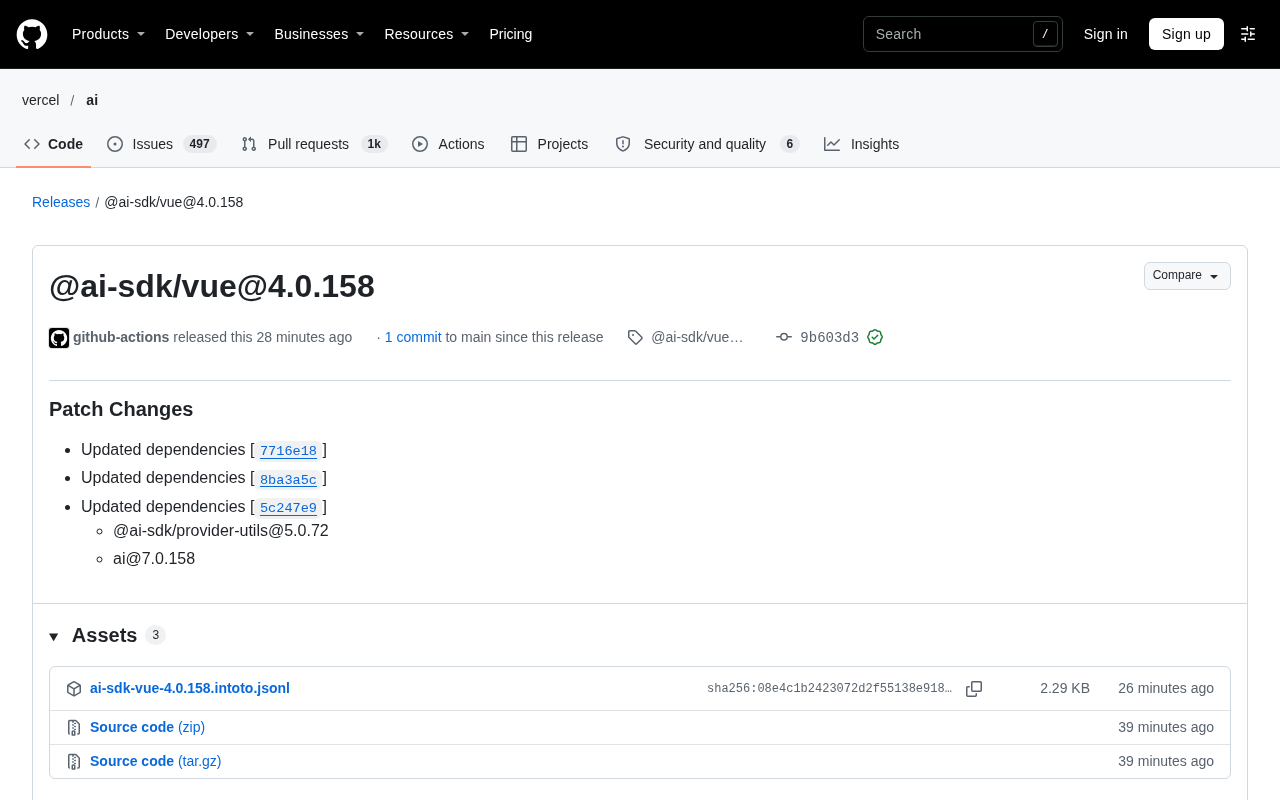
The Vue adapter package in the AI SDK ecosystem, @ai-sdk/vue, has released version 4.0.158. According to the GitHub release notes, this update is a patch version (Patch Changes), and its core content is a synchronized upgrade of dependencies without introducing new APIs or breaking changes. For developers building Vue applications with the AI SDK, this type of update typically means the underlying toolchain's stability and compatibility have been maintained.
Linked Updates Across the Dependency Chain
This release explicitly lists three dependency updates, corresponding to commits 7716e18, 8ba3a5c, and 5c247e9. Among them, it can be confirmed that @ai-sdk/provider-utils was upgraded to 5.0.72, and the ai core package was upgraded to 7.0.158. This pattern of "advancing the main package and adapter package with the same version number" is not uncommon in the AI SDK's release cadence, as it helps reduce the cost for developers troubleshooting version mismatch issues.
Interestingly, the release notes do not mention any functional changes or bug fix details, only dependency changes. This aligns with the convention of patch numbers in semantic versioning: no changes to public interfaces, only backward-compatible fixes. For production environment projects, such updates carry low risk, but it is still recommended to run existing tests after upgrading.
Semantic Versioning (SemVer) is the key basis for determining the nature of this release. SemVer splits version numbers into three segments: "major.minor.patch." A major version increment indicates incompatible breaking changes; a minor version increment indicates new features added in a backward-compatible manner; a patch increment indicates only backward-compatible bug fixes. The 4.0.158 in this article only changes the third segment relative to the previous version, so it can be inferred from the version number itself that there are no interface-level changes. It is important to note that SemVer constrains the package's own exposed public API, not the upgrade scope of its internal dependencies—a patch version can absolutely jump a lower-level dependency up several versions, which is precisely why this update warrants separately checking the dependency tree.
Practical Impact on Vue Developers
@ai-sdk/vue is the official adapter layer of the AI SDK for the Vue framework, responsible for exposing capabilities such as streaming responses and tool calls to Vue components in the form of Composition API. Since this is a patch-level update, existing component code and invocation patterns require no adjustments. What actually changes are its internal dependencies, provider-utils and the ai core package, which often involve fundamental capabilities such as model provider adaptation and message stream processing.
In other words, if your project indirectly depends on these lower-level modules through @ai-sdk/vue, after upgrading to 4.0.158, what actually runs are the updated versions of provider-utils and ai. Such linked updates can sometimes bring subtle behavioral fixes that are not itemized in the official release notes; developers can confirm the scope of changes by comparing the dependency tree.
Composition API is the core programming paradigm introduced in Vue 3, organizing logic through the setup function and reactive primitives such as ref, computed, and watch, and achieving logic reuse through custom composable functions in the form of useXxx. @ai-sdk/vue wraps AI capabilities into composable functions in exactly this form—for example, calling them in a component returns reactive state and operation methods for direct consumption by the template. Compared with Vue 2's Options API, the Composition API is better suited for aggregating code by feature rather than by option, and for encapsulating asynchronous states such as streaming responses and tool calls into testable, reusable units. Only by understanding this layer of encapsulation can one understand why patch updates to the adapter package are usually transparent to business components—changes occur inside the composable functions, while the externally exposed signatures remain unchanged.
How to Evaluate Whether to Upgrade
For projects with pinned versions, whether to follow this patch depends on two factors: first, whether the current dependency tree has known issues related to provider-utils 5.0.72 or ai 7.0.158; second, the team's standard policy for patch updates. Since the release notes provide limited information, it is recommended to first install 4.0.158 on a development branch, observe whether build and runtime behavior matches expectations, and then decide whether to merge into the mainline.
From the release process perspective, this version was automatically published by github-actions with a GitHub verified signature, and the commit record shows a single commit merged into the main branch. This process indicates that the update comes from the official automated release channel rather than a manual community submission, giving it relatively high credibility.
Lock files and dependency trees are the primary tools for determining the actual scope of impact of such linked updates. npm's package-lock.json, pnpm's pnpm-lock.yaml, and yarn's yarn.lock precisely record the resolved version and source of each package, so comparing lock file differences before and after an upgrade reveals which transitive dependencies were bumped or replaced. Combined with commands like npm ls @ai-sdk/provider-utils or pnpm why ai, you can trace which dependency chain introduces a given lower-level package. Since @ai-sdk/vue is only an adapter layer, its dependencies provider-utils and ai are often also referenced by other AI SDK-related packages in the project. If the version ranges required by different packages are inconsistent, multiple instances of the same lower-level package may be installed, leading to subtle issues with inconsistent state or types—checking the dependency tree is precisely to catch such conflicts in advance.
Summary
@ai-sdk/vue 4.0.158 is a patch release focused primarily on dependency synchronization, with no new developer-facing features. The key to understanding such updates is to see the changes in the dependency chain, not just the version number itself. For Vue projects prioritizing stability, handling it according to the standard patch policy is sufficient.
Related articles

DeepSeek Open-Sources DeepInfer: What Is an Inference Framework Actually For?
DeepSeek open-sources its inference framework DeepInfer under Apache 2.0, supporting DeepSeek V4.1 Flash offline inference. This article explains its request scheduling, FlashMLA/DeepGEMM compute optimization, DSPark speculative verification acceleration, and what it means for developers and ordinary users.

Open-Source AI Learning Agent: A Full Workflow Experience from Topology Graphs to Exam Generation
Explore an open-source AI learning agent: built on DeepSeek API, it constructs knowledge systems via topology graphs, with automatic document generation, notes, super documents, and exams. Learn about its Agent workflow and design highlights.

DeepSeek Whale Girl Open-Source MV Meme: AI Industry Coded Slang About Pivoting to Closed Source
Bilibili's DeepSeek Whale Girl rap MV uses fictional memes to tease the AI open-source vs. closed-source debate, with lyrics full of industry slang. This article explains the meme culture, the Whale Girl symbol, and the open/closed tension.