AI SDK Vue Patch Release Syncs with ai Core Package

@ai-sdk/vue releases patch 4.0.159, syncing only the core dependency ai@7.0.159.
The Vue adapter package @ai-sdk/vue from Vercel's AI SDK project released patch version 4.0.159, auto-published by GitHub Actions with a single signed commit and no new features or bug fixes—only syncing the core dependency ai@7.0.159. The article notes that AI SDK uses a core-plus-multi-framework-adapter architecture, and adapters releasing on the same day as the main package with linked version numbers is a routine engineering cadence. Patch versions contain no breaking changes and the API surface is stable, so Vue and Nuxt developers can update dependencies as usual with low risk; if the project enforces strict locking, verify the core package version matches the adapter's declaration. A single patch carries limited information, but the sync frequency between adapters and the core package can serve as a reference indicator for evaluating the ecosystem's long-term maintenance quality.
A Typical Ecosystem Sync Update
The Vercel-owned AI SDK project recently released version 4.0.159 of @ai-sdk/vue. This is a standard patch release, published on the 30th by an automated GitHub Actions workflow, containing only a single commit and verified with a GitHub signature.
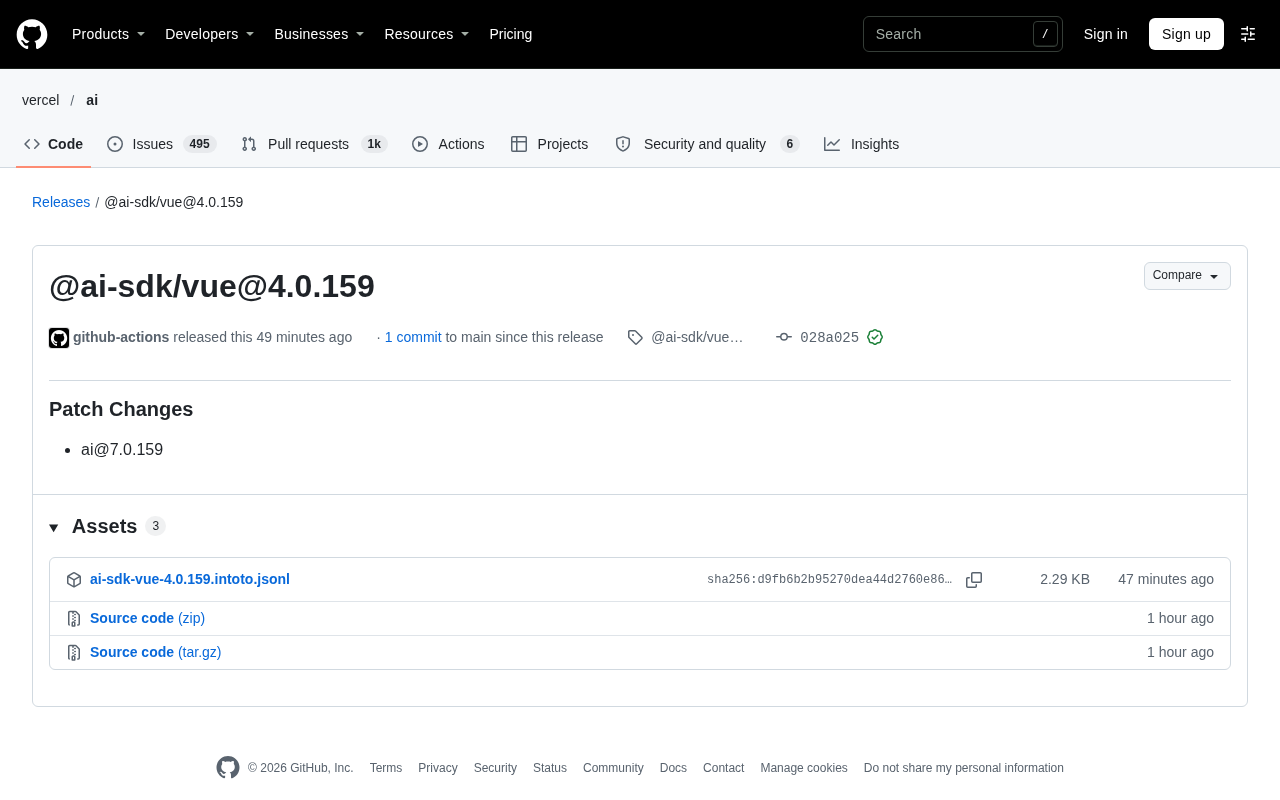
According to the release record, this update has no new features or bug fixes—the only change points to syncing the core dependency ai@7.0.159. This "sub-package follows main package" versioning rhythm is a routine move in AI SDK's multi-framework adaptation strategy.
Why Patch Updates Are Worth Noticing
AI SDK's architecture places core logic in the ai package, while framework adapters for Vue, React, Svelte, and others are released as separate packages. When the core package iterates to 7.0.159, @ai-sdk/vue follows with 4.0.159, ensuring Vue developers call API behavior consistent with the core. For teams using Nuxt or pure Vue projects to integrate large model capabilities, aligning dependency versions reduces type errors or runtime exceptions caused by the main package and adapter layer being out of sync.
Semantic Versioning (SemVer) and Patch Numbers
Semantic versioning follows the form MAJOR.MINOR.PATCH. A patch number increment typically represents only backward-compatible bug fixes, documentation, or dependency syncs, without changing public API behavior; a minor version increment indicates backward-compatible feature additions; a major version increment may contain breaking changes. Therefore, changes like 4.0.158 → 4.0.159 are conventionally considered safe to upgrade. Note that in AI SDK, the core package ai is at 7.x while the Vue adapter is at 4.x, indicating they have separate version lines—the adapter does not share version numbers with the main package, only maintaining the same release cadence. When judging compatibility, rely on the adapter's dependency declaration on the core package rather than simply comparing numbers.
Practical Impact on Vue Developers
Upgrade Recommendations and Risk Assessment
Patch versions typically contain no breaking changes. This release only syncs the core dependency, meaning the API surface remains stable and upgrade risk is low. Developers can perform a routine dependency update in package.json without modifying business code. If the project enforces strict version locking, check whether the core package ai version matches the adapter layer.
peerDependencies and Dependency Alignment
In the npm ecosystem, framework adapter packages typically declare their dependency version range on the core package via dependencies or peerDependencies. If the adapter lists ai as a peer dependency, the consuming project installs the core package itself, and the package manager will warn or even error on version mismatch; if listed as a regular dependency, installing the adapter automatically pulls the matching core version. This explains why "synchronized releases" matter: the adapter's type definitions must match the core package's export signatures. Once they misalign, TypeScript projects easily report type incompatibilities at compile time, and APIs may be missing at runtime. When upgrading, run npm ls ai or check the lockfile to confirm the ai version actually resolved in the project falls within the range declared by the adapter.
The Observational Value of Ecosystem Cadence
A single patch release carries limited information on its own, but it reflects the AI SDK team's ongoing maintenance rhythm: the core package and multi-framework adapters release on the same day with linked version numbers. This engineering practice is a useful reference for teams depending on this ecosystem—when choosing AI SDK, whether the adapter update frequency stays in sync with the core package is one indicator for evaluating long-term maintenance quality.
AI SDK's Layered Architecture
AI SDK adopts a "core + framework adapter" layered design: the core package ai handles framework-agnostic logic such as model call abstraction, streaming response handling, tool calling, and structured output; adapter packages like @ai-sdk/vue, @ai-sdk/react, and @ai-sdk/svelte wrap core capabilities into reactive primitives for their respective frameworks—for example, composables and reactive state on the Vue side. This split means core logic is maintained in one place while users of each framework get APIs idiomatic to that framework; the cost is that every core change triggers multiple adapter packages to release together, forming the observed release pattern of "same day, multiple packages, synchronized version increments."
Conclusion
@ai-sdk/vue@4.0.159 is a routine update that requires no over-interpretation—its value lies in maintaining consistency between the Vue adapter and the AI SDK core. For developers using or evaluating this toolchain, keeping dependencies in sync and following the main package's changelog is more practically meaningful than focusing on any single patch.
Related articles

9 AI Subscription Plans Compared: The Real Cost Per 100M Tokens Revealed
Bilibili creator tests 9 AI subscription plans from Volcano, Alibaba, Tencent, Baidu, Zhipu, Xiaomi, MiniMax and more, converting them all to real cost per 100M tokens, breaking down fixed-quota vs. three-tier coefficient billing and how caching, time-of-day discounts, and window limits affect actual quota.

Vibe Coding for Beginners: Expressing Intent Instead of Handwriting Code
What is Vibe Coding? A 137-episode Bilibili course defines it: the core is expressing intent, not writing code. This article analyzes Vibe Coding's productivity logic, target audience, and entry expectations to help beginners decide if it's worth learning.

LangChain Beginner's Guide: An Agent Development Roadmap from LangGraph to Deep Agents
Clarify the encapsulation relationship among LangChain, LangGraph, and Deep Agents, and master the learning path and selection logic for agent development frameworks—suitable for beginners in large model development.