AI SDK Workflow 2.0.100 Patch Release: What the Dependency Chain Update Means
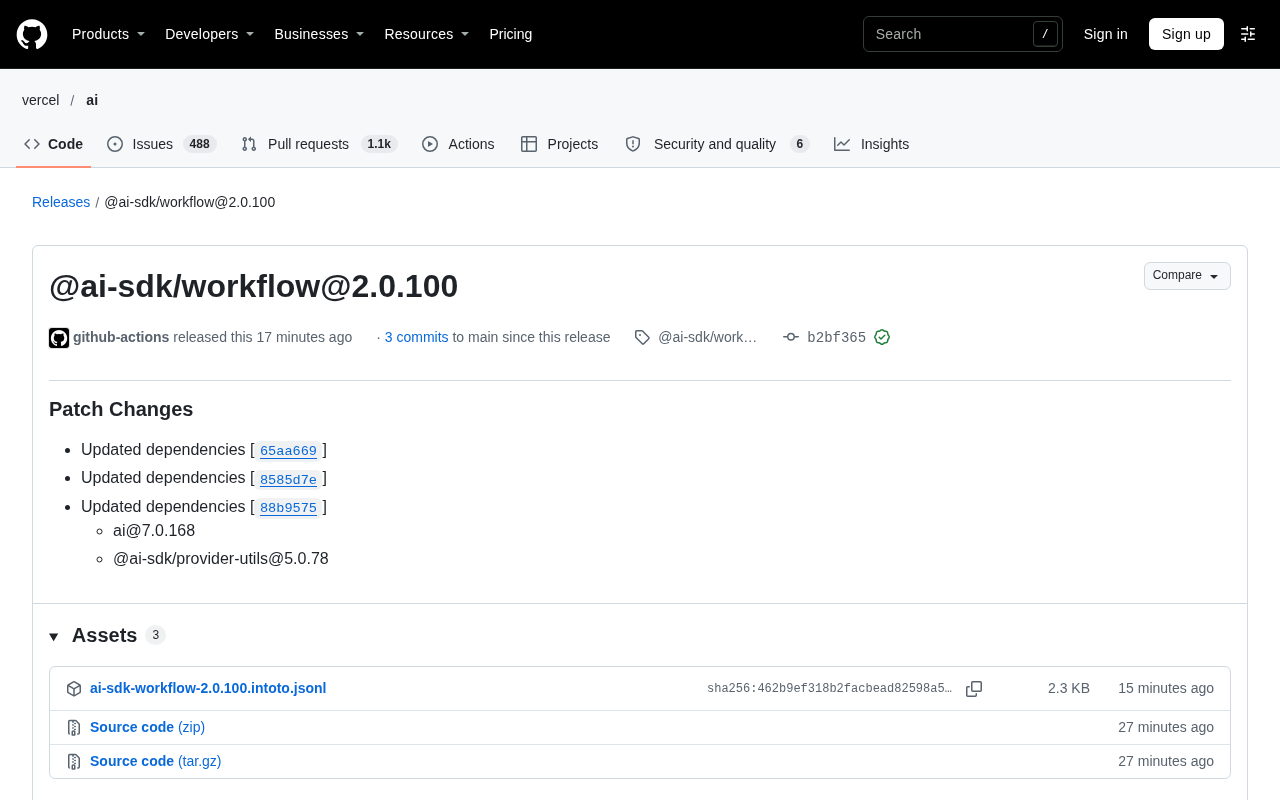
@ai-sdk/workflow 2.0.100 pure patch release, only synchronizing upstream dependencies, no API changes.
@ai-sdk/workflow has released version 2.0.100, a patch release that only updates dependencies, involving ai 7.0.168 and @ai-sdk/provider-utils 5.0.78. The release was automatically completed by github-actions with a GPG signature, reflecting the pipelining of the release process. The article points out that in the AI SDK monorepo system, dependency synchronization is key to ensuring dependency graph consistency and propagating upstream fixes, and developers should follow such patch upgrades for low-cost healthy maintenance. It recommends paying attention to upstream package changelogs, checking ai version convergence in the lockfile, and understanding the positioning of the workflow package (2.x) as an upper-layer orchestration abstraction built on a mature core package (7.x).
The AI SDK ecosystem has rolled out another routine update. @ai-sdk/workflow has released version 2.0.100, and judging from the version number and changes, this is a patch release purely aimed at dependency synchronization rather than a feature iteration. For developers building AI application workflows, understanding the signals behind these "minor versions" is sometimes more valuable than fixating on new features.
What This Update Changed
According to the release record on GitHub, version 2.0.100 was automatically published by github-actions, contains 3 commits, and the change type is explicitly marked as Patch Changes. The core content is just one item: updating dependencies.
Specifically, three upstream packages advanced in version—ai to 7.0.168, @ai-sdk/provider-utils to 5.0.78, and another dependency synchronized via commit 88b9575. The release commit is GPG-signed and verified, indicating that the integrity verification of the automated release process is functioning properly.
There are no new APIs, no behavior change descriptions, and no breaking changes. This type of release is very common in the Vercel AI SDK monorepo system: upstream packages fix bugs or adjust internal implementations, and downstream packages follow passively to ensure consistency across the entire dependency graph.
Why Dependency Synchronization Deserves Separate Mention
Many people see "only updating dependencies" and skip it directly. But in a multi-layered abstraction toolchain like AI SDK, dependency alignment itself is part of stability.
@ai-sdk/workflow is built on top of the ai core package and provider-utils—the former provides the foundational capabilities for model invocation and streaming processing, while the latter handles the adaptation layer between different model providers. When these two packages receive patch-level updates, it often means that a compatibility issue with some provider has been fixed at the underlying level, type definitions have been slightly adjusted, or the boundary handling of internal utility functions has become more rigorous. Only when the workflow package follows the upgrade can these fixes be delivered to developers using workflow orchestration.
In other words, you may not perceive the change, but your call chain has already benefited from upstream fixes. For teams using AI SDK in production environments, following these patch version upgrades is a low-cost healthy maintenance action.
Monorepo and dependency locking mechanisms: Vercel AI SDK uses a monorepo to manage multiple interdependent npm packages, such as ai, @ai-sdk/provider-utils, @ai-sdk/workflow, etc. In a monorepo, each package is versioned independently but references each other through workspace protocols or exact version ranges to ensure dependency graph consistency at release time. When an upstream package releases a patch, downstream packages need to synchronously upgrade their dependency declarations and republish, otherwise users might install mismatched version combinations. Although this "dependency locking" mechanism increases release frequency, it avoids type conflicts or behavioral differences caused by multiple versions coexisting at runtime. Understanding this makes it clear why "dependency-only" patch releases are a necessary and frequent routine operation in the monorepo ecosystem.
Practical Advice for Developers
Upgrade cost is extremely low. Patch versions do not involve API changes; simply running your package manager update as usual is sufficient, and business code typically does not need modification.
Pay attention to lockfile differences. If your project directly depends on both ai and @ai-sdk/workflow, check the lockfile after upgrading to confirm that the ai version referenced by both packages converges to the same version, avoiding type inconsistencies caused by duplicate instances in the dependency tree.
Focus on upstream changelogs rather than just the workflow package. The truly valuable information is in the release notes for ai@7.0.168 and @ai-sdk/provider-utils@5.0.78. The workflow package itself has no independent behavioral changes; when troubleshooting issues, you should trace back to upstream packages.
Automated releases are the norm. This release was triggered by github-actions and carries a GPG signature, indicating that the project maintainers have fully pipelined version releases. This is good for users—the release cadence is stable and traceable, and it also means that version number advancement itself does not represent heavyweight updates.
Lockfile and dependency convergence: The lockfile (such as package-lock.json, pnpm-lock.yaml) records the actual installed dependency version tree of the project. In the monorepo ecosystem, if a project directly depends on both ai and @ai-sdk/workflow, and their version requirements for ai are not fully consistent, the package manager may install multiple ai instances, leading to inconsistent type definitions or singleton state (such as global configuration) being split. After upgrading, checking the lockfile to confirm that only one version of ai exists is a key step to avoid "duplicate dependency" issues. For teams using pnpm, you can quickly investigate via pnpm why ai; npm users can check the output of npm ls ai.
Looking at AI SDK's Evolution from a Version Cadence Perspective
The ai package has advanced to the 7.x series, provider-utils is at 5.x, and workflow is at 2.x. The three packages are independently versioned yet mutually locked—this is a typical monorepo sub-package strategy. Its advantage is that each module can iterate as needed; the disadvantage is that users need to understand the dependency relationships between packages.
The release of 2.0.100 happens to be an observational sample: the workflow package is in a relatively early 2.x stage, while the core package it depends on has already reached 7.x, indicating that workflow, as an upper-layer orchestration capability, is a relatively new abstraction built on a mature foundation. For teams wanting to use AI SDK for complex agent process orchestration, the version evolution of this package is worth continuous tracking.
As for this specific release, it does not constitute any basis for decision-making, but it is a normal heartbeat of a healthy dependency chain. Incorporating such patch updates into your regular upgrade cadence is much less troublesome than waiting for major versions to handle them all at once.
Semantic versioning and patch numbers: Semantic versioning (SemVer) convention formats version numbers as major.minor.patch, corresponding to incompatible API changes, backward-compatible feature additions, and backward-compatible bug fixes, respectively. In @ai-sdk/workflow 2.0.100, the patch number increased from 99 to 100, indicating that this release only contains bug fixes or dependency updates and does not involve API changes. In a monorepo, each package independently follows SemVer, but patch numbers may grow rapidly due to frequent dependency synchronization—this does not represent the speed of feature iteration, but rather reflects the activity level of dependency chain maintenance. Developers can judge the upstream maintenance cadence by the frequency of patch number increments, but should not equate it with the speed of feature evolution.
One-line Summary
@ai-sdk/workflow 2.0.100 pure patch release, only synchronizing upstream dependencies, no API changes.
Paragraph Summary
@ai-sdk/workflow has released version 2.0.100, a patch release that only updates dependencies, involving ai 7.0.168 and @ai-sdk/provider-utils 5.0.78. The release was automatically completed by github-actions with a GPG signature, reflecting the pipelining of the release process. The article points out that in the AI SDK monorepo system, dependency synchronization is key to ensuring dependency graph consistency and propagating upstream fixes, and developers should follow such patch upgrades for low-cost healthy maintenance. It recommends paying attention to upstream package changelogs, checking ai version convergence in the lockfile, and understanding the positioning of the workflow package (2.x) as an upper-layer orchestration abstraction built on a mature core package (7.x).
Related articles

Microsoft WebIQ: Verifiable Real-Time Web Grounding for AI Agents
Microsoft WebIQ gives AI Agents real-time, citable web grounding across web, news, images, videos, and Places—164ms P95 latency, 50% fewer tokens, Scopes source control, and MCP integration.

Augmentable Gaussian Splatting: Building Photorealistic Simulation Environments for Robot Training
Team combines Gaussian Splatting with meshes to build photorealistic robot simulation environments, integrating MuJoCo Warp physics and Franka Panda for augmentable, relightable real-site simulation.

Gemini 4 Carbon Released: The Leap from Gemini 3 to Gemini 4 in Under a Year
Google releases Gemini 4 Carbon, less than a year after Gemini 3. In the official demo, Carbon reverse-engineered the Theme Park binary, added a new DeepMind-themed ride, and ported it to the web in one shot.