@ai-sdk/workflow 2.0.63 Released: Patch Update Breakdown

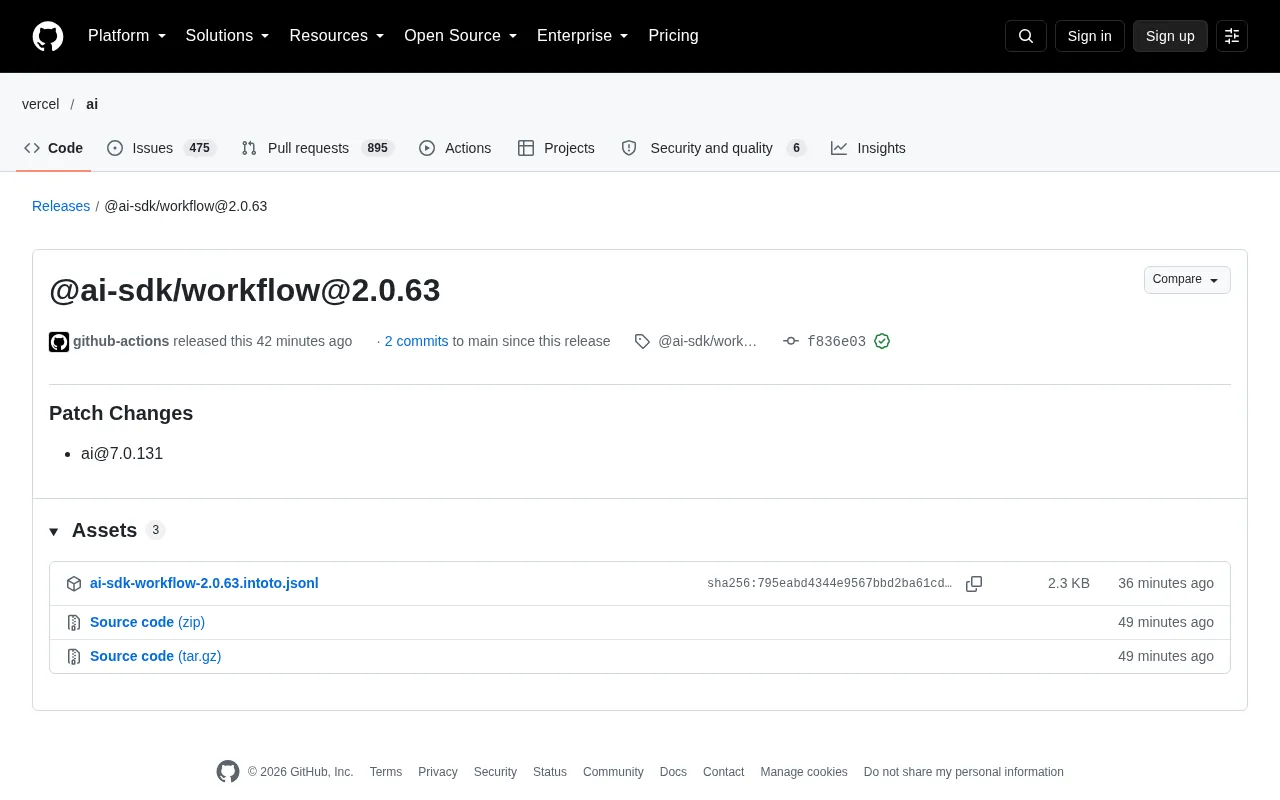
@ai-sdk/workflow 2.0.63 is a low-risk patch release that syncs the ai@7.0.131 core dependency.
@ai-sdk/workflow 2.0.63 is a typical follow-along patch release, automatically triggered by GitHub Actions and verified with GitHub's official GPG signature. The only substantive change is upgrading the underlying `ai` core package dependency to 7.0.131, with no functional changes to the workflow module itself. This stems from Vercel AI SDK's monorepo + changesets toolchain, where any core package patch triggers a sync release across related sub-packages. The upgrade is low-risk and can be applied seamlessly via `npm update` or `pnpm update`, though developers are encouraged to review the `ai@7.0.131` changelog for details on the underlying fixes.
Version Overview
@ai-sdk/workflow has released version 2.0.63, a patch-level update. According to GitHub's release records, this version was automatically published via github-actions and verified with GitHub's official GPG signature (key ID: B5690EEEBB952194), confirming it as an officially verified release.
Looking at the version increment pattern, 2.0.63 follows the patch version convention in Semantic Versioning (SemVer) — it contains only backward-compatible fixes or dependency upgrades, with no breaking changes or new features introduced. This means the risk of upgrading existing projects to this version is minimal, and it can typically be dropped in as a seamless replacement.
Key Changes
The core of this release's Patch Changes is a single dependency update: ai@7.0.131. As the workflow orchestration module within the AI SDK ecosystem, @ai-sdk/workflow relies on the core ai package under the hood. When the core package is upgraded, related sub-modules also publish patch versions in sync to maintain dependency consistency.
This release pattern is very common in open-source projects managed with a monorepo structure. Projects like Vercel's AI SDK typically use tools such as changesets for version management, where an update to a core package triggers a chain of patch releases across multiple related packages. As a result, 2.0.63 doesn't necessarily include functional changes to the workflow module itself — it's primarily a version sync following the ai core package.
Changesets is a version management tool designed specifically for monorepos, open-sourced by Atlassian and widely used in large frontend projects like Vercel and Remix. The core idea is: when submitting a PR, developers also include a changeset file describing which packages are affected and whether the change is a patch, minor, or major. Once merged into the main branch, the CI pipeline aggregates all changesets, automatically calculates the new version number for each package, and publishes them in bulk to npm. This means that even if @ai-sdk/workflow has no code changes of its own, as long as its dependency — the
aicore package — adds a patch changeset, the tooling will automatically bump the workflow package's version to ensure precise dependency alignment in lock files. This is the underlying mechanism behind the 2.0.63 release.
What This Means for Developers
For developers building applications with the AI SDK, a patch release signals a few things:
Keep Dependencies in Sync
If your project already references a newer version of the ai core package, upgrading to the corresponding workflow patch version helps avoid potential version mismatch issues. Mismatched versions in the dependency tree can sometimes cause type definition conflicts or runtime warnings.
Version mismatches are especially problematic in TypeScript projects. The
aicore package and@ai-sdk/workflowtypically share type definitions (such as streaming response types and tool-calling interfaces). If the two versions diverge too far, the TypeScript compiler may treat identically named types from "different versions" as incompatible, causing seemingly inexplicable type errors. In projects using pnpm workspaces or npm workspaces, the same package may even be resolved as two different versions — a "phantom dependency" problem that makes debugging significantly harder. So even though a patch version may seem trivial, keeping up with it is a best practice for maintaining a clean dependency tree.
Low-Risk Upgrade
Patch versions don't change API behavior, so developers can safely run npm update or pnpm update without worrying about needing to rewrite any code. For production environments, these kinds of updates can usually be deployed after quick validation.
Check the Full Changelog
Since individual release notes contain limited information, it's worth consulting the project's full CHANGELOG or the specific changes in ai core package version 7.0.131 to understand what issues were actually fixed or what underlying improvements were made in this dependency upgrade.
Summary
@ai-sdk/workflow 2.0.63 is a typical follow-along patch release, with the core change being an upgrade to the ai@7.0.131 dependency. It reflects the high-frequency, incremental iteration pace of the modern AI SDK ecosystem. While the information content of any single update is limited, staying on top of these versions remains worthwhile for maintaining a healthy dependency environment and getting timely access to underlying fixes. Developers can upgrade as needed and consult the full release notes to determine whether any changes are relevant to their specific use case.
Related articles

Microsoft AI Agent Breakthroughs: More Efficient, Better at Code and Weather Forecasting
Microsoft Research Focus Issue 97: ForkPilot cuts agent inference costs, Cabra reveals coding agents' code-understanding gap, Teletune learns workflows from logs, PBC improves extended forecasts, BioEMU-2 opens preview.

Prime Intellect Releases Prime Mega MoE: Trainable Fused MoE Kernel with 3.11x Forward Speedup
Prime Intellect releases Prime Mega MoE, adding backpropagation to DeepSeek's fused Mega MoE kernel for trainability. Up to 3.11x forward speedup and 34% faster Qwen3 MoE training steps in prime-rl.

Meta Quietly Launches AI Fashion App Style Sketch: Build a Virtual Wardrobe from Instagram Photos
Meta quietly launched Style Sketch, an AI fashion app that connects to Instagram to build a virtual wardrobe from shared photos, plus manual entry via camera, video, or gallery upload. This analysis covers its product logic, competitive landscape, and implications for AI app developers.