AI SDK Workflow 2.0.72 Released: Configurable Tool Call Concurrency
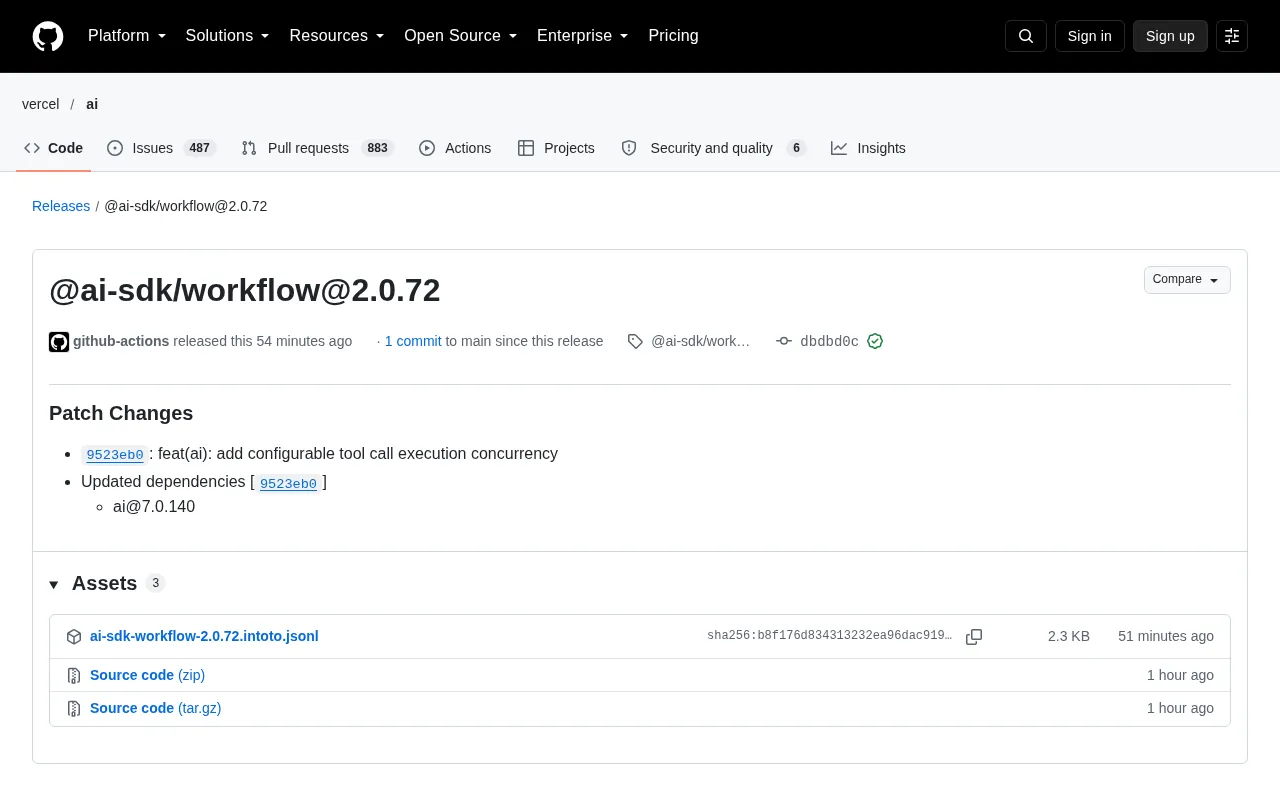
@ai-sdk/workflow 2.0.72 adds configurable tool call concurrency for more controllable Agent latency optimization.
The AI SDK ecosystem gets a fine-grained update: @ai-sdk/workflow@2.0.72, as a patch release, adds a configurable concurrency parameter for tool call execution via core commit 9523eb0. Previously the SDK's handling of multiple tool calls in a single turn was fixed, and serial execution significantly increased latency in independent scenarios like querying weather, calendar, and databases. The new version hands concurrency control back to developers for trading off throughput against resource usage. The article notes clear value in two scenarios — batch independent tool calls and high-latency tool combos — while cautioning about downstream API rate limits, context window, aggregation complexity, and more complex error handling. The update depends on ai@7.0.140, hinting this may extend core package capabilities.
The AI SDK ecosystem has received a fine-grained update. @ai-sdk/workflow@2.0.72, through a patch release, gives developers the ability to configure the concurrency level of tool call execution — a seemingly minor change that actually touches a key aspect of Agent workflow performance tuning.
Core Change: Concurrency Control Handed to Developers
According to the GitHub release notes, version 2.0.72 is a Patch Change, with the core commit 9523eb0 titled feat(ai): add configurable tool call execution concurrency. This means the AI SDK has added a configurable concurrency parameter at the tool call layer.
Previously, when an AI model returned multiple tool call requests within a single turn, the SDK's handling strategy was relatively fixed. For Agent scenarios that need to call multiple independent APIs in succession (such as querying weather, calendar, and databases simultaneously), serial execution significantly increases end-to-end latency. The new version allows developers to specify the concurrency count, making a trade-off between throughput and resource usage.
Why Tool Call Concurrency Matters
Tool calls are the bridge that takes modern AI applications from "conversation" to "action." When a model decides to invoke external functions, the workflow engine needs to schedule these calls and aggregate the results.
The value of concurrent execution shows up in two typical scenarios:
- Batch calls to independent tools: The model requests multiple mutually independent information sources at once — for example, simultaneously fetching user profiles, order history, and inventory status. Concurrent execution can reduce total time from the sum of individual calls down to the level of the slowest single call.
- Combinations of high-latency tools: When integrating third-party APIs with long response times, limiting concurrency can avoid triggering the other party's rate limits, while opening up concurrency can shorten user wait times.
This finer-grained control reflects how the AI SDK is evolving from a simple model wrapper into a more mature application runtime.
The mechanism of tool calls: In LLM applications, a tool call is the model's ability to declare, through structured output (typically JSON Schema), "I want to call a certain function, and here are the parameters." The SDK's workflow engine receives these declarations, actually executes the corresponding external functions (calling APIs, querying databases, reading/writing files, etc.), then feeds the results back to the model as tool messages, and the model continues reasoning or provides a final answer based on that. Within a single turn, the model may declare multiple tool calls at once, so the "execution" phase is essentially a scheduling problem: queue up serially, or dispatch in parallel. Configurable concurrency controls exactly the parallel window size at this scheduling layer.
The trade-off between concurrent execution and rate limits: Most third-party APIs limit the number of requests per unit time through token buckets or sliding windows; exceeding the limit returns a 429 status code or even a temporary ban. If the concurrency count is set too high, a burst of requests in a short period easily triggers rate limiting, causing retries and backoff that actually lengthen total time; if set too low, end-to-end latency cannot be compressed. Therefore concurrency is not simply a "bigger is better" performance knob, but an adjustment parameter among throughput, stability, and downstream capacity.
Mathematical intuition for end-to-end latency: Suppose there are N mutually independent tool calls within a turn, each taking t₁…t_N. The total time for serial execution is approximately Σtᵢ, while concurrent execution (concurrency ≥ N) takes approximately max(tᵢ). When the calls have similar durations and there are many of them, the benefit of parallelism is approximately linear; but when a single call is itself the bottleneck (max(tᵢ) is large), further increasing concurrency barely improves total latency and only adds resource pressure.
Dependency Coordination: ai@7.0.140 Updated in Sync
The dependencies in this release include ai@7.0.140. This suggests the concurrency control feature may be an extension of the core ai package's capabilities, with the workflow package ensuring interface consistency through dependency upgrades.
For teams using a monorepo or needing to lock versions, upgrades require attention to the version matching relationship between @ai-sdk/workflow and the ai package. Patch versions usually don't contain breaking changes, but it's still recommended to verify in a test environment whether existing tool call logic behaves as expected — especially business processes that depend on the default serial execution order.
Practical Advice for Developers
If you're building an Agent or workflow application based on the AI SDK, you can evaluate this update from the following angles:
- Audit existing tools: Review whether your workflow contains multiple tools that can be called in parallel, and assess the benefit of concurrency.
- Set a reasonable upper limit: Higher concurrency isn't always better. Considering the downstream API's capacity, the model's context window, and the complexity of result aggregation, it's recommended to start with small values and load test.
- Pay attention to error handling: In concurrent scenarios, strategies for handling partial call failures (retries, fallbacks, partial result returns) are more complex than in serial execution and need to be designed in advance.
This update doesn't introduce new concepts; rather, it returns a long-standing engineering problem — concurrent scheduling — to developers. For teams pursuing low-latency, high-throughput AI applications, this is a small version worth following.
One-line Summary
@ai-sdk/workflow 2.0.72 adds configurable tool call concurrency, making Agent latency optimization more controllable.
Paragraph Summary
The AI SDK ecosystem has received a fine-grained update. @ai-sdk/workflow@2.0.72, as a patch release, adds a configurable concurrency parameter for tool call execution through core commit 9523eb0. Previously the SDK's handling of multiple tool calls within a single model turn was relatively fixed, and serial execution significantly increased end-to-end latency in independent scenarios like simultaneously querying weather, calendar, and databases. The new version returns concurrency scheduling control to developers, allowing a trade-off between throughput and resource usage. The article points out that concurrent execution is clearly valuable in two types of scenarios — batch calls to independent tools and combinations of high-latency tools — while reminding developers to weigh downstream API rate limits, context window, and result aggregation complexity, and to pay special attention to the more complex error handling strategies in concurrent scenarios. The update's dependency includes ai@7.0.140, hinting that this capability may be an extension of the core package's capabilities.
Related articles

world2vec: Building Mechanistic World Models with Latent Dynamics Learning
world2vec proposes a reward-free method for learning mechanistic world models via latent dynamics, faithfully reproducing systems over long horizons with at least an order of magnitude fewer parameters than DreamerV3, TD-MPC2, and LeWM, and achieving accurate system identification on 71 attractor benchmarks.

A New KL-DRO Paradigm: Adaptive Scenario Generation Around a Learned Density Model
KL-DRO research proposes centering the KL ball on a learned density model instead of the empirical distribution, with adaptive scenario generation guiding sampling toward the worst case. Experiments show lower cost under distribution shift when records are scarce and the model can extrapolate, with comparable in-distribution cost.

ODE Samplers for Discrete Diffusion Models: Exponential Residual Flows Accelerate Generation
Discrete diffusion models lack deterministic ODE sampling? This article introduces Exponential Residual Flows (ERFs), which introduce continuous residual variables per token to construct piecewise ODEs for deterministic sampling and support consistency distillation acceleration. Superior to prior methods on code and text generation tasks.