@ai-sdk/workflow 2.0.80 Release Analysis: Dependency Coordination in the AI Workflow Ecosystem

@ai-sdk/workflow 2.0.80 patch syncs two underlying dependencies, reflecting AI SDK modular version coordination.
The article analyzes the release of @ai-sdk/workflow 2.0.80, a patch version with no independent code change notes whose core change is synchronously updating @ai-sdk/provider-utils to 5.0.65 and ai to 7.0.148—a common dependency-coordination release in monorepo projects. It notes that provider-utils handles provider adaptation and utility functions while the ai package is the core developer entry point, and their updates provide more stable underlying support for the workflow layer. For developers, the upgrade has no breaking changes and low risk; aligning lock file versions and verifying workflow cases in a test environment are recommended. The article concludes that the frequent patch cadence combined with dependency sync reflects a maintenance strategy oriented toward rapid fixes and continuous integration, and that following such releases helps identify version coupling points early.
A seemingly routine patch release that reveals the modular coordination behind the AI SDK
@ai-sdk/workflow in the AI SDK ecosystem has released version 2.0.80. According to the GitHub Release page, this update is marked as Patch Changes, with the main change being updates to two dependencies: @ai-sdk/provider-utils@5.0.65 and ai@7.0.148.
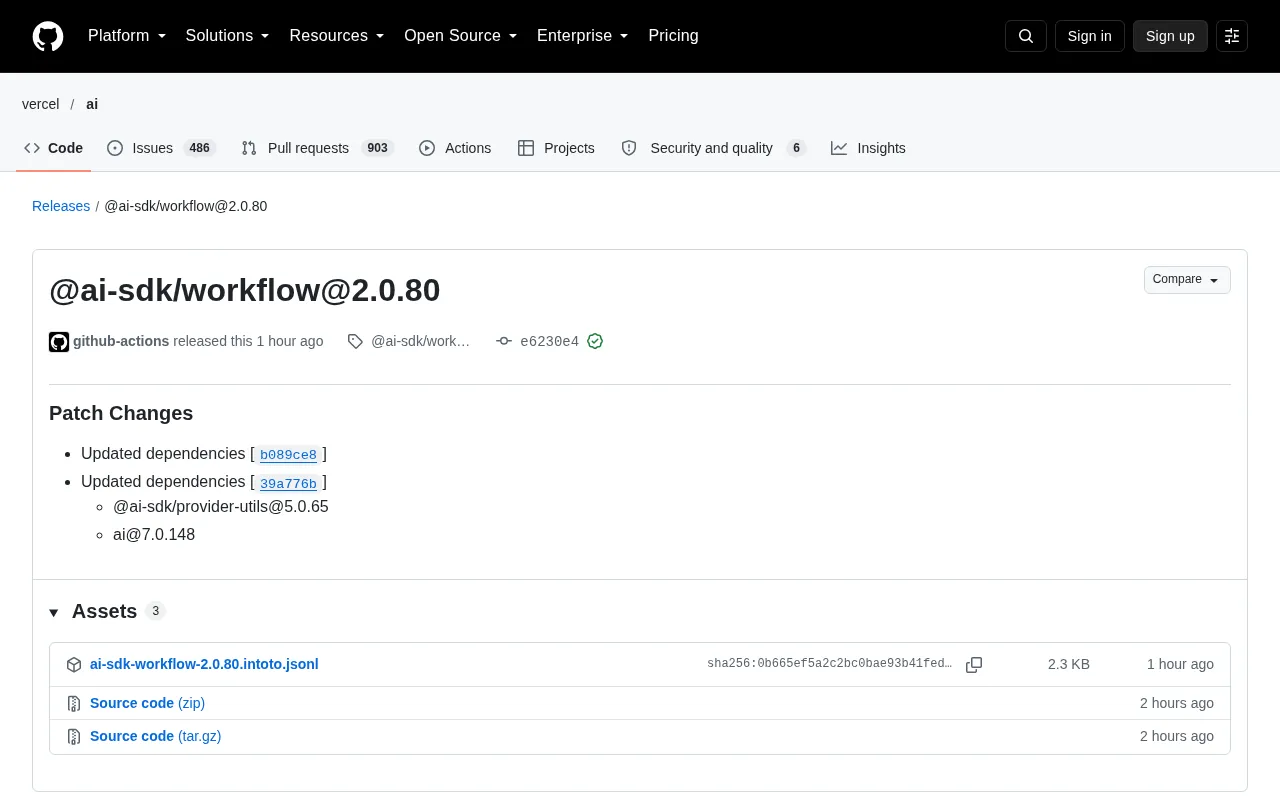
For developers who don't closely track version numbers, this kind of release information is easy to overlook. But from a dependency chain perspective, a single patch version being able to simultaneously bump both the provider utility layer and the core ai package shows that the AI SDK modules maintain tight version coordination.
What's hidden in a patch version: dependency updates mean feature synchronization
In the Semantic Versioning (SemVer) system, a patch number increment typically means backward-compatible fixes or minor improvements. @ai-sdk/workflow doesn't list any independent code change notes this time, but explicitly notes "Updated dependencies."
This approach is common in monorepo-style open source projects: when underlying packages (such as provider-utils or ai) release fixes, upper-layer packages need to sync their dependency versions to ensure users get the latest compatible combination when installing. In other words, the value of 2.0.80 isn't about what new APIs the workflow package itself adds, but about connecting the latest fixes in the ecosystem together.
The roles of provider-utils and the ai package
@ai-sdk/provider-utils is the underlying module in the AI SDK that handles provider adaptation and utility functions, responsible for unifying the calling conventions across different model service providers. The ai package is the core entry point for developers, providing foundational capabilities such as generation and streaming responses. Both packages updating to new versions means the workflow layer can get more stable underlying support when using model capabilities.
Semantic Versioning (SemVer) divides version numbers into three segments: major.minor.patch, corresponding to incompatible API changes, backward-compatible feature additions, and backward-compatible bug fixes respectively. When the patch number increments, users should theoretically be able to upgrade without modifying any code. For library authors, patch releases are also an appropriate vehicle for communicating "underlying dependencies have been updated"—especially when multiple packages share the same dependency tree, upper-layer packages can release patches to raise the dependency floor, avoiding the need for users to manually resolve version conflicts.
In the npm ecosystem, dependency versions are typically declared as ranges (e.g., ^5.0.0), and during installation the package manager resolves the latest version satisfying the range and writes it to the lock file. Therefore, "updating dependencies" doesn't always mean "users will definitely get the new version"—only when the publisher explicitly raises the dependency floor or synchronously releases an upper-layer patch can the compatible combination be truly guaranteed to be widely adopted. This is why many monorepo projects release a separate patch version purely for dependency synchronization.
The Provider abstraction layer is a core design of tools like the AI SDK: different model service providers differ in request formats, authentication methods, and streaming response protocols, and the SDK encapsulates these differences through a unified provider interface, so that upper-layer code only needs to program against a consistent calling contract. @ai-sdk/provider-utils is exactly what handles this kind of adaptation and common utility functions—it typically doesn't face end users directly, but is reused by individual provider packages and the core package.
The direct benefit of this layering is that when a service provider's API details change, fixes can be concentrated in the provider layer, and the core runtime and workflow orchestration layer only need to sync dependency versions to get the fix. The cost is tighter version coupling between packages—if versions aren't aligned, the same dependency may be installed multiple times, types may be inconsistent, or instance state may fail to be shared. This is also why the article recommends checking lock files and keeping versions consistent.
Practical impact on developers and upgrade recommendations
If your project directly depends on @ai-sdk/workflow, this upgrade is essentially a "seamless update." Recommended steps:
- Check whether
@ai-sdk/provider-utilsandaiin your lock file have been aligned to 5.0.65 and 7.0.148; - Run your existing workflow test cases in a test environment to confirm the dependency coordination hasn't introduced behavioral differences;
- If your project also directly depends on the
aipackage, make sure to keep versions consistent to avoid context-passing issues caused by duplicate instances.
For projects locked to older versions, this patch contains no breaking changes, so upgrade risk is low.
Lock files (such as package-lock.json, pnpm-lock.yaml, yarn.lock) record the exact resolved versions and the complete dependency tree. In projects with multiple packages sharing the same name prefix, the lock file is the most reliable basis for determining "what version is actually installed," rather than the version ranges declared in package.json.
When the same package appears in multiple versions in the dependency tree, the package manager may assign them different physical paths, causing the module to be loaded multiple times. For libraries with internal state or that require instanceof checks, this can cause hard-to-troubleshoot behavioral anomalies. After upgrading a patch version, checking for duplicate instances via npm ls <package-name> or pnpm why <package-name> is a low-cost but high-value verification step.
AI SDK maintenance strategy as seen through its release cadence
@ai-sdk/workflow reaching the 2.0.x patch sequence shows that the 2.0 major version has entered a stable maintenance period. Frequent patch releases combined with dependency synchronization reflect a maintenance approach oriented toward "rapid fixes and continuous integration."
Compared with similar AI application frameworks, this design—splitting provider abstraction, core runtime, and workflow orchestration into independent packages while maintaining version coordination—allows each module to evolve independently while consolidating compatibility through patch versions. For teams building products on the AI SDK, the value of paying attention to these patch releases is that they expose version coupling points in the ecosystem early, helping you understand the relationships between modules before upgrading major versions.
Summary
@ai-sdk/workflow@2.0.80 isn't a version that comes with much buzz—it's more like a gear meshing in the ecosystem. Understanding the meaning of dependency updates is more meaningful than chasing version numbers themselves—especially in today's rapidly changing AI toolchain, keeping dependencies aligned is often the first line of defense for stability.
Related articles

world2vec: Building Mechanistic World Models with Latent Dynamics Learning
world2vec proposes a reward-free method for learning mechanistic world models via latent dynamics, faithfully reproducing systems over long horizons with at least an order of magnitude fewer parameters than DreamerV3, TD-MPC2, and LeWM, and achieving accurate system identification on 71 attractor benchmarks.

A New KL-DRO Paradigm: Adaptive Scenario Generation Around a Learned Density Model
KL-DRO research proposes centering the KL ball on a learned density model instead of the empirical distribution, with adaptive scenario generation guiding sampling toward the worst case. Experiments show lower cost under distribution shift when records are scarce and the model can extrapolate, with comparable in-distribution cost.

ODE Samplers for Discrete Diffusion Models: Exponential Residual Flows Accelerate Generation
Discrete diffusion models lack deterministic ODE sampling? This article introduces Exponential Residual Flows (ERFs), which introduce continuous residual variables per token to construct piecewise ODEs for deterministic sampling and support consistency distillation acceleration. Superior to prior methods on code and text generation tasks.