@ai-sdk/workflow 2.0.86 Release Analysis

AI SDK workflow package 2.0.86 patch update synchronizes core dependencies and strengthens supply chain verifiability.
Vercel's `@ai-sdk/workflow` has released patch version 2.0.86. The main action is synchronizing the core dependencies `ai@7.0.154` and `@ai-sdk/provider-utils@5.0.69`, with no feature changes, making it a low-risk upgrade. The article notes that this dependency linkage reflects the high coupling between the workflow layer and the model access layer: when the core package advances, the workflow package must follow to keep the calling protocol consistent. The release was automated via github-actions, and the commit carries a GPG signature, providing supply chain security for AI application build pipelines. The author recommends including this upgrade in a regular window, verifying model calls and parameter passing in the test environment, and checking whether locked versions are outdated.
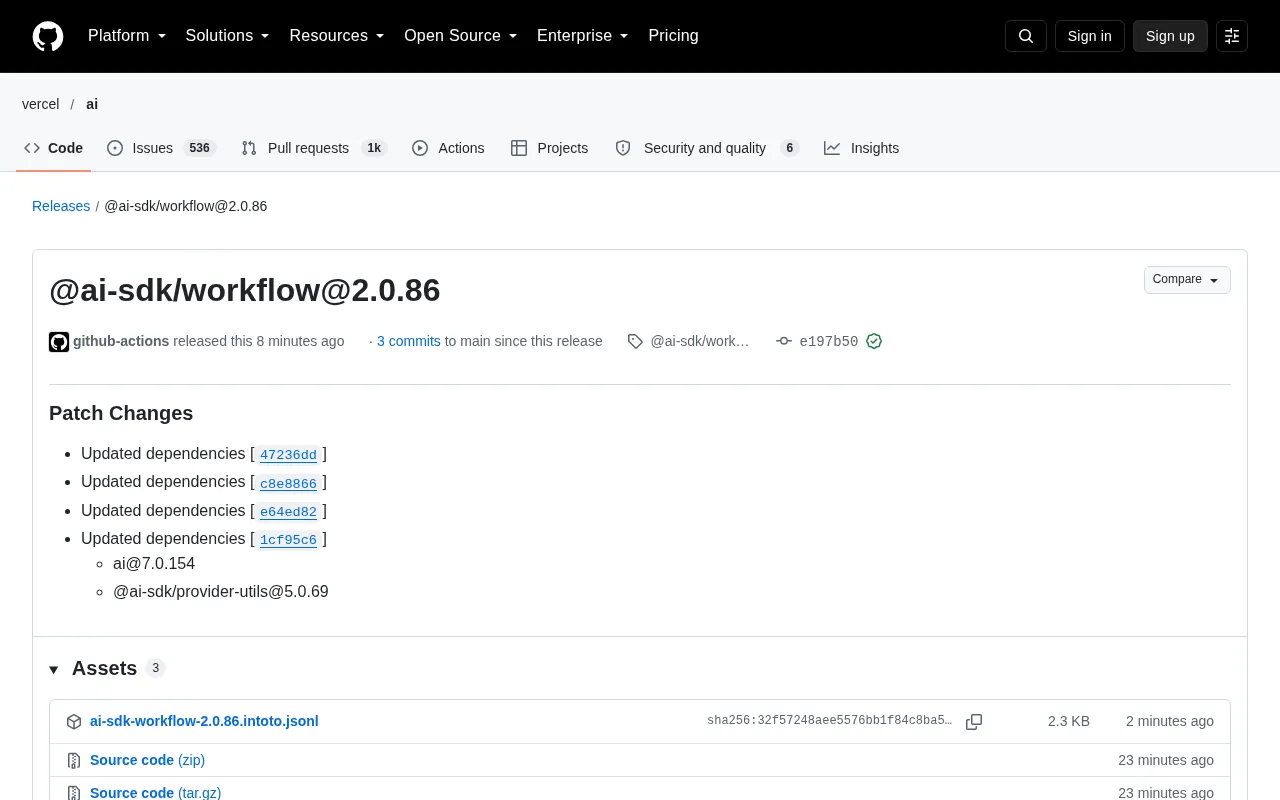
Vercel's AI SDK ecosystem has seen another version iteration. @ai-sdk/workflow has released version 2.0.86, which simultaneously updates the core dependencies ai@7.0.154 and @ai-sdk/provider-utils@5.0.69. Updates that look like routine patch releases often contain signals about the direction of the entire AI SDK architecture's evolution, and are worth developers' attention.
Core Contents of the Version Update
According to the release record, 2.0.86 is a standard Patch Changes update. The main action is synchronizing dependency versions across four dependency commits (47236dd, c8e8866, e64ed82, 1cf95c6).
Specifically, it points to two key packages: ai is upgraded to 7.0.154, and @ai-sdk/provider-utils is upgraded to 5.0.69. The release was completed automatically by github-actions, and commit e197b50 has passed GitHub signature verification, indicating that the entire release pipeline still follows an automated process and retains traceable signature verification.
For teams using @ai-sdk/workflow to build multi-step AI workflows, this update does not require changes to business code and is a low-risk upgrade.
Patch updates in semantic versioning: Following the SemVer (semantic versioning) convention, an increment in the third digit of the version number MAJOR.MINOR.PATCH represents a patch update, which usually contains only backward-compatible bug fixes, security patches, or dependency synchronization, and does not introduce new APIs or breaking changes. The 86 in 2.0.86 indicates that this is the 86th patch iteration in the 2.0.x series, which also indirectly shows that this package has a relatively high release frequency. For downstream projects, patch-level upgrades can generally be accepted with confidence, but it is still necessary to pay attention to whether transitive dependencies (such as ai and @ai-sdk/provider-utils in this case) have crossed a MINOR or MAJOR boundary, because breaking changes in transitive dependencies will not be reflected in this package's version number.
What Dependency Linkage Means
@ai-sdk/workflow is not an isolated package; it is built on top of the core ai package and the @ai-sdk/provider-utils utility layer. The latter handles underlying responsibilities such as model provider adaptation and request parameter normalization.
This kind of dependency linkage reflects a fact: the AI SDK's workflow capabilities are highly coupled with the underlying model access layer. Every step the core package takes forward, the workflow layer must follow in sync to ensure consistency in the calling protocol. This is also why the update content of 2.0.86 is "Updated dependencies" rather than feature-level changes.
For projects that need to maintain workflow orchestration logic over the long term, tracking the rhythm of such dependency updates can help avoid pitfalls better than chasing major-version features.
The layered architecture of the AI SDK: The Vercel AI SDK is roughly divided into three layers—the top layer is the application-facing entry point (such as @ai-sdk/workflow, which provides multi-step orchestration), the middle layer is the core package ai (unifying abstractions such as generateText, streamText, and tool calls), and the bottom layer is @ai-sdk/provider-utils and the various provider packages (OpenAI, Anthropic, etc.). provider-utils is responsible for smoothing over the differences among various model APIs into a unified request/response protocol, so once it changes parameter normalization logic, the calling contract of the upper-layer workflow may be affected. This layering determines that version linkage is rigid: after the core package is upgraded, if the workflow package does not follow up, runtime errors caused by protocol mismatches may occur.
The Value of Automated Releases and Signature Verification
This release is marked as github-actions released, and the commit carries a GPG signature (key ID B5690EEEBB952194). This information has practical significance at the supply chain security level.
AI applications often involve API keys, private data, and external model calls, and the integrity of the build pipeline directly affects production environment security. Automated releases combined with signature verification allow downstream projects to confirm that dependency sources have not been tampered with. When introducing dependencies in CI, teams can combine such signature information to perform stricter admission checks.
GPG commit signing and supply chain security: Git supports signing commits with GPG (or SSH) keys, and GitHub will display a "Verified" badge, indicating that the commit was indeed created by the holder of the corresponding private key and that the content has not been tampered with. The key ID B5690EEEBB952194 is the short identifier of the signing public key. Alongside this, there is also npm package provenance attestation (based on Sigstore), which can trace which CI pipeline and which commit built the package. Together, the two form a complete verifiable chain from source commit to artifact release, and are an important means of defending against supply chain attacks such as dependency poisoning and account hijacking. Teams can use npm audit signatures or verify commit signatures in CI for admission control.
What Developers Should Do
This update does not require urgent handling, but it is recommended to include it in a regular upgrade window.
- Check whether the versions of
aiand@ai-sdk/provider-utilsin the project lock file are lagging behind - Verify the workflow execution path in the test environment, focusing on model calls and parameter passing
- If the project has requirements for dependency signatures, verify the GPG information of this commit
Overall, 2.0.86 is a stability maintenance release focused mainly on dependency synchronization. Its value lies not in new capabilities, but in maintaining version alignment between the workflow layer and the core package.
One-line Summary
AI SDK workflow package 2.0.86 patch update synchronizes core dependencies and strengthens supply chain verifiability.
Paragraph Summary
Vercel's @ai-sdk/workflow has released patch version 2.0.86. The main action is synchronizing the core dependencies ai@7.0.154 and @ai-sdk/provider-utils@5.0.69, with no feature changes involved, making it a low-risk upgrade. The article points out that this dependency linkage reflects the high coupling between the workflow layer and the model access layer: when the core package advances, the workflow package must follow up to keep the calling protocol consistent. The release was completed automatically by github-actions, and the commit carries a GPG signature, providing supply chain security assurance for the AI application build pipeline. The author recommends including this upgrade in a regular window, verifying the model call and parameter passing paths in the test environment, and checking whether lock file versions are lagging behind.
Related articles

DeepSeek Open-Sources DeepInfer: What Is an Inference Framework Actually For?
DeepSeek open-sources its inference framework DeepInfer under Apache 2.0, supporting DeepSeek V4.1 Flash offline inference. This article explains its request scheduling, FlashMLA/DeepGEMM compute optimization, DSPark speculative verification acceleration, and what it means for developers and ordinary users.

Open-Source AI Learning Agent: A Full Workflow Experience from Topology Graphs to Exam Generation
Explore an open-source AI learning agent: built on DeepSeek API, it constructs knowledge systems via topology graphs, with automatic document generation, notes, super documents, and exams. Learn about its Agent workflow and design highlights.

DeepSeek Whale Girl Open-Source MV Meme: AI Industry Coded Slang About Pivoting to Closed Source
Bilibili's DeepSeek Whale Girl rap MV uses fictional memes to tease the AI open-source vs. closed-source debate, with lyrics full of industry slang. This article explains the meme culture, the Whale Girl symbol, and the open/closed tension.