@ai-sdk/workflow-harness 1.0.146 Release Notes

@ai-sdk/workflow-harness 1.0.146 patches dependency alignment with @ai-sdk/harness — routine maintenance, safe to upgrade.
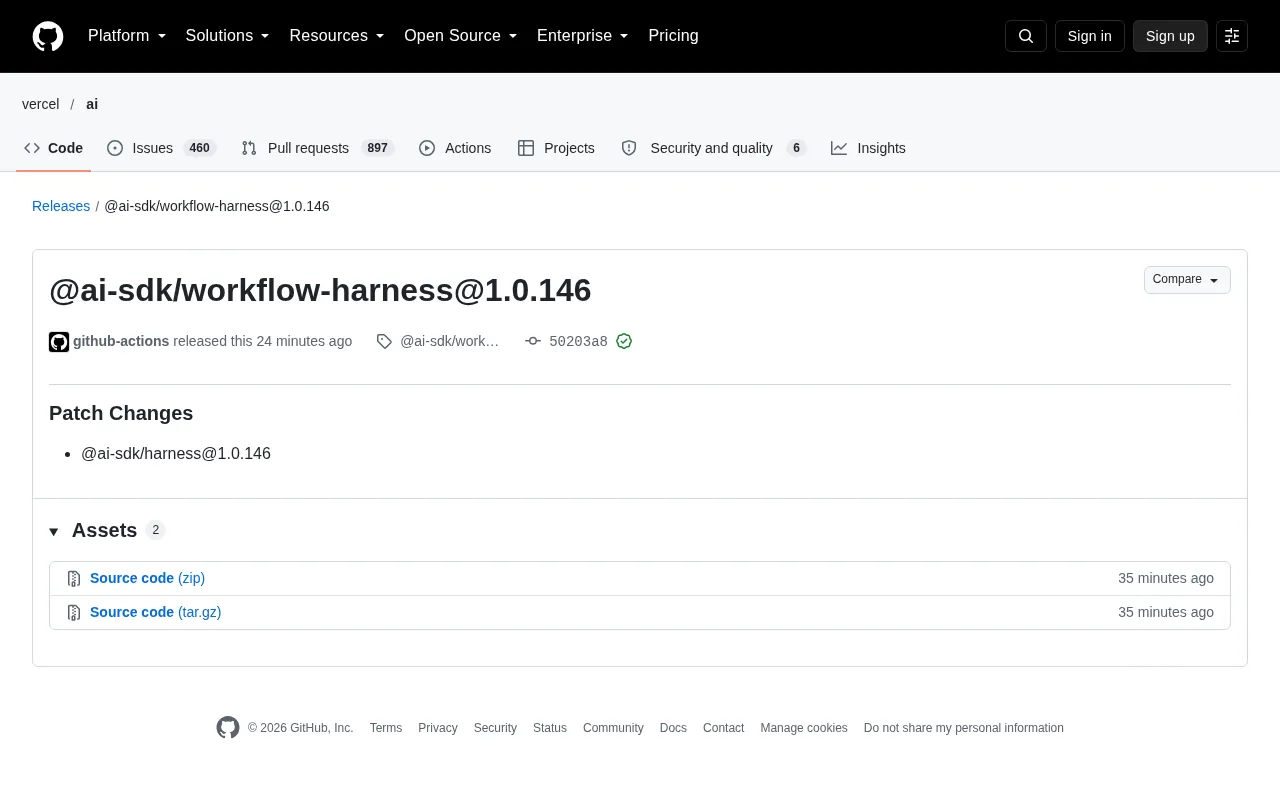
@ai-sdk/workflow-harness was automatically published at version 1.0.146 via GitHub Actions, with the sole change being a synchronized bump of the `@ai-sdk/harness` dependency to the same version. Per SemVer, this patch-level update introduces no breaking changes or new public APIs, making it a low-risk, safe upgrade for downstream consumers. Source material was limited to an RSS-captured GitHub Release page with no detailed bug fix list or feature description; refer to the official GitHub repository's CHANGELOG for full details.
Version Overview
GitHub Actions has automatically published version 1.0.146 of @ai-sdk/workflow-harness. This is a patch-level update that bumps the @ai-sdk/harness dependency to 1.0.146 in sync. The release was published with a verified GitHub signature at commit hash 50203a8.
Based on the publicly available release information, this update is a routine maintenance release focused primarily on dependency version alignment, with no specific feature additions or behavioral changes disclosed.
@ai-sdk/workflow-harness is a toolkit within the Vercel AI SDK ecosystem, designed to provide testing and runtime "harness" support for AI workflows — essentially a scaffolding layer around core logic that handles unified input/output management, error handling, and execution context. Under Semantic Versioning (SemVer), a version number is defined as MAJOR.MINOR.PATCH, where a PATCH increment is reserved exclusively for backward-compatible bug fixes or internal maintenance that does not affect the public API contract. The 1.0.145 → 1.0.146 bump therefore represents only a minor internal adjustment, requiring no changes whatsoever to downstream consumer code.
What's Changed
The official release page lists the changes solely as Patch Changes, corresponding to the dependency upgrade @ai-sdk/harness@1.0.146. Patch-level releases typically mean:
- No breaking changes
- No new publicly exposed APIs
- Primarily used for bug fixes or internal dependency version synchronization
For developers using this package, updates of this kind are generally safe to apply with minimal upgrade risk.
In a monorepo (single-repository multi-package) project, dependency version alignment is an extremely common reason for patch releases. The Vercel AI SDK uses Turborepo + Changesets to manage multiple sub-packages. When a lower-level package (such as @ai-sdk/harness) publishes a new version, dependent upstream packages often need to bump their version numbers in sync to ensure internal consistency — even if the upstream package's own code has not changed at all. This type of "cascading release" does not indicate a substantive change; rather, it is a version-locking mechanism automatically triggered by the toolchain to prevent potential incompatibility issues caused by version drift between packages.
A Note on Source Limitations
It should be noted transparently that the original source material for this article comes from a GitHub Release page captured via RSS, which provides very limited information. The page does not include specific changelog details, a list of fixed bugs, or descriptions of new features, making it impossible to offer a deeper technical analysis of this update's practical impact.
For the complete change history of this release, it is recommended to consult the project's official GitHub repository and CHANGELOG file directly for authoritative information.
Related articles

Mistral Large 4 Open-Sources a Trillion Parameters, Microsoft Offers Voluntary Severance to 60,000 Employees
Mistral Large 4 open-sources a trillion-parameter multimodal model with a coding agent score of 48; SanDisk earnings show AI inference reshaping NAND demand; Google Gemini adds in-app file editing, OpenAI raises Codex quotas, and Microsoft offers voluntary severance to 60,000 employees.
Mistral Large 4 Opens Its Weights: AI Morning Brief Roundup of Models and Ecosystem Trends
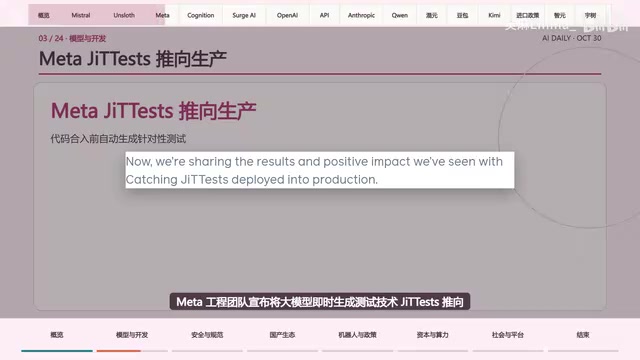
Mistral Large 4 opens its weights, a 1-trillion-parameter MoE architecture that can run locally on MacStudio; Meta's test-generation technology enters production; top tax benchmark pass rate only 10.8%; Canadian government takes a stake in Cohere; Doubao Work opens third-party model calls. This AI Morning Brief rounds up model, ecosystem, capital, and policy developments.

Mistral Large 4 Goes Open Source: A 1T-Parameter European Qwen Challenging DeepSeek
Mistral Large 4 is now open source: 1T total parameters, 52B activated, focused on coding and cybersecurity, with ~610G NVFP4 weights. We analyze its comparison with DeepSeek V4 Flash, API pricing, demo realism, and local deployment value.