AI SDK Workflow Harness 1.0.147 Release Notes

AI SDK releases workflow-harness 1.0.147 patch to sync the underlying harness dependency version.
`@ai-sdk/workflow-harness@1.0.147` is a routine patch maintenance release, with the core change being synchronization of the underlying dependency `@ai-sdk/harness` to the same version. Published via GitHub Actions and verified with a GPG signature, it's a trusted release. Under the AI SDK's monorepo model, sub-packages often bump versions in lockstep with lower-level packages to ensure compatibility. No new features or breaking changes are introduced, making the upgrade risk minimal. Teams using this package are advised to validate in CI before upgrading and review the `@ai-sdk/harness` changelog for underlying details.
The AI SDK ecosystem recently shipped a new version: @ai-sdk/workflow-harness@1.0.147. This is a patch release that primarily synchronizes the dependency @ai-sdk/harness@1.0.147.
Version Overview
According to the GitHub Releases page, this version was published by the github-actions automated pipeline on October 9th. The commit hash is e00b1b1, and the release was signed via GitHub's verified signature (GPG key ID: B5690EEEBB952194), making it a trusted release.
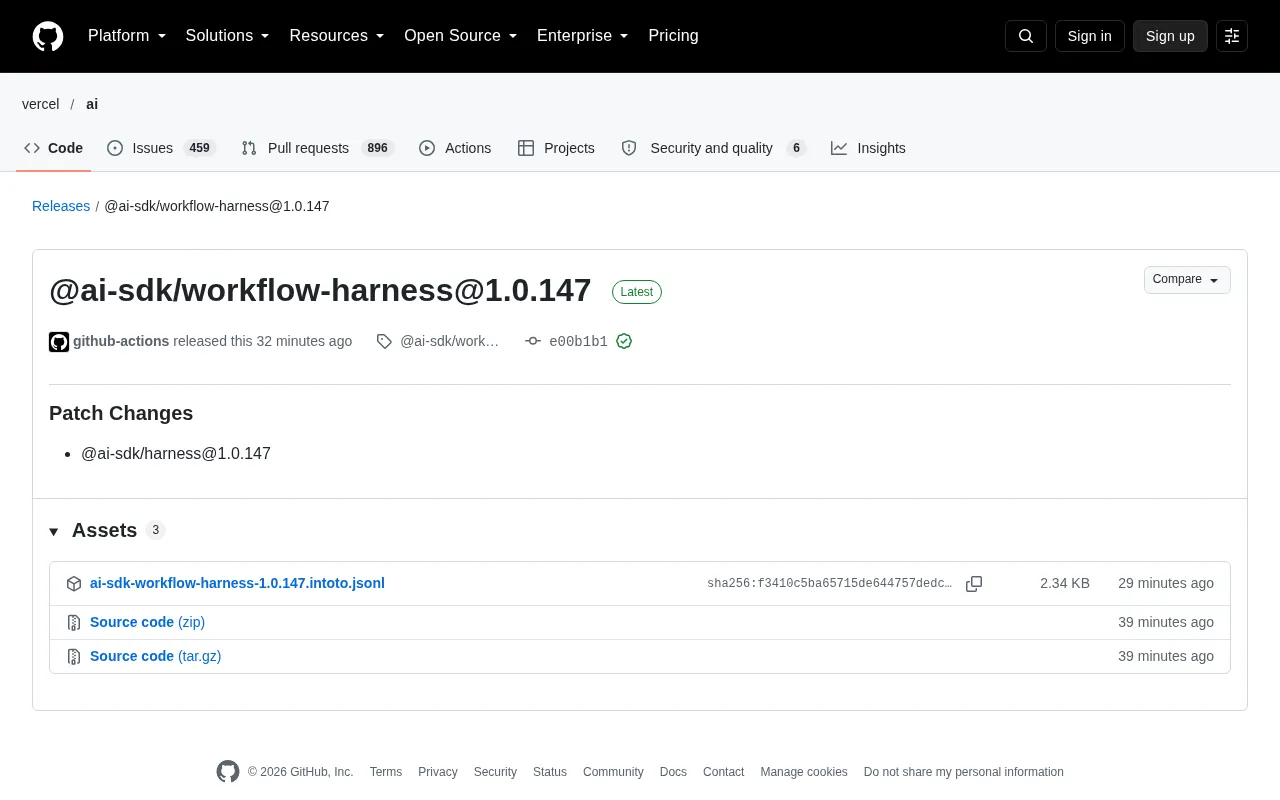
The version number 1.0.147 indicates this is a continuous iteration within a stable release series. Patch-level updates typically involve internal fixes, dependency alignment, or minor optimizations — not breaking changes — so developers can upgrade with confidence.
What Changed
The core change recorded in the Patch Changes for this release is:
@ai-sdk/harness@1.0.147
This means workflow-harness has been kept in version lockstep with the underlying harness package. In multi-package projects managed as a monorepo — like the AI SDK — related packages are often upgraded together to ensure inter-component compatibility. This release includes no detailed feature descriptions in the public release notes, making it a classic dependency-driven patch.
What is a Monorepo? A monorepo is an engineering practice of managing multiple related packages or projects within a single code repository. It's widely used in large open-source projects like the Vercel AI SDK, React, and Babel. In a monorepo setup, dependencies between sub-packages are managed centrally by build tools such as Turborepo, Nx, or pnpm workspaces. When a lower-level package (e.g.,
@ai-sdk/harness) changes, higher-level packages that depend on it (e.g.,@ai-sdk/workflow-harness) typically trigger a version bump as well — even if their own code hasn't changed. This "cascading version alignment" ensures that when consumers install a specific version, all internal sub-package dependencies are in a verified compatible state, avoiding implicit bugs caused by version drift.
What This Means for Developers
As a workflow-related utility component in the AI SDK, workflow-harness primarily serves application testing and orchestration scenarios built on the SDK. Staying in sync with the core package helps avoid potential issues caused by dependency version mismatches.
For teams currently using the AI SDK, here are the recommendations:
- If your project depends on
workflow-harness, you can upgrade to the latest patch version after confirming there are no breaking changes in the changelog. - Review the full changelog for
@ai-sdk/harnessto understand what actually changed under the hood. - Since this is a patch update, the upgrade risk is low — but it's still a good practice to validate in your CI environment before merging into the main branch.
A Note on Semantic Versioning (SemVer) SemVer defines version numbers as
MAJOR.MINOR.PATCH: MAJOR changes introduce incompatible breaking changes, MINOR changes add backward-compatible features, and PATCH changes include only backward-compatible bug fixes or internal adjustments. The147in1.0.147is the PATCH segment, meaning this package has gone through 147 patch iterations since1.0.0— each theoretically non-breaking to existing interfaces. This convention is the primary basis developers use to assess upgrade risk, and it's the underlying rule that package managers likenpmandyarnuse to auto-resolve dependency ranges (e.g.,^1.0.0).
Summary
This release of @ai-sdk/workflow-harness@1.0.147 is a routine patch maintenance update, with the core change being version synchronization with @ai-sdk/harness. There isn't much else to unpack here — for more details, refer to the project's official repository commit history and changelog.
Related articles

Private Key Set to 4? CA's Elementary Mistake Leaves TLS Exposed
CA eMudra set private keys to tiny values like 4, making TLS certificates brute-forceable. A Computerphile video demonstrates the full process from extracting public keys to forging certificates, and explores the fragility of the PKI trust chain.

How Gen Turns Data into Decisions with ChatGPT Work
In an OpenAI user case, business leader Gen shares how ChatGPT Work turns data into decisions: within hours of launch, teams can judge whether integrations and onboarding flows work, shifting decision iteration from hundreds of trial-and-error attempts to a fast feedback loop.

ChatGPT vs. Claude In-Depth Comparison: Strong at Coding but Weak at Research — How to Bridge the Gap?
A user considers switching from ChatGPT to Claude, finding Claude stronger at coding but shallower at research. We analyze the differences and share tips to make Claude's research deeper.