AI SDK Workflow Harness Toolkit 1.0.170 Patch Released

@ai-sdk/workflow-harness releases 1.0.170 patch, strictly aligned with underlying harness version.
@ai-sdk/workflow-harness in the AI SDK ecosystem released patch version 1.0.170, with version numbers exactly matching core dependency @ai-sdk/harness. Auto-published by GitHub Actions bot on October 30, containing a single GPG-verified commit, marked as Patch Changes with no breaking changes or specific new features/API changes listed. The package serves as testing and runtime scaffolding for AI workflows, enabling reproducible multi-step model and tool call flows locally or in CI. Main upgrade benefit is dependency tree consistency and avoiding version mismatch issues; running existing workflow tests after upgrading is recommended.
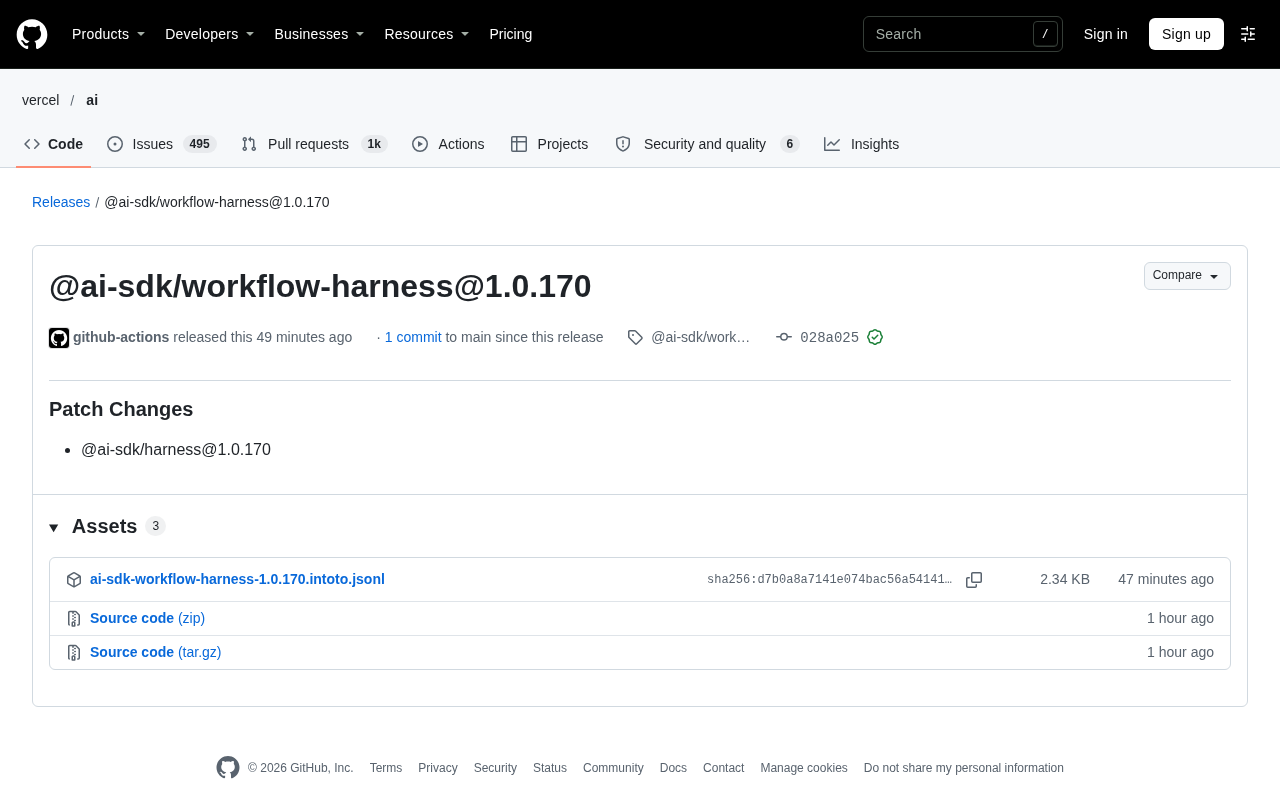
@ai-sdk/workflow-harness in the AI SDK ecosystem has released version 1.0.170. This update appeared on GitHub as a quick patch, with the version number directly corresponding to the core dependency @ai-sdk/harness@1.0.170, meaning the workflow orchestration layer maintains strict version alignment with the underlying harness.
Key Information About This Release
According to the GitHub Releases page, this version was published by the github-actions bot on October 30 at 22:19, containing only a single commit (commit 028a025), and that commit carries a GitHub-verified signature (GPG key ID: B5690EEEBB952194). Based on the release notes, this is a clear Patch Changes release with no breaking changes, focused on fixes and synchronization.
This release cadence, triggered directly by automated pipelines, is common in fast-iterating open-source toolchains like AI SDK. It typically means the upstream dependency (here @ai-sdk/harness) was updated first, with the workflow layer following to ensure developers using @ai-sdk/workflow-harness don't encounter version mismatch issues.
AI SDK is an open-source TypeScript toolkit for building AI applications, featuring a unified model invocation interface, streaming response handling, tool calling (function calling), and structured output capabilities. It supports multiple model providers through provider abstraction, and has spawned sub-packages around the core ai package including UI integrations (such as @ai-sdk/react), framework adapters, and runtime support. @ai-sdk/workflow-harness is one of the workflow orchestration helper layers, sharing version cadence with the core package, so its version number reflects the iteration progress of the entire SDK ecosystem.
GitHub Actions automated release: This refers to the repository automatically calculating version numbers, generating changelogs, tagging, and publishing to npm via CI pipelines (such as changesets combined with release workflows) after code is merged. Such processes typically involve bot accounts submitting release commits to ensure the release process is reproducible and requires no manual intervention, which also explains why a single patch version corresponds to just one commit.
Why This Package Is Worth Watching
The name @ai-sdk/workflow-harness already reveals its positioning: providing testing and runtime scaffolding for AI workflows. When building applications based on large models, developers often need to chain multiple model calls, tool calls, and conditional branches into reproducible flows. Workflow-harness provides exactly this kind of flow encapsulation and validation capability, enabling developers to reliably drive AI workflows in local or CI environments.
Its version number exactly matches @ai-sdk/harness, indicating they are companion packages released in tandem. For teams already using AI SDK workflow capabilities in their projects, the main benefit of upgrading to 1.0.170 is maintaining dependency tree consistency and avoiding implicit behavioral inconsistencies caused by patch version differences.
Testing harness originates from the test engineering domain, referring to a framework layer that wraps the system under test, providing controlled inputs, environment isolation, and result assertions. In AI scenarios, harnesses need to additionally handle non-deterministic outputs, multi-turn tool calls, and streaming intermediate states, so they typically offer recording/playback, mock model responses, and step-level assertions to make workflows reproducible locally and in CI.
Workflow orchestration refers to organizing multiple model calls, tool calls, and conditional branches into directed flows while managing state passing and error retries. Workflow-harness and harness are split into two packages to decouple orchestration logic from underlying runtime/testing infrastructure: the former is for developers writing flows, the latter provides the execution and validation foundation, and releasing them at the same version prevents interface contract mismatches.
Practical Impact of This Patch Update
Based on the release notes, no specific new features or API changes are listed, only one Patch Changes record. This typically corresponds to several scenarios: fixing edge cases in workflow execution, synchronizing internal interface adjustments in harness, or metadata updates to the release process itself.
For regular users, this type of patch version carries very low risk, but it's still recommended to run existing workflow test cases after upgrading to confirm behavior meets expectations. For projects that lock versions in CI, standard patch upgrade strategies can be applied; if the project is highly sensitive to workflow behavior, validate in a staging environment before merging to the main branch.
How to Track Subsequent Versions
The GitHub Releases page provides tag filtering and version comparison entry points, allowing developers to quickly view change scope by comparing adjacent tags. Since this repository uses GitHub Actions for automated releases, subsequent patch versions will likely appear at the same cadence. Following the version updates of @ai-sdk/harness will essentially allow you to predict when workflow-harness will be updated.
For teams currently evaluating AI workflow tools, this high-frequency patch release pattern also highlights a practical point: use explicit version ranges in dependency declarations and record each patch change in upgrade logs, so you can enjoy quick fixes while maintaining build traceability.
Related articles

Cloudflare GLM-5.3 Leaks User Prompts: Memory Residue Behind the 200 OK
A Cloudflare GLM-5.3 leak exposed other users' prompts in 155 responses, all returned as 200 OK, due to an SGLang memory page cleanup bug. Self-hosted users should upgrade to SGLang 0.5.22.

Mistral Large 4 Hands-On: How Good Is This Trillion-Parameter MoE Model at Coding?
Mistral Large 4 hands-on: 1T-parameter MoE, 49B active, 1M-token context, text+image input. Beats GLM 5.3 and Kimi K3 on benchmarks; generates 3D games and websites.

Gemini 4 Argon Lands in AI Studio: Build Enterprise Tools with a Single Prompt
Google AI Studio launches Gemini 4 Argon with over 1M token context and three reasoning levels. This article breaks down its core features, paid access limits, and demos three reusable workflows: lead tracking, campaign generation, and SEO audit.