@ai-sdk/xai 2.0.104 Patch Release: Coordinated Dependency Updates
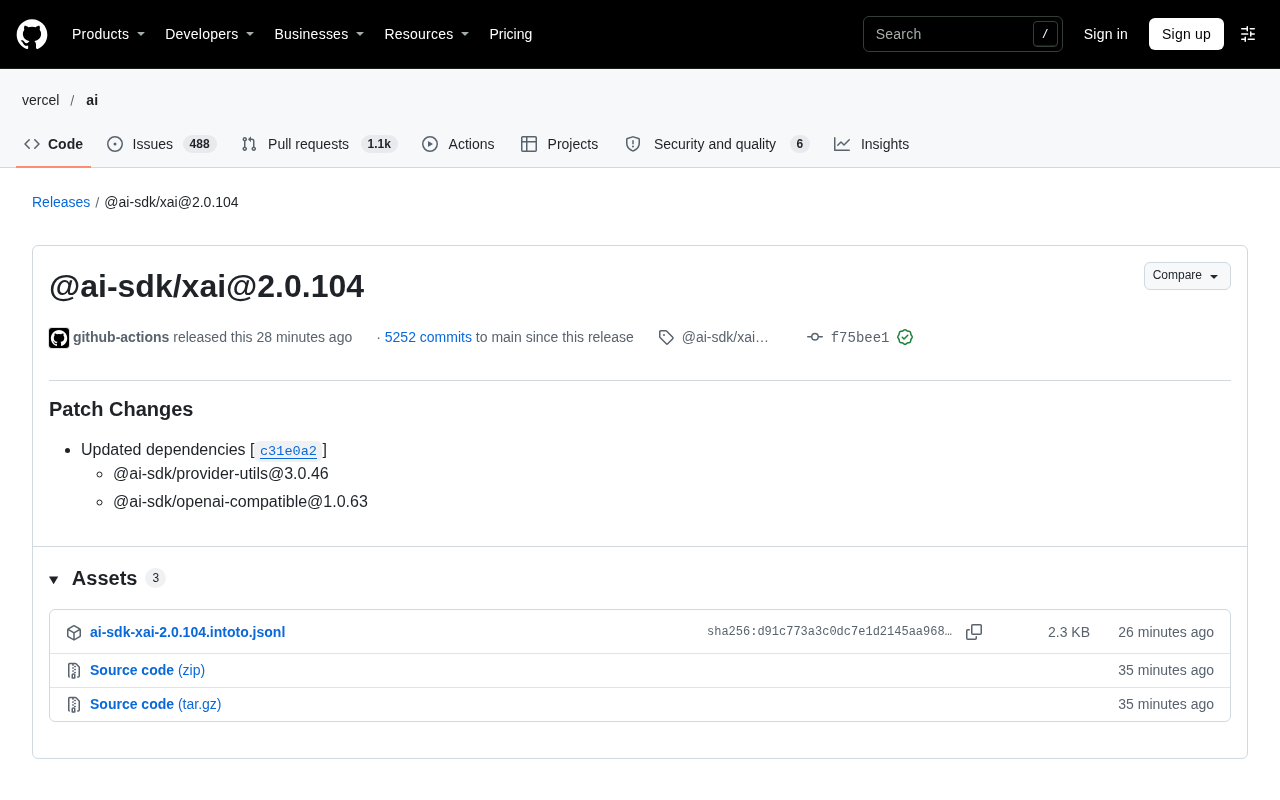
@ai-sdk/xai releases patch 2.0.104, syncing two shared dependency versions.
This article covers the 2.0.104 update of the xAI adapter package `@ai-sdk/xai` in the AI SDK ecosystem. Automatically published by GitHub Actions, it's a patch-level iteration with no new features or breaking changes. The core action is syncing two shared dependencies: `@ai-sdk/provider-utils` to 3.0.46 and `@ai-sdk/openai-compatible` to 1.0.63. provider-utils handles common logic like request construction and response parsing, and openai-compatible's presence shows xAI's API is highly compatible with OpenAI's. The article notes such updates have limited impact on single-provider projects, but for multi-provider projects, keeping shared dependency versions aligned avoids type mismatches and runtime differences. It also reminds readers that the 5,252 commits in the release record are the repo's overall history, not this change volume.
The xAI adapter package in the AI SDK ecosystem has received a version iteration. @ai-sdk/xai has released version 2.0.104. Judging from the versioning convention, this is a patch-level update focused primarily on dependency synchronization and maintenance.
Release Nature: A Typical Patch Iteration
Based on the Release record automatically published by github-actions on GitHub, the changes in this 2.0.104 version are quite restrained. The officially labeled change type is Patch Changes, meaning this release introduces no new features or breaking changes and falls under routine maintenance.
Such automated releases are quite common in modern open-source projects. When a shared underlying dependency is updated, upper-layer adapter packages trigger version increments accordingly to keep the dependency graph healthy.
Semantic Versioning and Automated Releases
A patch version (Patch Changes) is the last segment of MAJOR.MINOR.PATCH in the Semantic Versioning (SemVer) specification. By convention, a PATCH increment should only contain backward-compatible bug fixes and internal maintenance, without new features (MINOR) or breaking changes (MAJOR). This release was automatically completed by the github-actions bot, which typically means the project adopts a Changesets-style workflow: developers submit change description files in PRs, and after merging, CI aggregates them, batch-calculates new version numbers for affected packages, updates the changelog, and publishes to npm. In a monorepo, upgrading a shared package propagates along the dependency graph to all packages that depend on it, triggering a cascade of patch releases—this is exactly the mechanism behind the xAI adapter package's "passive" release, and an important clue for judging the actual scope of impact of an update.
Dependency Updates: provider-utils and openai-compatible
The core action of this update is synchronizing dependency versions. According to the Release notes, @ai-sdk/xai 2.0.104 updated the following dependencies:
@ai-sdk/provider-utilsto version 3.0.46@ai-sdk/openai-compatibleto version 1.0.63
Among these, provider-utils is the shared utility layer used by all provider packages in the AI SDK, handling common logic such as request construction, response parsing, and error mapping. The xAI adapter package depending on its latest patch version usually means there are detail fixes in the underlying utility layer, and the xAI package needs to follow up to stay behaviorally consistent.
The presence of openai-compatible reveals architectural information: xAI's API interface is largely compatible with OpenAI's, so the adapter layer reuses the capabilities of this compatibility package. This package is also upgraded to 1.0.63, likewise a patch-level update.
For developers building applications with the AI SDK, such patch updates along the dependency chain often bring no behavioral changes, but keeping versions aligned helps avoid potential compatibility issues.
The Layered Architecture of AI SDK and Provider Adapter Packages
The AI SDK (led by Vercel) adopts a "core + adapter" layered design. The core layer defines unified interfaces such as LanguageModelV1, abstracting capabilities like model invocation, streaming responses, and tool calling; while each model vendor (OpenAI, Anthropic, xAI, Google, etc.) corresponds to an independent provider package that translates each vendor's different HTTP API into a unified protocol the core layer can recognize. This way, application code only needs to be written against the AI SDK's unified interface, and switching models usually only requires changing one line of provider initialization code. @ai-sdk/provider-utils is the infrastructure shared by this adapter layer, including common tools like request parameter validation, streaming event parsing, and error wrapping; @ai-sdk/openai-compatible further encapsulates the de facto standard "OpenAI Chat Completions protocol", allowing any vendor compatible with that protocol to integrate with minimal code. Understanding this layering makes it clear why patches to upstream utility packages drive chain releases of downstream provider packages.
Practical Impact on Developers
Faced with such a patch version, the developer's decision is relatively simple. If your project directly depends on @ai-sdk/xai, you can optionally perform the upgrade; if your project pins an exact version and is currently running stably, there's no rush to follow up.
But if you use multiple AI SDK provider packages in the same project—for example, integrating xAI, OpenAI, or other compatible services simultaneously—then keeping shared dependencies like provider-utils version-aligned becomes more important. Version mismatches can sometimes cause hard-to-troubleshoot type mismatches or runtime behavioral differences.
You may not have noticed that this release also includes 3 Assets, all auto-generated source archives from GitHub. The release record shows this version is associated with 5,252 commits, which is the repository's overall commit history number rather than the change volume of this patch, and is easy to misread.
Summary
@ai-sdk/xai 2.0.104 is a standard patch release, introducing no new APIs and with no publicly documented behavioral changes. Its value lies in keeping dependency versions within the AI SDK ecosystem tidy and synchronized. For engineers focused on AI application development, such updates can serve as a reference signal for version management: when adapter packages frequently publish patches following underlying dependencies, it indicates the upstream utility layer is being actively maintained.
One-line Summary
@ai-sdk/xai releases patch version 2.0.104, synchronizing two shared dependency versions.
Paragraph Summary
This article covers the 2.0.104 version update of the xAI adapter package @ai-sdk/xai in the AI SDK ecosystem. This version was automatically published by GitHub Actions as a patch-level iteration with no new features or breaking changes. The core action is synchronizing two shared dependencies: @ai-sdk/provider-utils upgraded to 3.0.46 and @ai-sdk/openai-compatible upgraded to 1.0.63. Among these, provider-utils handles common logic like request construction and response parsing, while the presence of openai-compatible indicates that xAI's API is highly compatible with OpenAI's interface. The article notes that such updates have limited impact on single-provider projects, but for projects integrating multiple providers simultaneously, keeping shared dependency versions aligned can avoid type mismatches and runtime differences. The article also reminds readers that the 5,252 commits in the release record are the repository's overall history, not the change volume of this update.
Related articles
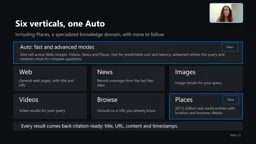
Microsoft WebIQ: Verifiable Real-Time Web Grounding for AI Agents
Microsoft WebIQ gives AI Agents real-time, citable web grounding across web, news, images, videos, and Places—164ms P95 latency, 50% fewer tokens, Scopes source control, and MCP integration.
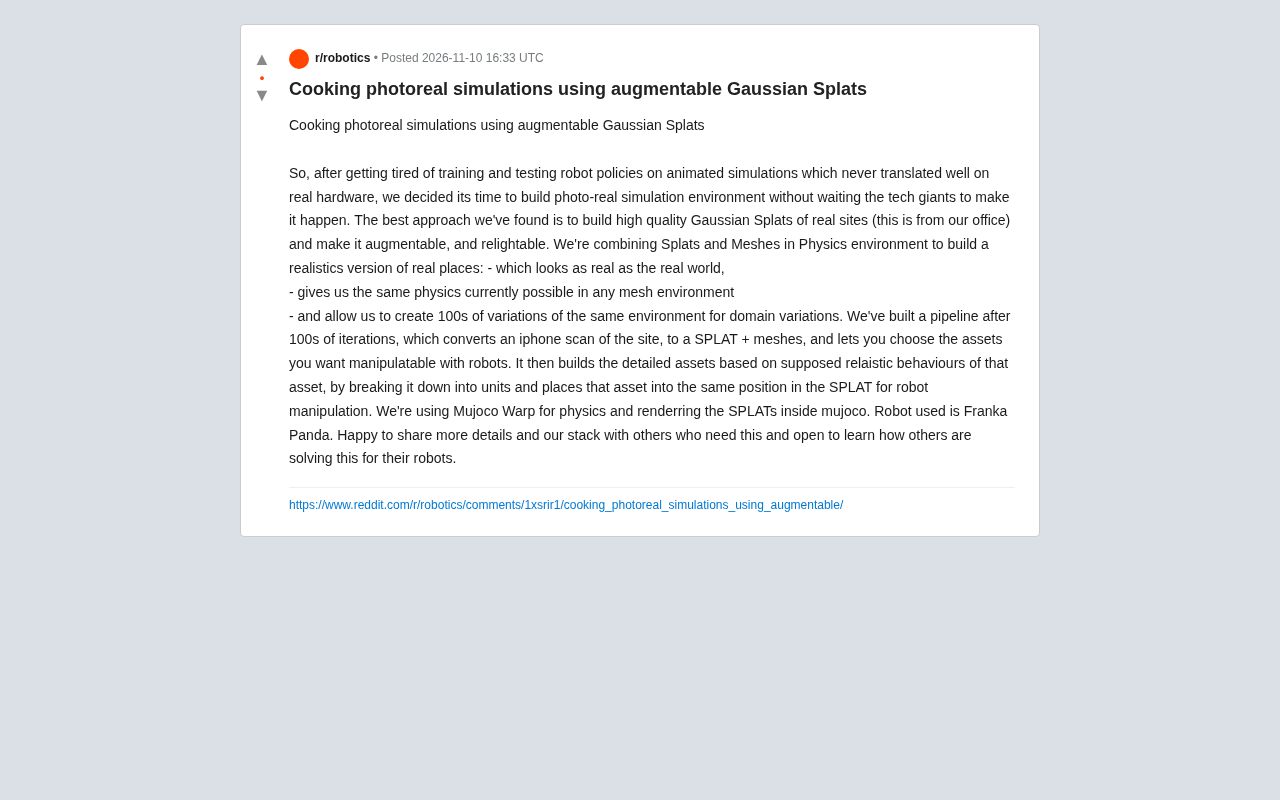
Augmentable Gaussian Splatting: Building Photorealistic Simulation Environments for Robot Training
Team combines Gaussian Splatting with meshes to build photorealistic robot simulation environments, integrating MuJoCo Warp physics and Franka Panda for augmentable, relightable real-site simulation.

Gemini 4 Carbon Released: The Leap from Gemini 3 to Gemini 4 in Under a Year
Google releases Gemini 4 Carbon, less than a year after Gemini 3. In the official demo, Carbon reverse-engineered the Theme Park binary, added a new DeepMind-themed ride, and ported it to the web in one shot.