AI SDK xAI 3.0.152 Patch Update: Dependency Upgrades and Ecosystem Compatibility
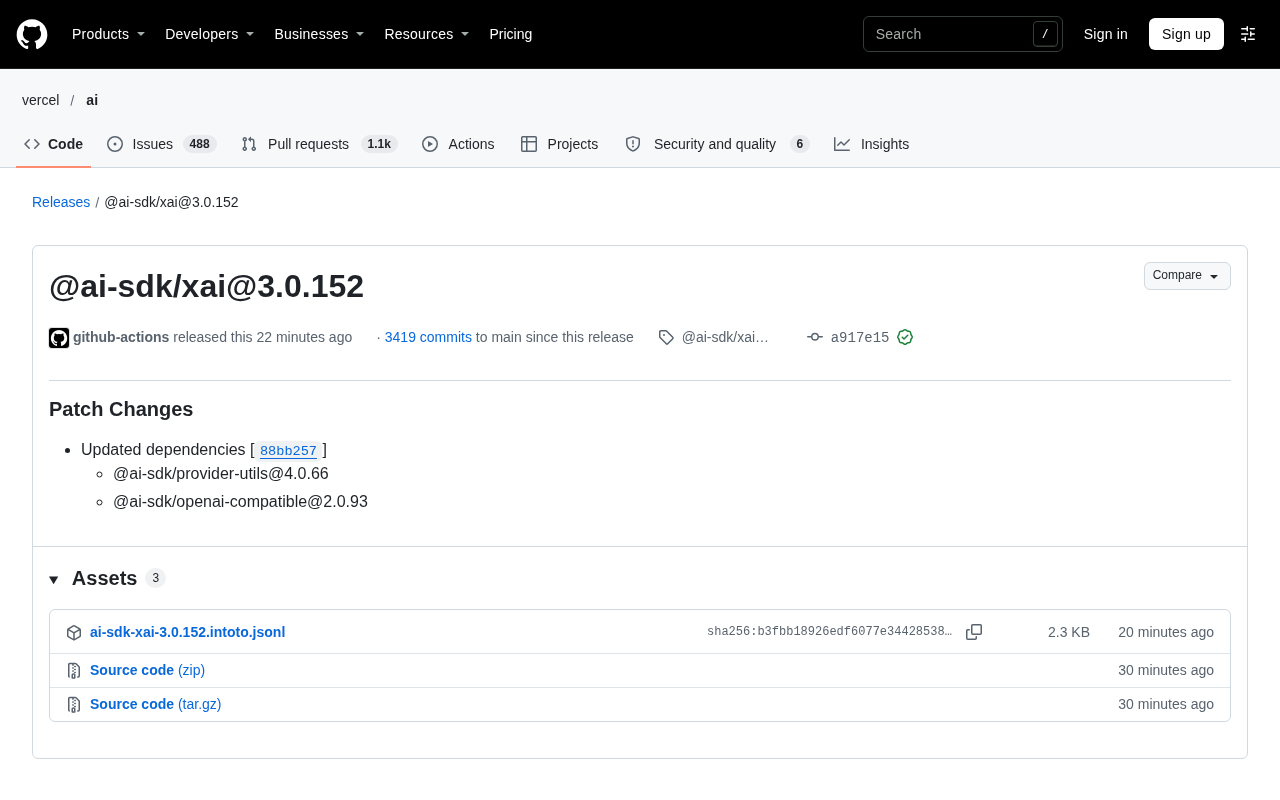
@ai-sdk/xai releases patch 3.0.152, syncing upstream dependencies—a low-risk maintenance upgrade.
Vercel's AI SDK `@ai-sdk/xai` has released version 3.0.152, a typical patch update that upgrades `@ai-sdk/provider-utils` to 4.0.66 and `@ai-sdk/openai-compatible` to 2.0.93. This version introduces no breaking changes and does not change how developers make calls; its value lies in maintaining dependency chain health and version consistency. The article notes that the xAI provider lets developers call Grok series models within a unified framework, and that minor version iterations of the OpenAI-compatible layer may indirectly affect its stability. The recommendation for users: projects with pinned versions can upgrade as needed, while range versions obtain it automatically; after upgrading, run existing tests, focusing on tool calls and streaming responses to prevent dependency updates from exposing previously masked issues.
Vercel's AI SDK project has recently released version 3.0.152 of @ai-sdk/xai. For engineers familiar with AI application development, this is not a major feature-level update, but rather a typical patch version (Patch Changes), whose core value lies in maintaining the health and stability of the dependency chain.
Breaking Down the Patch: Dependency Updates Take Center Stage
According to the release notes on GitHub, the changes in @ai-sdk/xai@3.0.152 are highly focused: the dependency @ai-sdk/provider-utils was updated to version 4.0.66, and @ai-sdk/openai-compatible was simultaneously updated to version 2.0.93.
Such "update dependencies" patches are very common in mature open-source projects. They typically mean that upstream packages have fixed some internal issues, adjusted the behavior of utility functions, or paved the way for upcoming new features. For developers using the xAI provider, this version itself does not change how you make calls, but upgrading helps maintain version consistency across the entire SDK ecosystem and avoids potential conflicts caused by dependency version mismatches.
Semantic Versioning (SemVer) and Patch Versions: Open-source npm packages generally follow the semantic versioning convention of major.minor.patch. A major version change indicates incompatible API changes (breaking changes), a minor version increase indicates new features added in a backward-compatible manner, and a patch number increment (such as 3.0.151 → 3.0.152) promises to contain only backward-compatible bug fixes. This is precisely the basis for the statement in the article that the patch version "does not change how you make calls." Dependency lock files (such as package-lock.json, pnpm-lock.yaml) record exact versions, so when using range declarations like ^3.0.0, the installer will automatically pull the latest patch version—this is also the reason stated in the article that it is "automatically included in the next installation."
Why the xAI Provider Is Worth Watching
xAI, the company behind the Grok models, has its API integrated into a unified calling system through the AI SDK's xAI provider. The design philosophy of AI SDK is "write once, adapt to multiple models," allowing developers to call the Grok series models within the Vercel AI SDK framework via @ai-sdk/xai while maintaining a code structure similar to that of other providers (such as OpenAI and Anthropic).
The update to @ai-sdk/openai-compatible is particularly noteworthy. This package provides an adaptation layer for service providers that adopt the OpenAI-compatible API format, and xAI's API is similar in interface design. Minor version iterations of this compatibility layer may involve subtle adjustments to request/response formats, thereby indirectly affecting the stability and compatibility of the xAI provider.
The Provider Abstraction Layer of AI SDK: Vercel AI SDK adopts a layered architecture. The core package ai only defines unified interfaces for generation, streaming output, and tool calls, while the capabilities of specific model service providers are implemented by independent provider packages (such as @ai-sdk/openai, @ai-sdk/anthropic, @ai-sdk/xai). These providers all rely on the standard interface specifications defined in @ai-sdk/provider and share the @ai-sdk/provider-utils utility library, which encapsulates common logic such as stream parsing, error handling, and request construction. Therefore, version synchronization of provider-utils simultaneously affects the behavioral consistency of multiple providers, which is why maintainers frequently upgrade it in unison.
OpenAI-Compatible Interface: @ai-sdk/openai-compatible is a general-purpose adaptation package for services that "mimic the OpenAI protocol"—as long as the server exposes endpoints consistent with OpenAI's structure, such as /chat/completions and /embeddings, this adaptation layer can be reused without writing a provider from scratch. Many emerging model vendors provide OpenAI-compatible endpoints to reduce integration costs, and xAI's Grok API is designed in this way, so iterations of this package will indirectly affect the request and response transformations of the xAI provider.
Practical Impact and Recommendations for Developers
For projects currently using @ai-sdk/xai, this update is a low-risk upgrade. If your project has pinned versions, you can upgrade as needed; if you use ^ range versions, this patch will be automatically included in the next installation.
It is worth noting that although patch versions do not introduce breaking changes, dependency chain updates can sometimes expose previously masked bugs. It is recommended to run your existing tests after upgrading, especially scenarios involving tool calls and streaming responses, to confirm that behavior is consistent with before the upgrade.
Summary
@ai-sdk/xai@3.0.152 is a maintenance-oriented release. It does not pursue feature highlights but instead ensures the long-term reliability of the SDK by synchronizing upstream dependencies. In an era of rapid iteration in AI applications, such "boring" patches are precisely the foundation for the stable operation of the ecosystem. For developers, keeping dependencies updated and maintaining test coverage is more effective at reducing unexpected risks in production environments than chasing every new feature.
One-line Summary
@ai-sdk/xai releases 3.0.152 patch, synchronizing upstream dependencies—a low-risk maintenance upgrade.
Paragraph Summary
Vercel's AI SDK @ai-sdk/xai has released version 3.0.152, a typical patch update whose core is upgrading @ai-sdk/provider-utils to 4.0.66 and @ai-sdk/openai-compatible to 2.0.93. This version introduces no breaking changes and does not change how developers make calls; its value lies in maintaining dependency chain health and version consistency. The article notes that the xAI provider allows developers to call Grok series models within a unified framework, and that minor version iterations of the OpenAI-compatible layer may indirectly affect its stability. The recommendation for users is: projects with pinned versions can upgrade as needed, while range versions will automatically obtain it; after upgrading, existing tests should be run, with particular attention to tool calls and streaming response scenarios, to prevent dependency updates from exposing previously masked issues.
Related articles
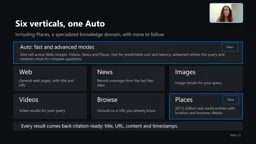
Microsoft WebIQ: Verifiable Real-Time Web Grounding for AI Agents
Microsoft WebIQ gives AI Agents real-time, citable web grounding across web, news, images, videos, and Places—164ms P95 latency, 50% fewer tokens, Scopes source control, and MCP integration.
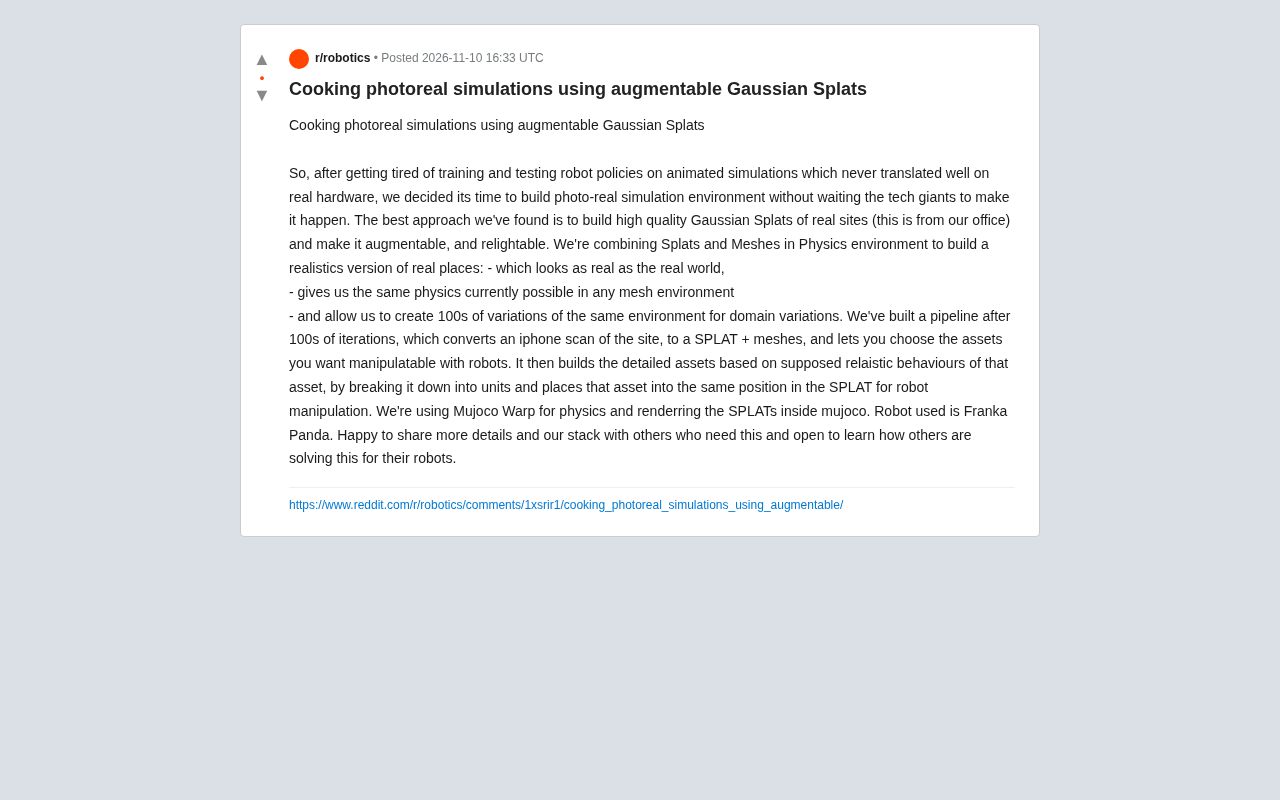
Augmentable Gaussian Splatting: Building Photorealistic Simulation Environments for Robot Training
Team combines Gaussian Splatting with meshes to build photorealistic robot simulation environments, integrating MuJoCo Warp physics and Franka Panda for augmentable, relightable real-site simulation.

Gemini 4 Carbon Released: The Leap from Gemini 3 to Gemini 4 in Under a Year
Google releases Gemini 4 Carbon, less than a year after Gemini 3. In the official demo, Carbon reverse-engineered the Theme Park binary, added a new DeepMind-themed ride, and ported it to the web in one shot.