AI SDK xAI 5.0.25 Patch Released: What Do the Dependency Updates Signal?

@ai-sdk/xai 5.0.25 patch only upgrades upstream dependencies, reducing version drift when mixing multiple providers.
@ai-sdk/xai releases patch 5.0.25 with no adapter layer code changes, only upgrading @ai-sdk/provider to 4.0.30 and @ai-sdk/provider-utils to 5.0.63. These foundational packages define model capability contracts and encapsulate common utilities like stream parsing and parameter validation; their synchronization helps narrow version drift between provider packages and reduces type conflict risks. The release includes 6 commits, auto-built and signed by GitHub Actions. The article recommends projects directly depending on this package upgrade within their regular window and focus regression testing on streaming responses and error handling; multi-provider projects should check dependency alignment and build a habit of tracking dependency changes in patches.
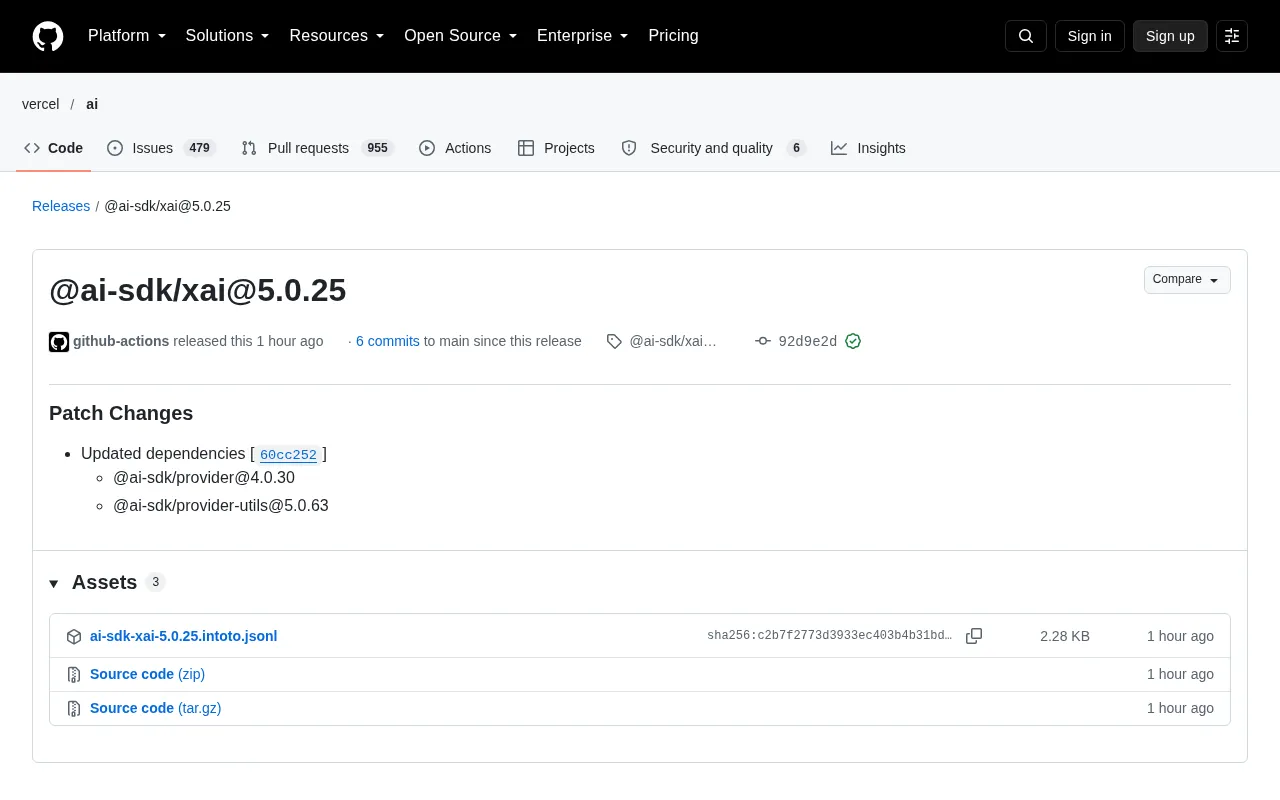
The AI SDK ecosystem has seen another minor iteration. @ai-sdk/xai has released patch version 5.0.25, with changes focused on the dependency level—upgrading @ai-sdk/provider to 4.0.30 and @ai-sdk/provider-utils to 5.0.63. The version numbers may look dull, but within the AI SDK's modular architecture, such patches often carry upstream compatibility fixes and behavior alignment.
What the Patch Actually Changes
A Release That Only Touches Dependencies
According to the GitHub release notes, 5.0.25 is a standard Patch Changes type: no new APIs, no adjustments to the xAI adapter layer's own business logic, and the only change is following minor version updates of two upstream core packages. The commit history shows this release includes 6 commits, automatically built by github-actions with GPG signature verification.
This "zero self-developed changes" release cadence is quite common in AI SDK maintenance. provider and provider-utils are the two foundational layers shared by all model adapter packages: the former defines the abstract interfaces for model capabilities, while the latter encapsulates common capabilities such as request construction, streaming parsing, and error handling. When minor corrections occur in the foundational layer, downstream adapter packages follow up with patches to ensure that callers mixing multiple providers don't run into behavioral inconsistencies.
Two Key Packages in the Dependency Chain
@ai-sdk/provider is responsible for model capability contracts, such as unified signatures for text generation, embeddings, and tool calling; @ai-sdk/provider-utils is closer to implementation details, handling SSE stream parsing, parameter validation, response transformation, and other chores. Syncing them to the latest minor versions essentially narrows version drift between different provider packages and reduces the probability of dependency conflicts.
For users, the most direct value of this update is: if you use multiple AI SDK provider packages in your project simultaneously, upgrading to 5.0.25 helps keep the entire dependency tree converged. It won't bring new features, but it can reduce implicit issues like "some package pinned an old version of utils causing type mismatches."
AI SDK's Modular Architecture: AI SDK (formerly Vercel AI SDK) uses a layered design, with core abstractions defined by @ai-sdk/provider, which declares unified TypeScript interfaces for capabilities such as language models, embedding models, and tool calling, enabling models from different vendors to be integrated consistently. @ai-sdk/provider-utils provides the common utilities needed to implement these interfaces, such as SSE stream parsing, request parameter validation, and error normalization. Each vendor adapter package (e.g., @ai-sdk/xai, @ai-sdk/openai) is only responsible for mapping vendor APIs to these abstract interfaces. This layering allows any fixes in the foundational layer to propagate quickly to all adapter packages via patches, but it also requires downstream packages to keep up with dependency versions; otherwise, interface contract inconsistencies arise.
The Ecosystem Rhythm Behind Version Numbers
Maintaining Stability Amid Rapid Iteration
AI SDK employs a high-frequency minor version release strategy, with the provider series packages having reached 4.x and 5.x, indicating that the foundational layer has undergone multiple structural adjustments. In this rhythm, patch versions play the role of "glue"—quickly propagating upstream fixes to each adapter package, preventing downstream users from staying on known problematic dependency combinations for long.
This also explains why this release came without change notes. When a Patch only involves dependency upgrades, the changelog has limited value; the real information is hidden in the commit history of the upgraded packages. For teams focused on stability, tracking dependency version changes in such patches is more effective than reading release notes line by line.
Semantic Versioning and Patch Changes: The AI SDK ecosystem follows Semantic Versioning (SemVer), where the version number MAJOR.MINOR.PATCH corresponds to incompatible changes, backward-compatible feature additions, and backward-compatible bug fixes, respectively. Patch versions typically contain only bug fixes or dependency upgrades and do not introduce new APIs, so they are considered low-risk updates. This 5.0.25 is a Patch, meaning the adapter layer code is unchanged and only upstream foundational packages have been synced to minor versions. In a dependency tree, multiple provider packages may pin different versions of provider-utils; if the version gap is too large, TypeScript types may be incompatible and runtime behavior may differ subtly. Patch releases are precisely meant to narrow this version drift and help consumers keep dependencies converged.
Significance for the xAI Adapter Layer
@ai-sdk/xai is the official AI SDK adapter package for xAI models, enabling developers to call xAI's model capabilities through a unified interface. Although patch versions don't change the adapter layer code, dependency syncing ensures it aligns with the latest official specifications in terms of interface contracts. For teams incorporating xAI into multi-model routing solutions, this means the adapter layer won't fall behind due to minor tweaks in the upstream toolchain.
Upgrade Recommendations
If your project directly depends on @ai-sdk/xai, 5.0.25 is a safe patch you can confidently follow. It's recommended to upgrade within your regular dependency update window and run your existing integration tests, focusing on streaming responses and error branches. If your project uses other AI SDK provider packages, check whether their provider and provider-utils versions are aligned, and upgrade uniformly if necessary to avoid type conflicts caused by multiple versions coexisting.
For teams using AI SDK as infrastructure, it's worth establishing a simple dependency tracking habit: glance at dependency version changes after each Patch release, which is much less effort than dealing with them all at once during a major version upgrade.
One-line Summary
@ai-sdk/xai 5.0.25 patch only upgrades upstream dependencies, reducing version drift when mixing multiple providers.
Paragraph Summary
@ai-sdk/xai has released patch version 5.0.25, with no changes to the adapter layer code—only upgrading @ai-sdk/provider to 4.0.30 and @ai-sdk/provider-utils to 5.0.63. These two foundational packages define model capability contracts and encapsulate common utilities like stream parsing and parameter validation, respectively; their synchronization helps narrow version drift between different provider packages and reduces the risk of type conflicts. This release includes 6 commits, automatically built and signed by GitHub Actions. The article recommends that projects directly depending on this package upgrade within their regular window and focus regression testing on streaming responses and error handling; multi-provider projects should check dependency version alignment and establish a habit of tracking dependency changes in patches.
Related articles

T3 Code: The Open-Source AI Coding Assistant's Comeback Story
T3 Code is an open-source AI coding assistant that unifies subscriptions like Codex and Claude, with powerful remote control and parallel task management.

Never Elected, Yet Ruled New York for 30 Years: The Ultimate Case Study in the Mechanics of Power
Robert Caro's biographies reveal how unelected Robert Moses ruled New York for 30 years through legal drafting and public authorities, and how Lyndon Johnson built leverage as a "powerless" Senate Majority Leader. Unpacking the underlying logic of accumulating and sustaining power.

The CPython 3.10 Recursion Trap and Synthetic Recovery in TokenGuard, an LLM Circuit Breaker
TokenGuard's author recounts a recursion crash caused by OrderedDict.pop in CPython 3.10 and introduces v0.3.0's Loop Nudge synthetic recovery, inline DLP scanning, and other new LLM agent circuit-breaker capabilities.