@ai-sdk/xai 5.0.30 Patch Release: What Syncing the Dependency Chain Means

@ai-sdk/xai 5.0.30 patch focuses on documentation cleanup and foundation dependency alignment, with low upgrade risk.
`@ai-sdk/xai@5.0.30` is a standard patch release. The core changes are README formatting standardization and deduplication, with no breaking interface changes. The substantive impact is the synchronized upgrade of two common foundation dependencies, `@ai-sdk/provider@4.0.34` and `@ai-sdk/provider-utils@5.0.68`. For projects integrating multiple AI SDK providers, foundation version consistency is more critical than feature updates to any single provider; version misalignment can cause type mismatches or runtime behavioral differences. The upgrade itself is low risk and existing code requires no changes, but it is recommended to check whether sub-dependencies in the lockfile are locked to older versions by other packages, and if necessary unify them via overrides or resolutions. The article also discusses the AI SDK's high-frequency minor release maintenance strategy and its impact on downstream teams.
Vercel's AI SDK ecosystem has another minor iteration. @ai-sdk/xai@5.0.30 was released as a patch version, and the change itself is unremarkable, but the dependency chain it touches and its impact on xAI model integration are worth a few minutes of developers' attention.
What This Update Changed
According to the GitHub release page, 5.0.30 is a standard patch release. The core change is at the documentation level: commit e729d58 updated README.md to standardize formatting and remove duplicate content. In other words, there are no breaking changes to the package's functional interface.
At the same time, this release synchronized upgrades to two underlying dependencies: @ai-sdk/provider@4.0.34 and @ai-sdk/provider-utils@5.0.68. These two are the common foundation for all provider packages in the AI SDK, responsible for encapsulating the unified invocation protocol and utility functions. The xai package, as an adapter layer on top of them, follows the foundation's versions as a matter of routine.
Why Dependency Updates Matter More Than Documentation
Looking only at the commit message, documentation cleanup seems to be the star. But for developers using @ai-sdk/xai, the real substantive impact is the version alignment of provider and provider-utils.
The AI SDK's design philosophy is to let integrations from different model vendors share the same set of abstractions: unified streaming responses, tool calls, structured output, and so on. When the foundation packages iterate, each provider package needs to synchronize its dependency versions to ensure consistent behavior. If a project mixes the xai package with other provider packages (such as the openai and anthropic adapters), mismatched dependency versions can cause type mismatches or runtime behavioral differences. The value of this patch is precisely that it brings xai back onto the same dependency line as the other packages.
AI SDK provider packages can be understood as "vendor adapters": they translate requests, responses, streaming events, and error codes from different vendors' APIs into the AI SDK's unified language model interface. The openai, anthropic, and xai packages each handle only protocol translation, while the truly common capabilities (such as message formats, tool definitions, stream part types, and retry and timeout utilities) are all provided by @ai-sdk/provider and @ai-sdk/provider-utils. Precisely because these foundation packages are shared runtime dependencies, if two different minor versions of provider-utils appear in the same Node process, problems such as failing instanceof checks, divergent type definitions, or inconsistent streaming parsing behavior can occur. This is also the practical reason this article emphasizes version alignment.
Practical Impact on Users
For the vast majority of projects, upgrading to 5.0.30 is a low-risk operation. There are no API signature changes, no deprecation warnings, and existing code requires no modifications.
What is worth noting is the change at the lockfile level. If your team uses pnpm or npm's strict dependency resolution, the sub-version bumps of provider and provider-utils will show up in the lockfile diff. It is recommended to check during the upgrade whether these two packages have been locked to older versions by other dependencies, and if necessary, use the overrides or resolutions fields to unify versions, avoiding loading multiple copies of provider-utils in the same process.
Scenarios Suitable for Upgrading
Applications that are using the xai provider to call the Grok series of models and that also integrate multiple AI SDK providers are the ones that should most follow up on this release. Small projects with a single provider can wait to upgrade together with the next feature version; the risk difference is minimal.
A lockfile is the file a package manager uses to record the "actually installed versions." pnpm uses pnpm-lock.yaml, and npm uses package-lock.json, which precisely record each package's resolved version and complete dependency tree. When @ai-sdk/xai bumps provider-utils from 5.0.67 to 5.0.68, if other provider packages in your project still declare ^5.0.60 and the lockfile has already locked an older version, the package manager may install two instances at the same time. pnpm's strict isolation and npm's nested dependency tree can both amplify this problem, so after upgrading you should directly search the lockfile for the provider-utils entry and confirm that only one version remains.
AI SDK's Maintenance Strategy as Seen Through Its Patch Cadence
@ai-sdk/xai maintains a high-frequency minor release cadence, with work such as documentation cleanup and dependency alignment delivered as separate patches rather than accumulated into major versions. This cadence is friendly to downstream users: each change has a small impact surface, is traceable, and when problems occur it is easy to pinpoint the specific commit.
The cost is that version numbers grow quickly, and the 5.0.x series has already accumulated a considerable number of patches. Teams accustomed to planning upgrades by major version need to establish automated dependency inspection mechanisms; otherwise, they may only discover they are several patches behind when a security advisory appears.
The GitHub release page itself also exposes some experience issues—the tag filtering and asset loading areas show error messages and require a page refresh to display properly. This does not affect the actual package content, but as the entry point for release information, page stability is equally important to developers troubleshooting problems.
Semantic Versioning (SemVer) stipulates that a version number consists of major.minor.patch: a major version change indicates a breaking API change, a minor version indicates backward-compatible new functionality, and a patch version indicates backward-compatible bug fixes. Under this convention, patch releases can be safely auto-upgraded without individual manual review. However, SemVer only describes the compatibility declared by a package externally; it does not guarantee that transitive dependencies will not drift. Therefore, "patches are low risk" still needs to be judged in combination with lockfile checks and dependency inspection. For projects with high-frequency patches, tools such as Renovate or Dependabot can be used to set up grouped upgrades and auto-merge policies, leaving human attention for minor and major versions.
Summary
5.0.30 is a maintenance release focused mainly on documentation cleanup and dependency synchronization. It reminds teams using the AI SDK's multi-provider architecture that the version consistency of foundation packages is often more worthy of attention than feature updates to any single provider.
Related articles

Why Does Self-Play AI Always Get Crushed by Cheap Units? An RTS Developer's Account of the Dilemma
An independent developer trained an RTS commander AI with pure self-play, only to find it dominated historical versions but was crushed by human players using cheap tier-1 units. This article analyzes the causes of self-play strategy collapse, explores solutions such as exploiters, diversity rewards, and reward design, and introduces the open Bot Kit and AI league plan.
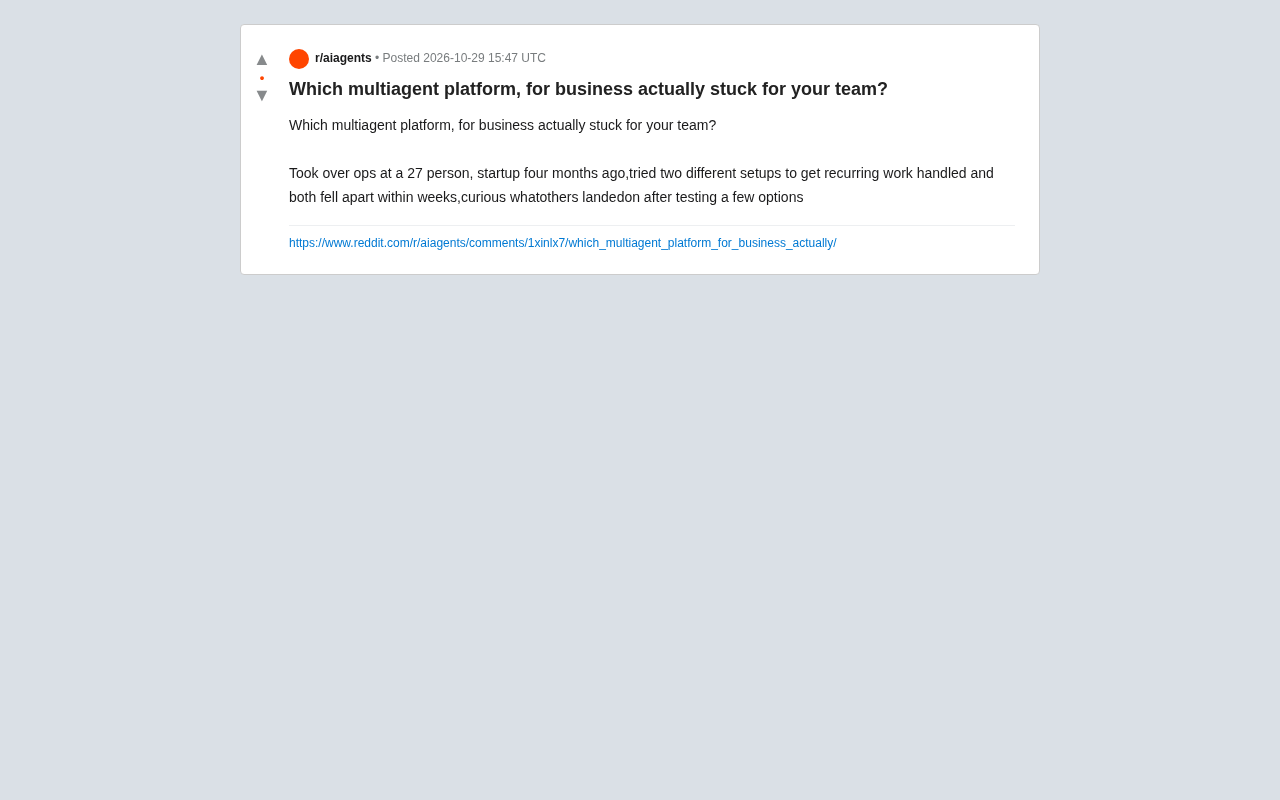
Which Multi-Agent Platform Wins? A Small Team's Battle Scars and Selection Considerations
A 27-person startup's ops lead tried two multi-agent platforms in four months and both failed. This article analyzes why small-team deployments break down, and offers selection guidance on integration depth, observability, and progressive rollout.

Thrive Holdings Takes ADT Private in $7.6 Billion Deal
Thrive Holdings acquires ADT for $7.6 billion in an all-cash take-private deal expected to close in Q1 2027. Analysis of the deal structure, ADT's asset value, and impact on the smart home security industry.