@ai-sdk/xai 5.0.31 Patch Update: A Routine Iteration of Underlying Dependencies
@ai-sdk/xai releases 5.0.31 patch, only upgrading the provider-utils dependency, with no API changes.
@ai-sdk/xai has released patch version 5.0.31. The only substantive change is upgrading the shared utility layer @ai-sdk/provider-utils to 5.0.69. This package is the official adapter for xAI (Grok models) in the Vercel AI SDK ecosystem. This update introduces no new APIs and does not change public behavior, making it a typical dependency synchronization release. For projects that use this package directly, upgrading usually requires no code changes, but multi-provider projects should pay attention to dependency tree consistency to avoid multiple versions of provider-utils causing behavioral differences.
Version Overview
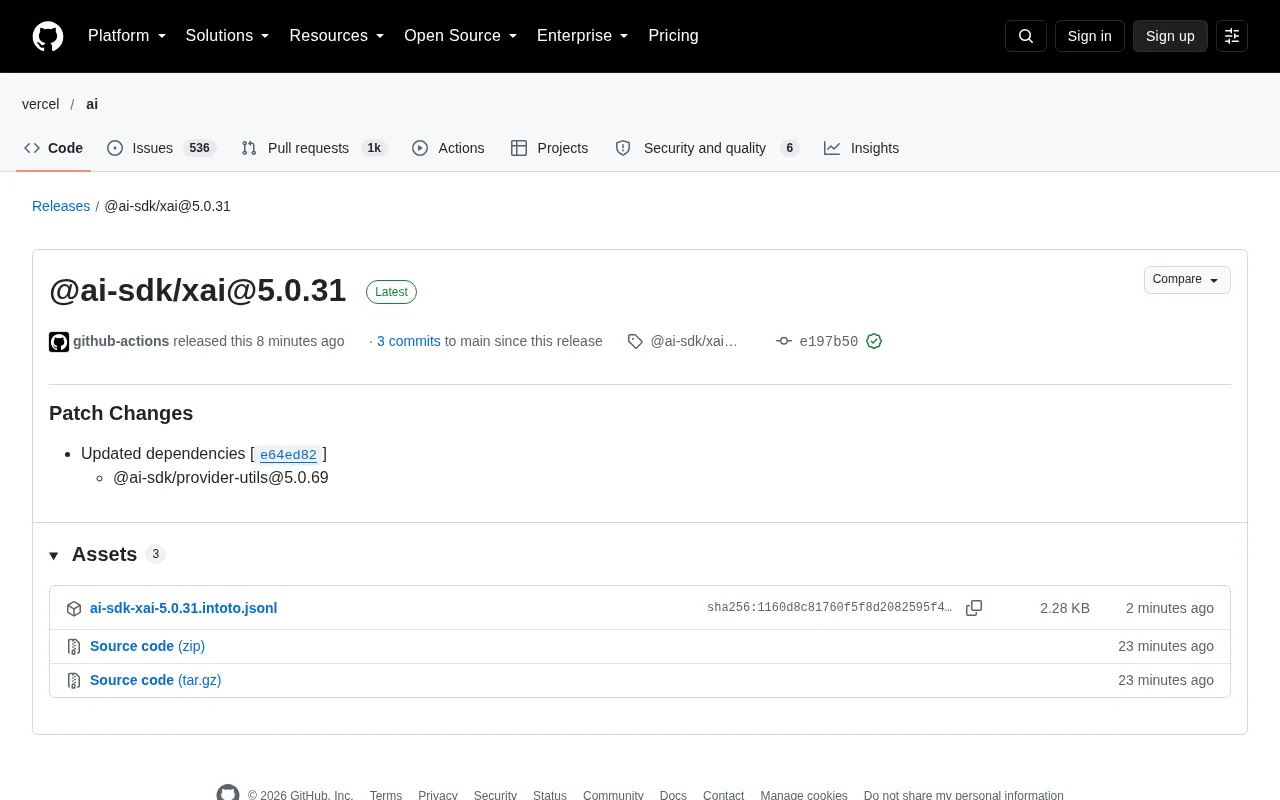
@ai-sdk/xai has released version 5.0.31. According to the GitHub release page, this update is a patch-level change (Patch Changes), and its core content is just one item: it updates the dependency on @ai-sdk/provider-utils to version 5.0.69.
For readers unfamiliar with this toolchain, @ai-sdk/xai is the official adapter package for xAI (Grok models) in Vercel's AI SDK ecosystem. Its job is to wrap xAI's model capabilities into a unified interface, allowing developers to switch between different model providers using the same calling pattern.
This kind of patch release is very common in open source projects. It does not introduce new APIs or change public behavior; the scope of change mainly lies in the dependency chain.
Vercel AI SDK is an open-source TypeScript toolkit for building AI applications, with the core package ai, which provides unified APIs such as generateText and streamText. Each model provider is integrated through an independent provider package, such as @ai-sdk/openai, @ai-sdk/anthropic, and @ai-sdk/xai, all of which implement the same provider interface, so developers only need to replace the model instance to switch backends. This design isolates vendor differences within the adapter layer, so upper-layer business code does not need to be aware of the specific model. @ai-sdk/provider-utils is the underlying utility library shared by these adapter packages, encapsulating common logic such as request construction, streaming parsing, and parameter validation.
What Actually Changed This Time
The Only Substantive Change Is the Dependency Upgrade
The Patch Changes in the release notes contain only one line: triggered by commit e64ed82, @ai-sdk/provider-utils was updated to 5.0.69. There are no new features, no breaking changes, and no deprecation warnings.
@ai-sdk/provider-utils is the utility layer shared by AI SDK provider packages, handling foundational work such as parameter validation, streaming response processing, and request construction. Provider packages from various vendors (xai, openai, anthropic, etc.) all depend on it, so once it receives a minor fix, downstream packages follow up with patch versions.
A lockfile is a snapshot file generated by the package manager when installing dependencies, recording the exact version, download address, and integrity hash of each dependency package. Common examples include npm's package-lock.json, Yarn's yarn.lock, and pnpm's pnpm-lock.yaml. When multiple packages depend on the same underlying utility package (such as provider-utils), the package manager tries to hoist or deduplicate them so they share the same installation; but if their version ranges do not overlap, multiple copies may appear, leading to "version drift" — different provider packages actually calling inconsistent versions of the utility layer. Ways to keep the dependency tree consistent include: upgrading all provider packages together, using the overrides/resolutions field to force a specific version, and verifying in CI that the lockfile is in sync with the manifest.
What the Version Cadence Means
Going from 5.0.30 to 5.0.31 is just a revision number increment, indicating that the maintainers judged this change to have minimal impact on users. For production environments, such updates can usually be upgraded directly, but it is still advisable to confirm the actually resolved dependency version at the lockfile level to avoid version drift with other provider packages.
Semantic Versioning (SemVer) divides version numbers into major, minor, and patch numbers, corresponding to breaking changes, backward-compatible feature additions, and backward-compatible bug fixes, respectively. A patch number increment (such as 5.0.30 → 5.0.31) means the maintainers believe this change does not alter the public API contract and carries low risk. However, SemVer is a convention rather than a mandatory specification, and the actual impact still needs to be judged in conjunction with the changelog. In a dependency chain, a patch number upgrade may also indirectly introduce subtle behavioral adjustments in the upstream utility layer, so the role of lockfiles (such as package-lock.json and pnpm-lock.yaml) is to pin the actually resolved version and ensure reproducible builds.
Practical Impact on Developers
If your project uses @ai-sdk/xai directly, upgrading to 5.0.31 generally does not require code changes. What is worth paying attention to is the consistency of the dependency tree: when a project introduces multiple AI SDK provider packages at the same time, try to make them share the same version of provider-utils, which can reduce potential duplicate installations and behavioral differences.
From an engineering perspective, the value of such patches is not in features, but in synchronizing fixes from the upstream utility layer to downstream. The robustness of the open source ecosystem often depends on this kind of high-frequency, small-step version progression rather than occasional major-version rewrites. The release is automatically completed by GitHub Actions and carries a verification signature, which also shows that the project has formed a pipeline in its release process.
For long-term maintained projects, such patches can be incorporated into the routine dependency update cadence rather than tracked manually one by one. What truly requires regression testing before upgrading are still those version notes that involve behavioral changes in provider-utils.
Key Takeaways: This is a purely dependency synchronization update and does not involve API changes; developers can treat it as a routine patch, with the focus on dependency consistency.
One-line Summary
@ai-sdk/xai releases 5.0.31 patch, only upgrading the provider-utils dependency, with no API changes.
Paragraph Summary
@ai-sdk/xai has released patch version 5.0.31. The only substantive change is upgrading the shared utility layer @ai-sdk/provider-utils to 5.0.69. This package is the official adapter for xAI (Grok models) in the Vercel AI SDK ecosystem. This update introduces no new APIs and does not change public behavior, making it a typical dependency synchronization release. For projects that use this package directly, upgrading usually requires no code changes, but multi-provider projects should pay attention to dependency tree consistency to avoid multiple versions of provider-utils causing behavioral differences. The article also notes that the release is automatically completed by GitHub Actions and carries a verification signature, reflecting that the project's release process has been pipelineized, and recommends incorporating such patches into the routine dependency update cadence.
Related articles

The Truth Behind Titanic's Sinking: Key Decisions and Communication Failures in the National Geographic Documentary
National Geographic's The Unsinkable Ship uses survivor testimony to reconstruct Titanic's fatal decisions—from the missing MSG telegram prefix and the broken boiler-room-to-bridge link to how 'unsinkable' thinking delayed damage control and evacuation.

74M-Parameter Open-Source Model Partially Outperforms Jev AI in Testing
Fastino AI's Glider 2.5 models, with just 74M–300M parameters, reportedly outperform Jev AI in some guardrail benchmarks per YouTube testing, run on consumer hardware, and even play Doom. We analyze small models' competitiveness and deployment value on specific tasks.

Gemini 4 Argon Hands-On: Aggressive Pricing, 3D Capabilities Need Coaching
Gemini 4 Argon hands-on: limited-time $2/$10 pricing, million-token output, strong 3D and reverse-engineering work, but weak front-end aesthetics and zero-shot ability need coaching.