@ai-sdk/xai 5.0.40 Patch Release: What the Dependency Chain Update Means

The AI SDK's xAI adapter releases patch 5.0.40, syncing only underlying dependencies and reflecting continued ecosystem maintenance.
This article explains the patch release of `@ai-sdk/xai@5.0.40` in the Vercel AI SDK ecosystem. The version adds no new APIs and has no breaking changes; its core is syncing updates to two underlying dependencies, `@ai-sdk/provider-utils@5.0.76` and `@ai-sdk/provider@4.0.37`. The article notes that this "follow-the-leader" release reflects the xAI adapter's continued alignment with the abstract foundation, helping ensure behavioral consistency when developers switch between OpenAI, Anthropic, and xAI. For production environments, it recommends pinning versions and regression-testing streaming output and tool-call paths in the test environment before merging. The article also emphasizes that in a rapidly changing model ecosystem, continuous maintenance of the adapter layer is itself an important reference indicator for evaluating multi-model integration solutions.
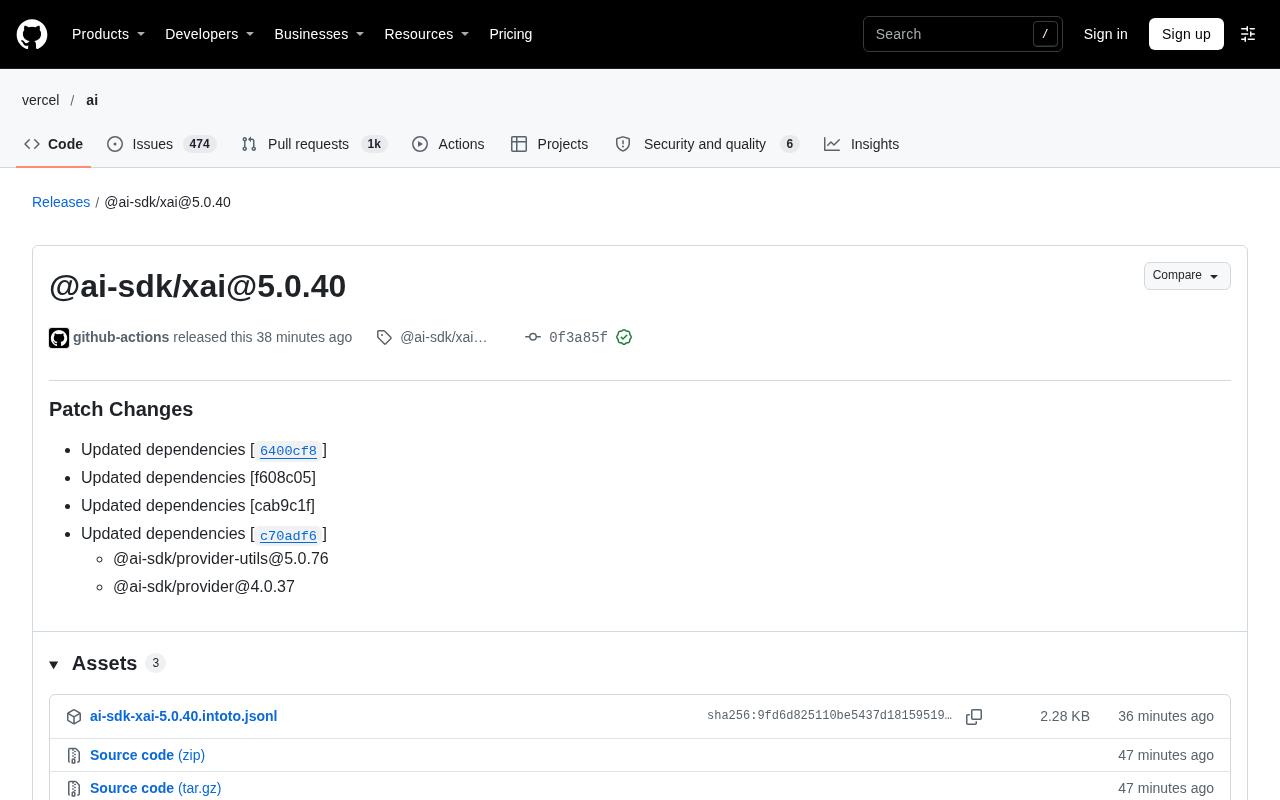
The AI SDK ecosystem under Vercel has another routine but noteworthy version iteration. @ai-sdk/xai@5.0.40 was released as a patch version. On the surface, it's just a dependency update, but for developers using this toolchain to integrate xAI (the Grok series models), this kind of version change is precisely a bellwether for judging ecosystem maturity.
What This Update Actually Changed
From the release notes, @ai-sdk/xai@5.0.40 falls under Patch Changes, and the core content is updating several underlying dependencies, involving two packages: @ai-sdk/provider-utils@5.0.76 and @ai-sdk/provider@4.0.37. There are no new APIs, no breaking changes, and no functional-level change descriptions.
In other words, this is a typical "follow-the-leader" release: the upstream provider abstraction layer changed, and the xAI adapter package aligned in sync. This release cadence is common in the AI SDK ecosystem, indicating that the xAI adapter follows the evolution of the core packages rather than going its own way.
Semantic Versioning (SemVer) is the prerequisite for understanding this kind of release. SemVer specifies the version number format as MAJOR.MINOR.PATCH: a major version change represents incompatible API-breaking changes, a minor version represents backward-compatible feature additions, and a patch number represents only backward-compatible bug fixes. Therefore, @ai-sdk/xai jumping from 5.0.x to 5.0.40 is a patch-level update and, by convention, should not introduce breaking changes.
It's worth noting that SemVer's compatibility promise only constrains the package's own public API, not its transitive dependencies. Although this update is labeled Patch Changes, it simultaneously upgraded @ai-sdk/provider-utils and @ai-sdk/provider. If the upstream packages themselves had minor version jumps, the actual behavior could still change. This is precisely why the article recommends regression testing the dependency chain.
The Architectural Signal Behind Dependency Alignment
@ai-sdk/provider is the abstract foundation of the entire AI SDK, defining capabilities such as model invocation, streaming responses, and tool calls; @ai-sdk/provider-utils carries a large number of shared utility functions. The xAI package depends on these two foundational packages, meaning its behavioral consistency is determined upstream.
For applications relying on xAI models, the value of this alignment lies in: when Vercel adjusts the interface semantics or error handling details of the provider layer, the xAI adapter can keep up as quickly as possible, reducing behavioral differences when switching across models. When developers use the same codebase to switch between OpenAI, Anthropic, and xAI, underlying consistency is what they care about most.
The provider abstraction layer is the core design pattern adopted by the AI SDK. It abstracts "calling a certain model" into a unified interface—text generation, streaming responses, tool calls, structured output, etc.—which is then implemented by vendor adapter packages (such as @ai-sdk/openai, @ai-sdk/anthropic, @ai-sdk/xai). Application code is programmed only against the abstraction layer; switching models requires only replacing the provider instance and model ID.
The cost of this layering is a longer dependency chain: the behavior of adapter packages is defined by the abstraction layer, and adjustments to the abstraction layer's interface semantics or error formats propagate downward. @ai-sdk/provider-utils centralizes shared logic such as streaming parsing, SSE handling, and message format conversion. Each adapter package reuses the same implementation, thereby ensuring consistent behavior across models. Understanding this makes it clear why patch releases of adapter packages tend to merely "follow" upstream rather than evolve independently.
Should You Chase Patch Versions?
The patch number being at the .40 level shows that @ai-sdk/xai iterates quite frequently. For production environments, it's advisable to check whether the changelog involves excessively large dependency version jumps—if provider-utils has jumped across many minor versions, regression testing of streaming output and tool-call paths may be needed.
The conventional approach is: pin versions in the lockfile, periodically pull patch updates in the test environment and run integration test cases, and merge into the main branch only after confirming no anomalies. For most applications, the risk of pure dependency-update patches is low, but there's no need to blindly chase the latest.
Lockfiles and version range symbols together determine the dependency resolution result. package-lock.json, pnpm-lock.yaml, and yarn.lock record the exact installed versions, ensuring reproducibility across teams and CI environments; while ^5.0.40 in package.json allows pulling the latest patch and minor versions within 5.x, ~5.0.40 allows only patch-level updates.
If a project uses the ^ range and does not commit a lockfile, running an install will automatically pull the latest patch, effectively accepting updates passively; if exact versions are pinned, explicit upgrades are required. The article's "pin versions + periodic verification in the test environment" is actually about using lockfiles to control production determinism, then evaluating dependency chain changes through a separate upgrade process, balancing stability and maintainability.
The Practical Impact on xAI Integrators
If you use Grok models through the AI SDK, this update itself won't bring new capabilities. But the signal it sends is: AI SDK's support for xAI is still actively maintained, and the adapter layer has not fallen into disrepair. In a rapidly reshuffling model ecosystem, "stable maintenance" is itself a product value.
For teams evaluating multi-model strategies, this kind of patch release can serve as an observation indicator—an adapter that keeps up continuously means you won't fall behind when subsequently integrating new models and capabilities.
FAQ
Will patch updates affect existing code? Usually not. Patch Changes, per semantic versioning conventions, contain no breaking changes, but dependency chain updates still warrant verification in the test environment.
Do I need to upgrade manually? It depends on your dependency strategy. Using the ^ range pulls automatically; pinned versions require manual updates.
What's the difference between this package and calling the xAI API directly? The AI SDK provides a unified abstraction layer, facilitating multi-model switching and streaming handling, at the cost of an extra dependency layer.
Summary
@ai-sdk/xai@5.0.40 is a low-key maintenance release with no dramatic changes, but it reflects the AI SDK ecosystem's continued investment in xAI support. For developers, understanding the meaning of such releases is more important than chasing every version number.
Related articles
 Tech Frontiers
MuJoCo: An Analysis of DeepMind's Open-Source General-Purpose Physics Simulator
An in-depth analysis of Google DeepMind's open-source physics simulator MuJoCo: high-performance C++ kernel, MJCF modeling format, contact solving principles, MJX GPU acceleration, and robot reinforcement learning use cases.
 Tech Frontiers
Claude API Quick Start: The Official Quickstarts Project Collection
Anthropic's official claude-quickstarts project collection helps developers quickly build deployable apps with the Claude API. Nearly 20k stars, Python-based, great for beginners and prototyping.
 Tech Frontiers
AI Agents Connecting Directly to APIs: Which Calls Can Be Safely Allowed?
AI agents can call any API, but the real challenge is deciding which calls can be safely allowed. This article analyzes allowance decisions from three dimensions—intent matching, least privilege, and controllable impact—and argues that the control layer should sit outside the agent, combined with audit traceability to build a trustworthy API call governance mechanism.