@ai-sdk/zai 2.0.21 Patch Released: Dependency Updates and Ecosystem Synergy
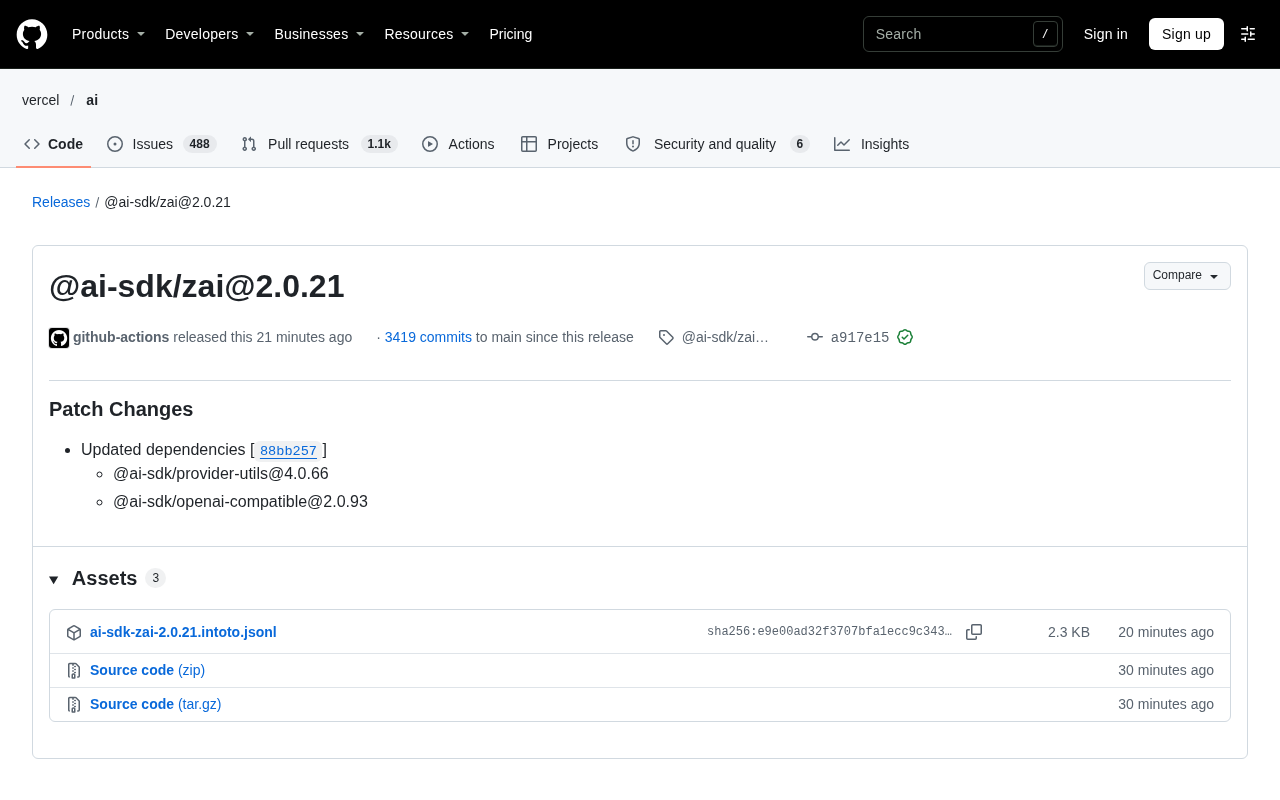
@ai-sdk/zai releases 2.0.21 patch, only syncing underlying dependencies, no breaking changes.
@ai-sdk/zai has released patch 2.0.21, a routine dependency sync release with no new features or breaking changes. The core change upgrades @ai-sdk/provider-utils to 4.0.66 and @ai-sdk/openai-compatible to 2.0.93. The article highlights that such monorepo chain updates reflect the high-frequency iteration of the AI SDK ecosystem and the continued convergence of the OpenAI-compatible layer. Developers with pinned versions can upgrade smoothly, and unifying dependency versions in multi-provider projects helps reduce peer dependency conflicts. After upgrading, validate model invocation flows in a test environment and watch for potential provider-utils adjustments in error handling and request construction. The release was automatically triggered by GitHub Actions with a verified signature, ensuring supply chain traceability.
Vercel's AI SDK ecosystem has received a small but noteworthy patch update. @ai-sdk/zai has released version 2.0.21. Judging from the versioning convention and the changes, this is a routine dependency sync release that introduces no breaking changes or new features.
Patch Content: A Chain Reaction of Dependency Updates
According to the GitHub release page, version 2.0.21 is a Patch Changes release. The core action was updating two dependency packages: @ai-sdk/provider-utils to 4.0.66 and @ai-sdk/openai-compatible to 2.0.93. These two packages handle the foundational utility functions at the provider layer and the adaptation of the OpenAI-compatible interface, respectively. Their synchronized updates often signal that the underlying abstraction layer is continuously being refined.
Such releases are not uncommon in monorepos. Because the AI SDK packages are highly coupled, a minor fix or adjustment in provider-utils propagates through the dependency graph to all packages that depend on it. @ai-sdk/zai, as the integration adapter for the Z.ai model, naturally needs to follow the underlying update to ensure compatibility and behavioral consistency.
Semantic Versioning (SemVer): A three-part version number like 2.0.21 follows the SemVer specification, with the format major.minor.patch. A major version change indicates breaking API changes, a minor version increase indicates backward-compatible new features, and a patch number increment contains only backward-compatible bug fixes and internal optimizations. Therefore, from the patch position of 2.0.21, we can infer that this release does not change the public API and carries low upgrade risk. In the npm ecosystem, when using range declarations like ^2.0.21, the package manager will only automatically upgrade the patch and minor positions, never crossing the major version. This is precisely why SemVer is widely adopted—it allows dependency resolution to be automated without breaking existing code.
Monorepo Dependency Propagation: The AI SDK is managed as a monorepo, where all packages share the same repository and release pipeline, and reference each other through the workspace protocol. When the underlying @ai-sdk/provider-utils releases a new patch, every upper-level package that depends on it needs to synchronously upgrade its dependency declaration and republish; otherwise, users may resolve to inconsistent version combinations during installation. This "chain update" is a typical cost of monorepos, in exchange for the ability to commit cross-package changes atomically and test them uniformly.
Why Dependency Updates Are Worth Noticing
For developers who directly use @ai-sdk/zai, such patches usually require no immediate action and bring no obvious API changes after upgrading. But from an engineering perspective, it sends two signals.
First, the maintenance cadence of the AI SDK remains high-frequency. The release record shows this commit is 3419 commits ahead of the mainline, indicating that the community and core team iterate quickly and dependency packages keep rolling forward. Second, the OpenAI-compatible layer is still converging. As the unified entry point for many third-party model integrations, @ai-sdk/openai-compatible can, with each minor version update, affect multiple integration packages similar to Z.ai; one sync means these packages remain aligned in underlying behavior.
OpenAI-Compatible Interface: @ai-sdk/openai-compatible is a general-purpose adaptation layer that implements client logic according to the OpenAI Chat Completions API request/response format (such as the messages array, choices, finish_reason, streaming SSE chunks, etc.). Many third-party model providers (including Z.ai) choose to expose endpoints consistent with OpenAI, thereby reusing existing SDKs and toolchains. This package consolidates the shared serialization, streaming parsing, and error mapping logic into one place, so each provider package only needs to supply the baseURL, authentication method, and a small amount of差异化 configuration to integrate. Therefore, each patch update of this package simultaneously affects all integration packages built on it—which is why a minor version sync is worth noticing.
Practical Impact on Developers
If you have pinned the version of @ai-sdk/zai in your project, 2.0.21 can be adopted as a smooth upgrade. This is especially true when your project uses multiple AI SDK provider packages simultaneously; unifying dependency versions reduces the risk of peer dependency conflicts.
What to watch for after upgrading is whether there are subtle adjustments in provider-utils behavior. Although patch versions typically only fix bugs or make internal optimizations, changes at the utility function level can sometimes indirectly affect error handling, request construction, or response parsing. It is recommended to first validate a round of model invocation flows in a test environment before pushing to production.
Peer Dependency Conflicts: A peer dependency means that a package requires the host project to provide a specified version of another package, commonly seen in plugin-style ecosystems. When a project installs multiple AI SDK provider packages simultaneously, they often share the same copy of @ai-sdk/provider-utils. If the peer ranges declared by each provider do not overlap, npm 7+ will report an ERESOLVE error, while pnpm may install multiple copies, leading to type mismatches or inconsistent runtime instances. Unifying upgrades to the latest patch version can realign the dependency ranges of all providers, reducing the probability of such conflicts. After upgrading, focus on validating streaming response parsing and error object structures in the test environment, as adjustments at the utility function layer are most likely to surface in these two areas.
Release Background
This release was automatically triggered by GitHub Actions, and the commit carries GitHub's verified signature with GPG key ID B5690EEEBB952194. From a process perspective, this is a standardized automated release pipeline, and the release page also provides three downloadable assets. For teams concerned about supply chain security, the verifiably signed commit records provide a certain degree of trust assurance.
Overall, @ai-sdk/zai 2.0.21 is a quiet maintenance release. It does not change the rules of the game, but it reflects the AI SDK ecosystem's ongoing work to solidify its infrastructure.
One-line Summary
@ai-sdk/zai releases the 2.0.21 patch, merely syncing underlying dependencies with no breaking changes.
Paragraph Summary
@ai-sdk/zai has released patch version 2.0.21, a routine dependency sync release that introduces no new features or breaking changes. The core change is upgrading @ai-sdk/provider-utils to 4.0.66 and @ai-sdk/openai-compatible to 2.0.93. The article notes that such monorepo chain updates reflect two signals: the high-frequency iteration of the AI SDK ecosystem and the continued convergence of the OpenAI-compatible layer. For developers, projects with pinned versions can upgrade smoothly, and unifying dependency versions in multi-provider projects helps reduce peer dependency conflicts; however, after upgrading, model invocation flows should be validated in a test environment, paying attention to potential subtle adjustments in provider-utils regarding error handling and request construction. The release was automatically triggered by GitHub Actions and comes with a verified signature, making the supply chain traceable.
Related articles

Microsoft WebIQ: Verifiable Real-Time Web Grounding for AI Agents
Microsoft WebIQ gives AI Agents real-time, citable web grounding across web, news, images, videos, and Places—164ms P95 latency, 50% fewer tokens, Scopes source control, and MCP integration.

Augmentable Gaussian Splatting: Building Photorealistic Simulation Environments for Robot Training
Team combines Gaussian Splatting with meshes to build photorealistic robot simulation environments, integrating MuJoCo Warp physics and Franka Panda for augmentable, relightable real-site simulation.

Gemini 4 Carbon Released: The Leap from Gemini 3 to Gemini 4 in Under a Year
Google releases Gemini 4 Carbon, less than a year after Gemini 3. In the official demo, Carbon reverse-engineered the Theme Park binary, added a new DeepMind-themed ride, and ported it to the web in one shot.