@ai-sdk/zai@2.0.6 Released: A Look at Vercel AI SDK Dependency Updates

Vercel AI SDK releases @ai-sdk/zai@2.0.6 patch update to sync upstream dependencies and maintain stability.
@ai-sdk/zai@2.0.6 is a patch-level maintenance update for the Vercel AI SDK's Z.ai model adapter, syncing `@ai-sdk/provider-utils@4.0.54` and `@ai-sdk/openai-compatible@2.0.78`. Following SemVer, it introduces no API changes and is fully backward-compatible. The release was auto-published via GitHub Actions and GPG-signed for authenticity. Thanks to the SDK's modular provider architecture, each adapter can iterate independently — keeping maintenance overhead low for developers.
The official Vercel AI SDK repository recently released version @ai-sdk/zai@2.0.6. This is a patch-level update focused primarily on syncing upstream dependencies. While maintenance updates like this don't introduce new features, they directly affect the stability and compatibility of the underlying foundation — which matters for any developer building applications on top of the Vercel AI SDK.
What's Changed in This Release
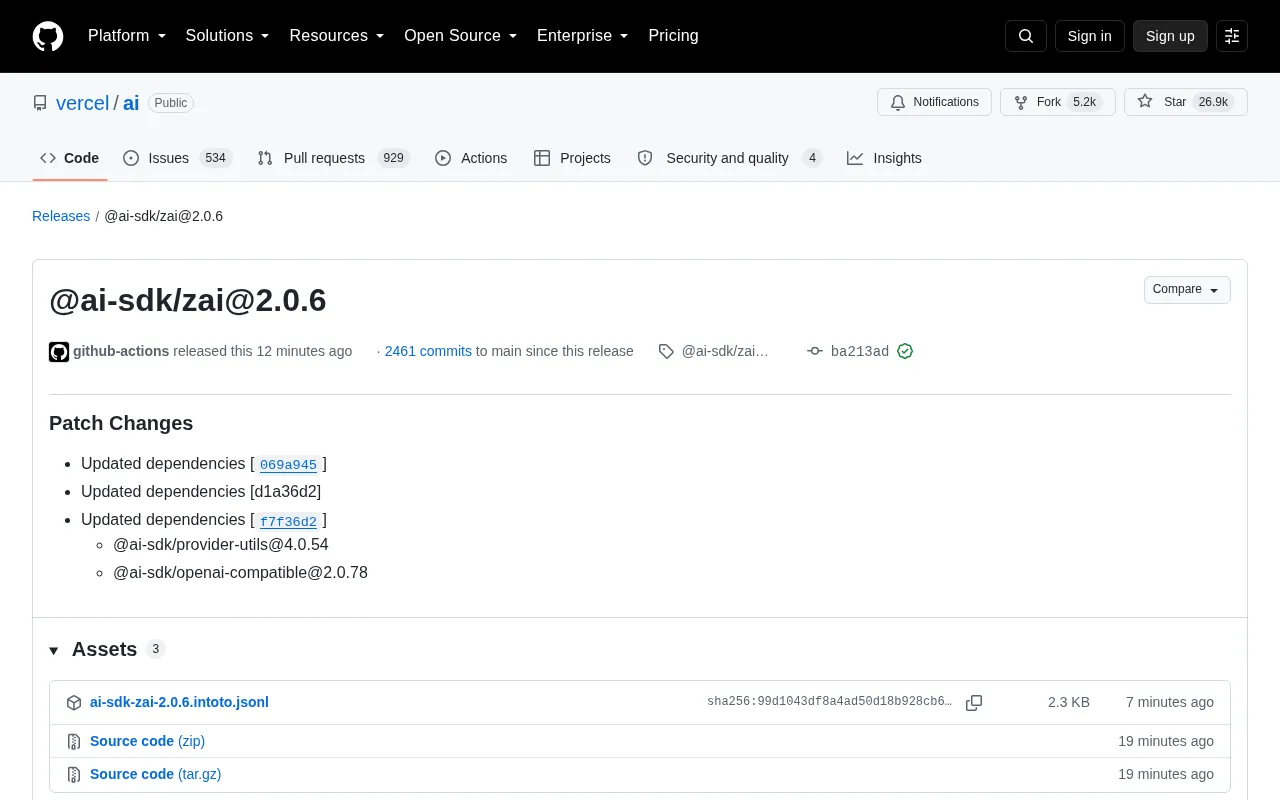
According to the GitHub Release page, @ai-sdk/zai@2.0.6 falls under Patch Changes, with the core update being the synchronization of several upstream package versions. The specific dependency updates include:
@ai-sdk/provider-utils@4.0.54@ai-sdk/openai-compatible@2.0.78
This version was published automatically via GitHub Actions with commit hash ba213ad, and verified through GitHub's trusted signing (GPG key ID: B5690EEEBB952194), ensuring the integrity and authenticity of the release artifact.
What Does a Patch Update Actually Mean?
Following Semantic Versioning (SemVer), the increment in the final digit of 2.0.6 indicates a backward-compatible, non-breaking release. It introduces no API changes and no breaking modifications. The value of updates like this lies in keeping the higher-level zai provider aligned with iterating foundational packages like provider-utils and openai-compatible — avoiding potential issues caused by version mismatches.
For use cases that rely on OpenAI-compatible interfaces, the upgrade to @ai-sdk/openai-compatible is particularly significant. It serves as the bridge for many third-party models to integrate with the Vercel AI SDK, and keeping this dependency in sync helps maintain consistency across the model invocation chain.
About Semantic Versioning (SemVer): SemVer is the industry-standard convention for software version naming, formatted as
MAJOR.MINOR.PATCH. A MAJOR increment signals incompatible API changes; MINOR indicates new backward-compatible functionality; PATCH covers only backward-compatible bug fixes or maintenance changes. This convention lets developers immediately gauge the risk level of any upgrade — Patch updates are theoretically safe to apply, while Major updates require a migration cost assessment. Vercel AI SDK strictly follows SemVer, meaning its frequent small releases don't impose extra maintenance burden on downstream projects.
The Vercel AI SDK Ecosystem
Vercel AI SDK is one of the go-to tools for frontend and full-stack developers building AI-powered applications today. Its GitHub repository has garnered over 26.9k stars and 5.2k forks, reflecting a highly active community. The entire SDK is designed with a modular architecture, splitting different model providers into independent packages. @ai-sdk/zai is specifically the adapter layer for Z.ai (Zhipu AI / GLM series) models.
The advantages of this modular design are clear: each provider can iterate and release independently, and developers only need to pull in the packages they actually use — without bearing the cost of upgrading the entire SDK. The high frequency of Patch releases (the repository has already seen 2,460+ commits to the main branch) also reflects the team's rapid maintenance cadence.
About Z.ai (Zhipu AI): Z.ai is a leading large model service provider in China. Its GLM series models (such as GLM-4, GLM-4V, etc.) offer an API format that is highly compatible with OpenAI's interface.
@ai-sdk/zai, as the corresponding provider adapter layer in the Vercel AI SDK, is responsible for translating the SDK's unified call interface into Z.ai's specific request format while handling response parsing and streaming output. This "adapter layer" design means developers don't need to worry about interface differences between model providers — switching between models is as simple as swapping the provider package, dramatically reducing the complexity of building multi-model applications.
How Should Developers Respond?
For production projects, it's recommended to track these dependency updates within your CI/CD pipeline. While Patch versions are generally safe, it's still worth following these practices:
- Validate model calls in a test environment after upgrading
- Keep an eye on the changelogs for
provider-utilsandopenai-compatibleto understand what's changing under the hood - Use a lockfile to manage versions and avoid uncertainty introduced by automatic upgrades
Overall, @ai-sdk/zai@2.0.6 is a textbook dependency maintenance update — one that reflects Vercel AI SDK's commitment to stability amid rapid evolution. Developers can upgrade with confidence. It also serves as a reminder that in today's fast-moving AI toolchain landscape, keeping dependencies in sync is an essential part of engineering health.
Related articles

Data Scraping, AI Proofs, and Open Source Contracts: This Week's Deep Dive into the Tech World
From the 3D model crawler controversy and OpenAI's Lean formal proofs to AI agents challenging Brooks' Law and Debian rejecting LLM review, this week's tech discussions center on openness and verifiability.

Build a Reasoning Model from Scratch: An 11-Hour Open-Source Course Breakdown
Sebastian Raschka releases a free 8-episode, ~11-hour video course teaching you to build a reasoning model from scratch with Python and PyTorch—from a small Qwen3 model through Verifier, Inference Time Scaling, GRPO, and distillation, with open-source code on GitHub.

An 11-Hour Reasoning Model Course in Practice: How Small Models Learn to Think
Starting from Sebastian Raschka's 11-hour reasoning model course and HN buzz, this analyzes small-model training, legal text version control, Anthropic data policy, and product reliability reviews.