@ai-sdk/zai 3.0.49 Patch Update: Dependency Chain Upgraded in Sync
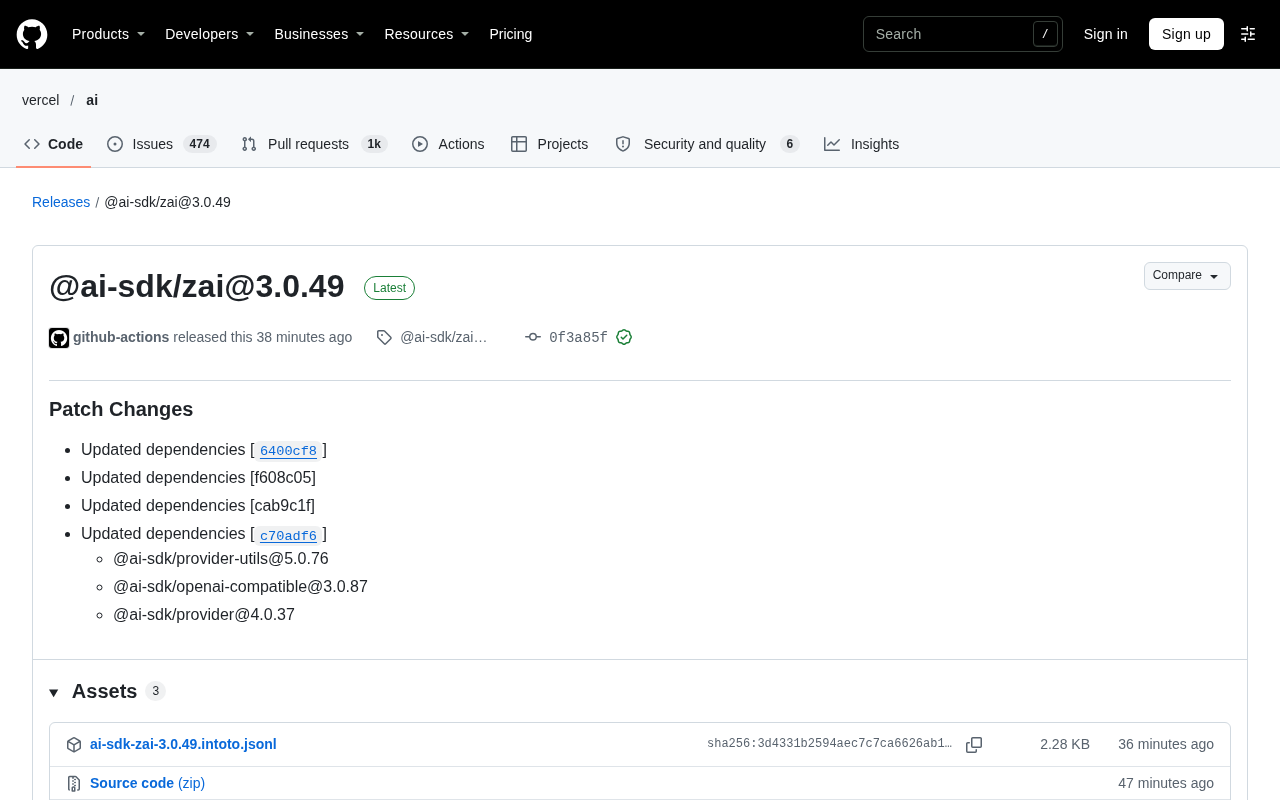
@ai-sdk/zai releases patch 3.0.49, only syncing three underlying provider dependencies, reminding to align the entire chain.
`@ai-sdk/zai` released 3.0.49, officially classified as a patch update with no new features or breaking changes. The core action is upgrading `@ai-sdk/provider-utils`, `@ai-sdk/openai-compatible`, and `@ai-sdk/provider` to 5.0.76, 3.0.87, and 4.0.37 respectively. The article explains the roles of these three in the Vercel AI SDK's layered architecture: provider defines the unified interface, provider-utils provides shared utilities, and openai-compatible handles protocol adaptation. Z.ai's adapter package is built on top of them, so it must follow versions to stay consistent. The article also notes that patch number changes are not trivial—utility function adjustments may affect streaming parsing and error structures. When upgrading, align the entire chain to avoid version mismatches between the adapter package and the provider layer. This version was automatically released by GitHub Actions with a verified signature, representing a routine maintenance release.
What Changed in This Update
@ai-sdk/zai has released version 3.0.49, which the maintainers classify as a patch change. According to the release notes, this version introduces no new features or breaking changes—the core action is synchronizing a set of underlying dependencies: @ai-sdk/provider-utils bumped to 5.0.76, @ai-sdk/openai-compatible bumped to 3.0.87, and @ai-sdk/provider bumped to 4.0.37.
For developers using the Vercel AI SDK ecosystem to access Z.ai models, this type of update typically means compatibility maintenance: fixes made at the upstream provider layer propagate down through this adapter package, while the adapter package itself requires no changes to business code.
What the Dependency Version Changes Mean
The Provider Layer Is the Foundation of the Entire Chain
@ai-sdk/provider defines the unified interface contract for model invocation, @ai-sdk/provider-utils provides shared utility functions for all providers, and @ai-sdk/openai-compatible is responsible for connecting services that follow the OpenAI-compatible protocol into a unified abstraction. Z.ai's adapter package is built on top of these three, so whenever any of them releases a new version, the adapter package needs to follow suit to ensure consistent behavior.
Vercel AI SDK adopts a layered provider architecture: @ai-sdk/provider is the lowest-level specification package, containing only type declarations and interface contracts with no dependency on any specific service; @ai-sdk/provider-utils provides common capabilities that all provider implementations reuse, such as incremental parsing of streaming responses (SSE framing), request retries, error wrapping, and JSON schema validation; above that sits the protocol adaptation layer like @ai-sdk/openai-compatible, which converges any service following the OpenAI /chat/completions shape into a unified invocation method. Only at the top layer do vendor-specific packages like @ai-sdk/zai sit. The benefit of this layering is that low-level fixes benefit all providers at once, at the cost of version compatibility requirements—upper-layer packages declare the version ranges of the lower-layer dependencies they rely on in dependencies, and following versions is precisely to keep the entire chain on the same verified combination.
Why Patch Versions Are Worth Paying Attention To
Patch number changes may seem trivial, but in the provider ecosystem, subtle behavior adjustments in utility functions or tightening of interface contracts can affect low-level details like streaming response parsing and error object structure. If developers encounter type errors or response format differences after upgrading, these dependency version combinations are exactly what to check first.
Under semantic versioning (SemVer) conventions, the patch number (third digit) should only contain backward-compatible bug fixes, but patch upgrades of cross-package dependencies can still introduce observable behavior differences. Common scenarios include: streaming parsing becoming stricter about chunk boundaries, causing some non-standard responses to be truncated or error out; error objects gaining or adjusting fields, affecting code that branches on error.type or error.cause; and adjustments to the incremental assembly logic for tool call arguments. Additionally, in the AI SDK ecosystem there is implicit coupling between provider packages and the core ai package—if only the provider side is upgraded while the ai package version is too old, type mismatches may occur. Therefore, when troubleshooting upgrade issues, it's recommended to verify the version matrix of ai, @ai-sdk/provider*, and the specific vendor package together.
Upgrade Recommendations
If your project pins the version of @ai-sdk/zai directly, it's recommended to upgrade it together with the @ai-sdk/provider family of dependencies to avoid version mismatches between the adapter package and the provider layer. If you use pnpm or npm's default resolution strategy, simply reinstalling dependencies will align the entire chain to the version combination declared in this release.
This release was completed automatically by GitHub Actions, and the commit carries a GitHub-verified signature, which is a routine automated release process. The release page itself includes no migration notes or behavior change descriptions, indicating that the maintainers regard it as a maintenance update requiring no additional explanation.
One-line Summary
@ai-sdk/zai releases 3.0.49 patch, only syncing three underlying provider dependencies, reminding to align the entire chain.
Paragraph Summary
@ai-sdk/zai released 3.0.49, officially classified as a patch update with no new features or breaking changes. The core action is upgrading @ai-sdk/provider-utils, @ai-sdk/openai-compatible, and @ai-sdk/provider to 5.0.76, 3.0.87, and 4.0.37 respectively. The article explains the roles of these three in the Vercel AI SDK's layered architecture: provider defines the unified interface, provider-utils provides shared utilities, and openai-compatible handles protocol adaptation. Z.ai's adapter package is built on top of them, so it must follow versions to stay consistent. The article also notes that patch number changes are not trivial—utility function adjustments may affect streaming parsing and error structures. When upgrading, align the entire chain to avoid version mismatches between the adapter package and the provider layer. This version was automatically released by GitHub Actions with a verified signature, representing a routine maintenance release.
Related articles
 Tech Frontiers
MuJoCo: An Analysis of DeepMind's Open-Source General-Purpose Physics Simulator
An in-depth analysis of Google DeepMind's open-source physics simulator MuJoCo: high-performance C++ kernel, MJCF modeling format, contact solving principles, MJX GPU acceleration, and robot reinforcement learning use cases.
 Tech Frontiers
Claude API Quick Start: The Official Quickstarts Project Collection
Anthropic's official claude-quickstarts project collection helps developers quickly build deployable apps with the Claude API. Nearly 20k stars, Python-based, great for beginners and prototyping.
 Tech Frontiers
AI Agents Connecting Directly to APIs: Which Calls Can Be Safely Allowed?
AI agents can call any API, but the real challenge is deciding which calls can be safely allowed. This article analyzes allowance decisions from three dimensions—intent matching, least privilege, and controllable impact—and argues that the control layer should sit outside the agent, combined with audit traceability to build a trustworthy API call governance mechanism.