AI Vulnerability Hunting Tutorial: How Beginners Can Find Their First SRC Vulnerability with AI + Automation

How AI and Agent intelligent agents lower the barrier for beginners hunting SRC vulnerabilities and improve efficiency.
The article compares traditional vulnerability discovery with AI-assisted bug hunting. Traditional bug hunting relies on manual information gathering, testing, verification, and reporting, with a high experience threshold and low efficiency. AI lets beginners use large models to sort out website architecture, analyze login page risks, explain code logic, filter scanner false positives, and draft reports. Agent intelligent agents are the key change: they can read files, execute commands, call security tools, and autonomously advance analysis, upgrading AI from a Q&A assistant to a workflow participant. The core value of AI bug hunting lies in lowering the learning threshold and improving efficiency, but humans still handle final decisions and result verification—AI does not fully replace manual work.
Title
AI Vulnerability Hunting Tutorial: How Beginners Can Find Their First SRC Vulnerability with AI + Automation
Meta Description
AI vulnerability hunting tutorial: comparing the traditional vulnerability discovery workflow, detailing AI's role in information gathering, code analysis, false-positive filtering, and report generation, and how Agent intelligent agents deeply participate in bug hunting—helping beginners lower the barrier and boost efficiency to find their first SRC vulnerability.
Article Content
Traditional vulnerability discovery is not beginner-friendly: information gathering, manual testing, vulnerability verification, and report writing—each step depends on accumulated experience. The addition of AI is changing this situation. Based on the tutorial content of a Bilibili UP host, this article sorts out the core differences between AI-driven and traditional bug hunting, and explains how Agent intelligent agents let AI truly participate in the vulnerability discovery workflow, helping beginners complete their first SRC vulnerability hunt with a lower barrier and higher efficiency.
The Workflow and Pain Points of Traditional Vulnerability Discovery
After getting a brand-new target, the first step is usually information gathering: figuring out the website's functional structure, underlying technology, and data interfaces. Next, based on the collected information, you judge which locations may have security issues—features such as user login, file upload, and interface parameter passing all need to be tested manually one by one. After discovering anomalies, you must continue to manually verify whether the vulnerability truly exists and how much risk impact it can cause, and finally organize the testing process and write a vulnerability report.
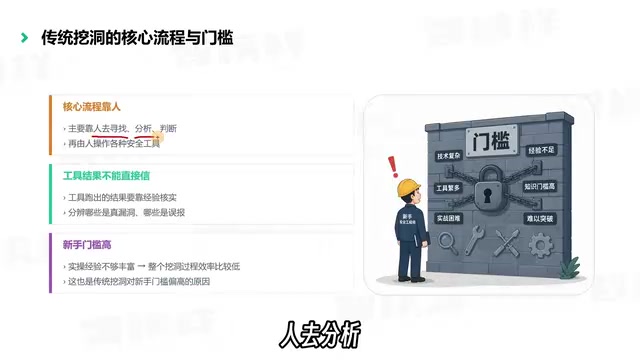
The core workflow of traditional bug hunting relies on people to find, people to analyze, people to judge, and then people to operate various security tools. Even the results produced by tools cannot be directly treated as final conclusions; experience is needed to verify which are real vulnerabilities and which are false positives. When early-stage hands-on experience is insufficient, the entire bug-hunting process is indeed inefficient—this is also why traditional vulnerability discovery has a high barrier for beginners.
SRC (Security Response Center) is a vulnerability intake and response platform set up by enterprises or organizations; white hats obtain rewards and reputation by submitting vulnerability reports. The core difference between SRC hunting and penetration testing is: SRC usually targets real production environments, must be tested within the authorized scope, and emphasizes the real harm and reproducibility of vulnerabilities. For beginners, the first SRC vulnerability is often the hardest threshold to cross—you must overcome the confusion of "not knowing where to start" while ensuring report quality meets platform review standards. Common entry-level directions include information disclosure, unauthorized access, XSS, SSRF, and other medium-to-low-risk vulnerabilities; these depend less on tools and have clear verification paths, making them suitable practice targets. Understanding SRC's rule boundaries (e.g., prohibiting high-frequency requests from scanners and prohibiting touching user data) is also a prerequisite beginners must master in advance.
What Changes in the Bug-Hunting Workflow After AI Joins
Facing a brand-new website, you previously had to collect information bit by bit yourself; now you can first have AI sort out the website's technical architecture, core functions, and main access entry points to quickly understand the target. When you see a login page, you can first have AI analyze possible security risks and provide testing ideas, then verify along that direction. When you encounter code you don't understand, you can have AI explain the execution logic while analyzing potential hidden security issues.
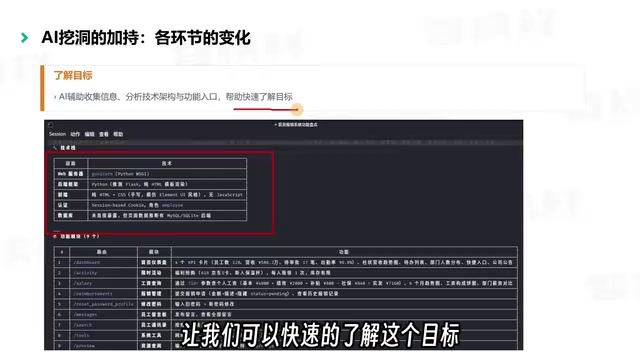
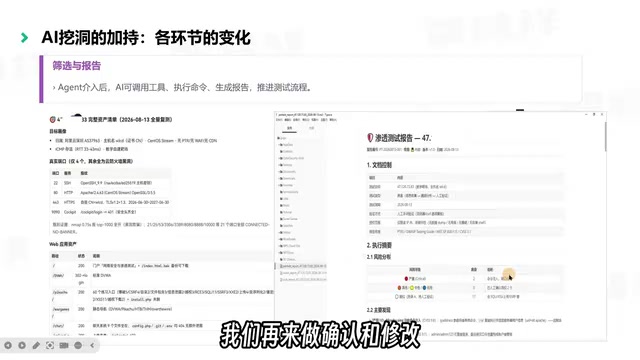
When various scanning tools produce a large amount of cluttered results, you don't have to read them from beginning to end; you can have AI filter out key priorities and filter false positives, so people only need to deeply test truly valuable issues. At the stage of writing vulnerability reports, you can also have AI generate a first draft based on test records, then confirm and revise it.
False Positive refers to a situation where a scanning tool reports a vulnerability but actual verification does not hold. Traditional scanners are based on rule matching and feature signatures and are prone to misjudging similar code patterns or specific response features, causing the result list to be mixed with a large number of invalid alerts, and manual verification one by one is extremely time-consuming. The idea of having AI participate in false-positive filtering is: submit the request, response, and context code corresponding to the alert to the model, and let it judge whether that feature constitutes a truly exploitable vulnerability and provide the basis for its judgment. The advantage of this approach is that the model can combine semantic understanding rather than pure pattern matching, but there is also the possibility of "AI misjudgment," so manual sampling review is still needed in the end. In practice, a layered strategy of "AI initial screening + manual confirmation" is usually adopted to balance efficiency and accuracy.
Agent Intelligent Agents: Letting AI Truly Participate in Bug Hunting
A very key change here is the emergence of Agent intelligent agents. It makes AI no longer just chat with people or answer questions, but directly participate in actual vulnerability discovery work: reading project files, analyzing code logic, and even executing commands or calling various security tools, then continuing to analyze the next step based on the running results.
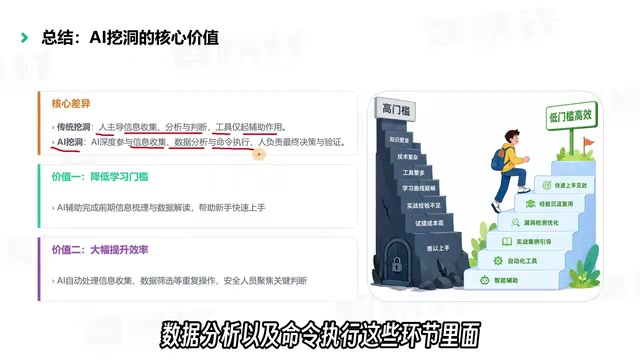
Traditional bug hunting relies more on people to find, analyze, and judge, with tools only assisting; AI bug hunting lets AI deeply participate in information collection, data analysis, command execution, and other links, while people are mainly responsible for final decision-making and result verification.
Agent differs essentially from ordinary conversational AI in its "tool calling" and "autonomous loop" capabilities. Ordinary large models can only generate text based on existing context, while Agents can call external tools—such as file reading, Shell commands, HTTP requests, and vulnerability scanners—through mechanisms such as Function Calling or MCP (Model Context Protocol), and decide the next action based on the results returned by the tools, forming a closed loop of "think—act—observe—think again." In vulnerability discovery scenarios, this means the Agent can autonomously complete a continuous process of "read source code → locate suspicious functions → construct test requests → analyze responses → determine whether a vulnerability exists." Common implementations include general Agent frameworks based on the ReAct paradigm and automated penetration tools specifically oriented to security scenarios. It should be noted that the autonomy of Agents also brings risks: they must run in isolated environments or within explicitly authorized scopes to avoid accidental operations on production systems.
The Core Value and Boundaries of AI Bug Hunting
AI brings core value mainly in two aspects. First, it lowers the learning threshold for beginners—much of the content they previously could not understand or do can first be sorted out and interpreted with AI's help. Second, it greatly improves bug-hunting efficiency—by handing a large number of repetitive and tedious operations to AI and Agents, people can focus their time on places that truly require deep analysis and judgment.
It should be clear that AI bug hunting does not mean letting AI completely replace people in finding vulnerabilities, but rather enabling people to complete vulnerability discovery work that originally required a great deal of experience and a long time with a lower barrier and higher efficiency. For beginners, this means they can more quickly run through the complete process from environment setup to vulnerability verification and find their first SRC vulnerability.
One-line Summary
How AI and Agent intelligent agents lower the barrier for beginners hunting SRC vulnerabilities and improve efficiency.
Paragraph Summary
The article compares the workflow differences between traditional vulnerability discovery and AI-assisted bug hunting. Traditional bug hunting relies on manual information gathering, functional testing, vulnerability verification, and report writing, with a high experience threshold and low efficiency. With AI, beginners can use large models to sort out website architecture, analyze login page risks, explain code logic, filter scanner false positives, and generate report drafts. The emergence of Agent intelligent agents is a key change: they can read files, execute commands, call security tools, and autonomously advance analysis based on results, upgrading AI from a "Q&A assistant" to a "workflow participant." The article emphasizes that the core value of AI bug hunting lies in lowering the learning threshold and improving efficiency, but humans still need to be responsible for final decisions and result verification—AI does not completely replace manual work.
Related articles

T3 Code: The Open-Source AI Coding Assistant's Comeback Story
T3 Code is an open-source AI coding assistant that unifies subscriptions like Codex and Claude, with powerful remote control and parallel task management.

Never Elected, Yet Ruled New York for 30 Years: The Ultimate Case Study in the Mechanics of Power
Robert Caro's biographies reveal how unelected Robert Moses ruled New York for 30 years through legal drafting and public authorities, and how Lyndon Johnson built leverage as a "powerless" Senate Majority Leader. Unpacking the underlying logic of accumulating and sustaining power.

The CPython 3.10 Recursion Trap and Synthetic Recovery in TokenGuard, an LLM Circuit Breaker
TokenGuard's author recounts a recursion crash caused by OrderedDict.pop in CPython 3.10 and introduces v0.3.0's Loop Nudge synthetic recovery, inline DLP scanning, and other new LLM agent circuit-breaker capabilities.