Altman's Startup Lesson: Great Products Spread Themselves — How Startups Win

Altman breaks down startup success: great products spread themselves, pick growing markets, build a strong team, keep momentum.
The article distills Sam Altman's Stanford entrepreneurship talk: startup success roughly equals how good your product is at getting users to recommend it spontaneously—the key to 80% of success. He advises choosing markets already or about to grow exponentially rather than only current TAM, and distinguishing real from fake trends by early users' obsessive use. Founders should be chief evangelists with ambitious vision; great founders hold confident views of the future. Teams need optimists, idea generators, and people who say "I'll handle it," while leveraging inexperienced talent. Founders must never lose momentum, clarify long-term advantage and business model, and exploit three openings to beat big companies: good ideas that sound bad, fast-changing markets, and major platform shifts.
In a classic talk by OpenAI founder Sam Altman circulating on Bilibili, he systematically breaks down the core logic behind startup success. The sharing comes from a Stanford entrepreneurship class. Though only about twenty minutes long, it distills the hands-on experience YC has extracted from thousands of projects. For anyone on or about to embark on the entrepreneurial path, these insights are worth chewing over again and again.
The Most Core Principle: Build a Product People Can't Help Telling Friends About
Altman opens with what he considers the most important startup rule: how successful a company becomes roughly equals how good your product is at getting users to recommend it to friends on their own. He admits founders always want to hear some other secret, because this one is simply too hard to achieve. But that's the truth—if you can pull this off, you've already done 80% of the work needed for success.
Think about the most successful products around you, whether Google or Facebook—how did you first hear about them? Most likely because a friend told you: "You've got to try this, it's amazing." That's the standard. A related key metric: the product must be simple enough to explain clearly in a few sentences. If you can't even do that, it usually means your thinking isn't clear enough, or the need itself isn't big enough.
"Product self-propagation" in the growth field is often broken down as an outward signal of PMF (Product-Market Fit). Marc Andreessen once defined PMF as a state where "the product is pulled by the market and demand exceeds supply," while Altman's version leans more behavioral: users aren't just satisfied—they feel the urge to actively recommend. This aligns with the intuition behind NPS (Net Promoter Score)—a truly great product produces an extremely high share of "promoters." What needs distinguishing is that self-propagation is not the same as viral marketing: the former is word of mouth from product value overflow, the latter may just be short-term behavior driven by marketing mechanics or subsidies. Altman's emphasis on "explainable in a few sentences" is essentially testing whether demand is sufficiently concentrated and the value proposition sharp enough; if you can't explain it clearly, it often means the target users are too broad or the pain point isn't real.
Pick the Right Market: Find the Elevator of Exponential Growth
Altman points out that startups need to find a market that has already begun or is about to experience exponential growth. Here he criticizes a common evaluation mistake among investors: investors always fixate on current revenue scale, forgetting to apply the same growth logic to the market itself.
He uses the iPhone app market as an example: eleven years ago the market size was zero, and today it's a giant. If you only stare at today's total addressable market (TAM), you'll make a big mistake. What you should really do is identify a market growing year after year, then get on that upward elevator.
So how do you distinguish a real trend from a fake one? Altman offers a simple and effective criterion: a real trend is when, after a new tech platform emerges, early users use it obsessively and proactively tell friends how much they love it; a fake trend is when people may buy the product but simply don't use it. He uses the iPhone to illustrate a real trend—early sales were small, but owners used it for hours every day, and it became the center of their lives. In his view, VR at the time was a fake trend: many people talked about it and even bought it, but deep usage behavior among early users never appeared.
TAM (Total Addressable Market) is a market-size metric commonly used in investment and strategic analysis, usually referring to all potential demand a product could cover under ideal conditions. The traditional use is to look at "how big it is today," but that static view is exactly what Altman criticizes: during a tech platform transition, today's zero may correspond to tomorrow's huge market, and static TAM systematically underestimates early opportunities. Alongside it are SAM (Serviceable Available Market) and SOM (Serviceable Obtainable Market), which together form a top-down market sizing framework. For founders, a more practical approach is to combine "bottom-up" sizing (target users × penetration rate × average order value) and observe growth rates, rather than just citing a total figure from a consulting report.
The Founder Must Be the Chief Evangelist
A startup needs at least one evangelist, usually the CEO. This person is responsible for recruiting, selling the product, communicating with the media, fundraising, and being able to infect everyone with enthusiasm for the whole world. Altman stresses that without this ability, it's nearly impossible to build a team, let alone achieve great success.
What supports this evangelism is an ambitious vision. He warns against grandiosity, which scares people off, but says your ambition should grow organically over time. Interestingly, he offers a counterintuitive view: in Silicon Valley, doing a hard startup is actually easier than doing a simple one. Because big problems are inherently attractive, while mediocre projects hit an existential crisis by the time they recruit employee #20—what does this mean for the world?
The Shared Trait of Great Founders: Confident and Certain
Altman observes that the best founders repeatedly display one trait: a confident and clear view of the future. They may be wrong, but that sense of certainty—"I think things will happen this way"—and the courage to stick to their beliefs when challenged are highly correlated with success.
This connects again to ambitious vision. The entire startup ecosystem is best suited to supporting companies with a low probability of success but huge returns if they succeed, because only such goals can attract the best people.
Building a Team: Optimists, Idea Machines, and "I'll Handle It"
Altman quotes Vinod Khosla: "The team you build is the company you build." He has seen only a handful of founders who truly invest enough time in recruiting, and Mark Zuckerberg is a famous one. All successful founders go through the transition from "building a product" to "building a company," and building a company is essentially building a team.
He lists several indispensable types of people: optimists, because the world will keep knocking you down and it's hard to keep going without inner belief; at least a few idea generators, who keep throwing out ideas, most of them bad, but the team needs that atmosphere; and the phrase he most loves to hear—"I'll handle it." In big companies you often hear "that's not my job," while startups need people who step in proactively and have a bias for action.
He also talks about "the blessing of inexperience": many startups do amazing things precisely because no one told them how hard it was. Steve Wozniak said the best things he ever did came from having no experience and no money. Of course you can't hire only inexperienced people, but you can place more bets on high-potential newcomers.
Altman's mention of "from building a product to building a company" corresponds to the founder's role transition: early on you drive things through personal output, afterward you must amplify through the organization. This involves the concept of hiring leverage—the first 10 to 20 employees define company culture, decision-making style, and talent density, and the cost of a bad hire far exceeds the cost of hiring slowly. Both Vinod Khosla and Paul Buchheit point to the same thing: team quality is a function of founder time. The so-called "blessing of inexperience" can also be understood in organizational behavior as the novice advantage: lacking existing paradigms actually lowers assumptions about what's "impossible," making people more willing to try unconventional paths; but this needs to be paired with the judgment of a few experienced people, otherwise it's easy to stumble during the scaling phase.
Never Lose Momentum, and Think Clearly About Long-Term Advantage
Altman believes one of a founder's most important jobs is to never lose momentum. It's a bit cruel—you can't ease off the gas for the first few years. Startups survive on their own momentum: with momentum, people can deliver results beyond what they imagined; once lost, it's hard to get back. So keep the rhythm and keep winning in predictable short cycles.
He also mentions two seemingly obvious but often overlooked questions: what is the long-term monopoly effect or competitive advantage? What is a reasonable business model? And how do you acquire users? When founders look blank when asked these questions, that's a danger signal. YC partner Paul Buchheit once summarized the traits of great founders as: frugality, focus, obsession, and love. Altman strongly agrees.
How Startups Beat Big Companies
Altman analyzes three areas where startups repeatedly win. The first is "good ideas that sound like bad ideas": in a big company, a product manager needs to convince everyone from their boss to the CEO to say yes, and a single no can kill the project; while a startup only needs one investor's yes at Demo Day to get going. The second is fast-changing markets, where a startup's agility and speed advantages amplify as decision frequency increases. The third is major platform shifts—big companies operate on annual rhythms and turn slowly like battleships, while startups can go all in on a new direction overnight.
This talk has no fancy tricks; it's all about the most plain underlying logic of startups: build a product people love, pick a growing market, build a team that can fight, keep momentum, and think clearly about why you will win. For founders in the AI era, these principles still hold—and are even more important because platform shifts are accelerating.
One important reason big companies turn slowly is the decision approval chain and annual budget cycles: resources are allocated by fiscal year, projects require cross-level consensus, and any single point of veto can terminate exploration. Startups rely on option-style experimentation—validating multiple directions in parallel at very low cost, cutting losses on failure and doubling down on success. This is the structural reason "good ideas that sound like bad ideas" can survive: in a big company it can't pass review, in a small company it only needs one person who believes. Platform transition periods (such as PC to mobile, mobile to AI) amplify this difference, because during the transition window old advantages depreciate and the new paradigm isn't yet settled, making speed and organizational flexibility more important than existing resources.
One-line Summary
Altman breaks down the underlying logic of startup success: great products spread themselves, pick growing markets, build a team that can fight, and keep momentum.
Paragraph Summary
The article distills Sam Altman's sharing from a Stanford entrepreneurship class. The core view: startup success roughly equals how good your product is at getting users to recommend it spontaneously, which is the key to 80% of success. He advocates choosing a market that has begun or is about to grow exponentially rather than only looking at current TAM, and distinguishing real from fake trends by whether early users use the product obsessively. Founders should be chief evangelists, attracting talent with an ambitious vision; great founders tend to have a certain view of the future. Teams need optimists, idea generators, and people who proactively say "I'll handle it," and should leverage the potential of the inexperienced. Founders must also never lose momentum, think clearly about long-term competitive advantage and business model, and use three opportunities—good ideas that sound bad, fast-changing markets, and major platform shifts—to beat big companies.
Related articles

Why Does Self-Play AI Always Get Crushed by Cheap Units? An RTS Developer's Account of the Dilemma
An independent developer trained an RTS commander AI with pure self-play, only to find it dominated historical versions but was crushed by human players using cheap tier-1 units. This article analyzes the causes of self-play strategy collapse, explores solutions such as exploiters, diversity rewards, and reward design, and introduces the open Bot Kit and AI league plan.
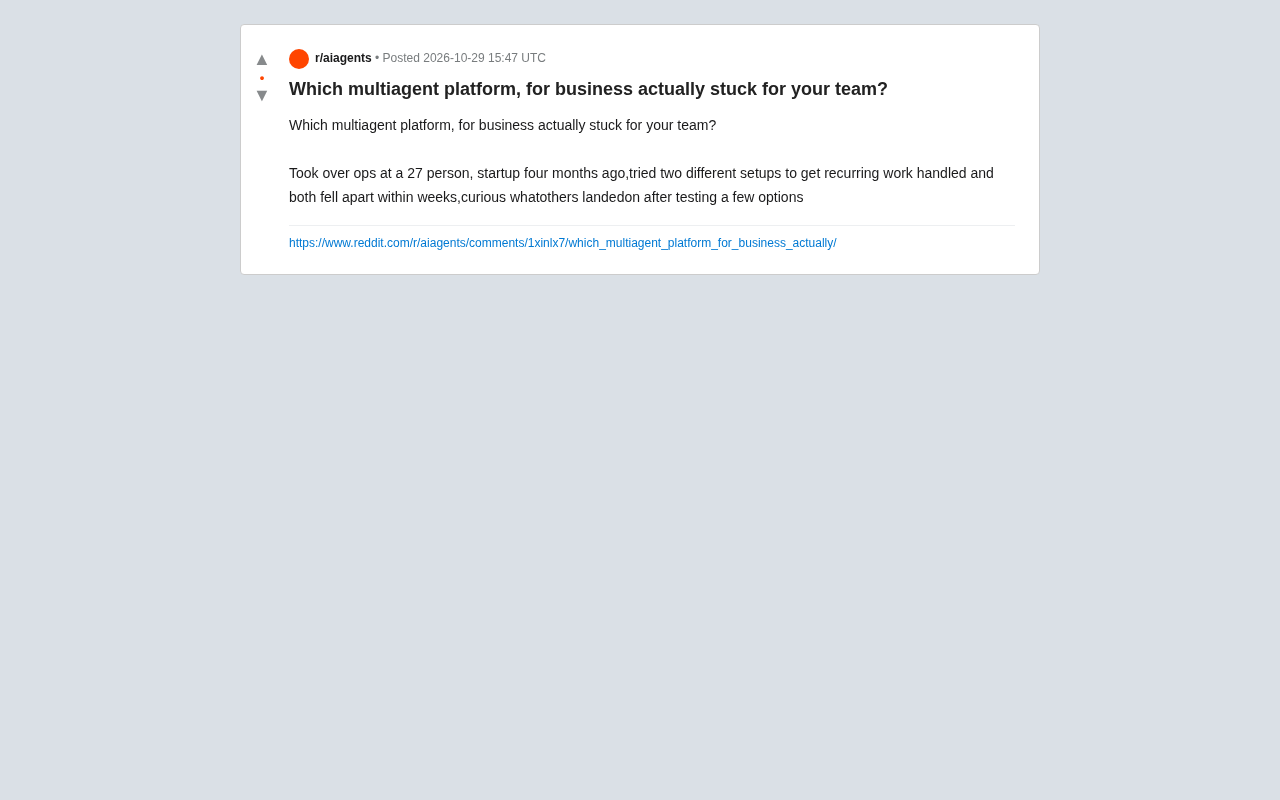
Which Multi-Agent Platform Wins? A Small Team's Battle Scars and Selection Considerations
A 27-person startup's ops lead tried two multi-agent platforms in four months and both failed. This article analyzes why small-team deployments break down, and offers selection guidance on integration depth, observability, and progressive rollout.

Thrive Holdings Takes ADT Private in $7.6 Billion Deal
Thrive Holdings acquires ADT for $7.6 billion in an all-cash take-private deal expected to close in Q1 2027. Analysis of the deal structure, ADT's asset value, and impact on the smart home security industry.