Altman Sympathizes with Mathematicians, But OpenAI's Math Offensive Won't Stop
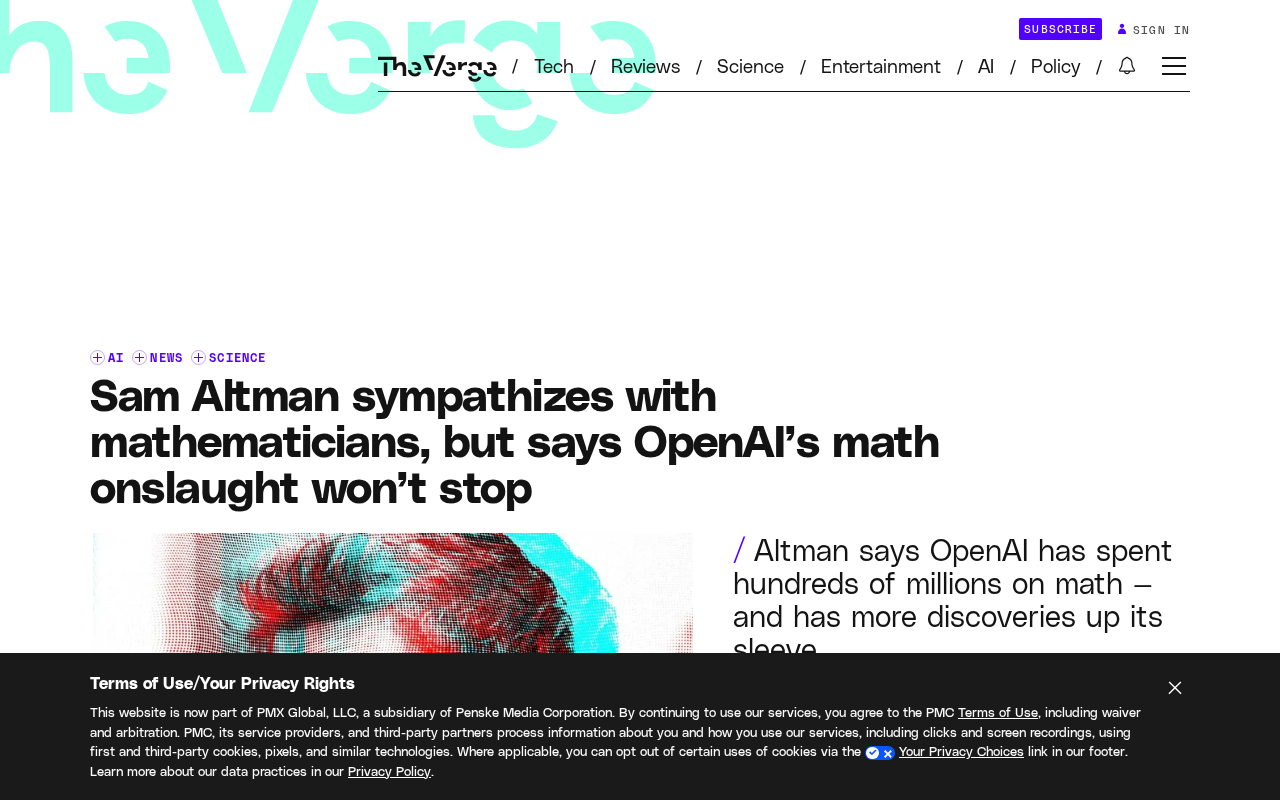
Altman sympathizes with overwhelmed mathematicians, but OpenAI will keep ramping up its math output.
OpenAI has been flooding the math community with AI-generated results, leaving researchers overwhelmed. CEO Sam Altman publicly acknowledged their plight but made clear the company won't slow down, hinting at more results in its "discovery backlog." OpenAI's focus on math stems from the fact that proofs can be rigorously verified, making them ideal for showcasing deep reasoning. Meanwhile, AI's output speed far exceeds human capacity to verify and absorb, straining an academic ecosystem built on slow, rigorous peer review.
OpenAI has spent recent months flooding the mathematical community with AI-generated results, and this "math bombardment" has left many researchers struggling to keep up. CEO Sam Altman has publicly expressed sympathy for their situation, but made clear the company won't be backing off—he even hinted that more results are waiting in OpenAI's discovery backlog.
Mathematicians' Struggles and Altman's Response
According to the original report, after months of dense output consisting of AI-generated results, Altman expressed understanding for researchers' predicament of "trying to make sense of it all." This sympathy isn't just politeness—when AI produces mathematical conjectures and proofs at a pace far exceeding human capacity to digest them, the academic community's peer review mechanisms and knowledge integration processes come under enormous strain.
But Altman's stance is equally clear: understanding is one thing, and OpenAI won't be slowing down because of it. He mentioned that the company's "discovery backlog" may hold more results waiting to be released, suggesting the current pace of output may only be the beginning.
Why OpenAI Is So Committed to Mathematics
Mathematics is a natural touchstone for testing AI's reasoning capabilities. Unlike natural language tasks, the correctness of mathematical proofs can be rigorously verified, making it an ideal arena for demonstrating a model's deep reasoning abilities. OpenAI's continued investment in mathematics is essentially about using verifiable, concrete results to prove that its models' capability boundaries are expanding.
From an industry competition perspective, mathematical results also make for a highly persuasive technical narrative. When AI can produce results that the mathematical community takes seriously, the debate over whether "AI truly possesses reasoning capabilities" tilts in favor of AI companies.
What "rigorously verifiable" means is that the truth or falsity of a mathematical proposition doesn't depend on empirical observation or subjective judgment, but can be checked step by step through formal proof, with each step of reasoning independently reviewable. This stands in sharp contrast to natural language tasks: whether a piece of text is "reasonable" is often a matter of opinion, whereas a theorem's proof either holds or has a flaw. For this reason, mathematics has long served as a benchmark for measuring machine reasoning, from early automated theorem proving to today's neuro-symbolic methods. However, it's worth noting that AI-generated mathematical results may still contain hidden errors or rely on unproven lemmas, so "verifiable" doesn't mean "verified"—human experts still need to invest substantial time in review.
Structural Challenges Facing the Academic Ecosystem
Altman's statement touches on a deeper question: when AI generates results faster than humans can verify and absorb them, how should the academic community respond?
Traditional mathematical research relies on slow and rigorous peer review, with an important paper often taking months or even years from submission to being digested by the community. AI, meanwhile, can mass-produce propositions awaiting verification, and this asymmetry is imposing unprecedented cognitive load on researchers. Altman's "sympathy" is an acknowledgment of this reality, but his proposed solution is clearly not to slow down, but to have academia adapt to the new pace.
It remains unclear how OpenAI will work with the mathematical community to establish more efficient verification mechanisms, nor is the specific scale and content of its "discovery backlog" known. What is certain is that this wave of AI-driven mathematical output won't recede in the short term, and the mathematical community needs to find a way to coexist with this new pace while maintaining rigor.
Peer review is the quality-control mechanism in academic publishing: after submission, a paper is anonymously reviewed by experts in the same field who assess its correctness, novelty, and importance; authors revise based on feedback, and a final decision is made on acceptance. This process is especially cautious in mathematics, because a single subtle flaw in a proof can invalidate the entire conclusion. AI's mass-produced results put pressure on this mechanism in two ways: first, the limited number of reviewers makes it hard to handle a surge in submissions; second, AI-generated content may appear complete while harboring errors, increasing the cognitive cost of review. This also explains why academia has begun discussing supplementary tools like preprint platforms and formal verification tools to share the burden on traditional review.
One-line Summary
Altman sympathizes with overwhelmed mathematicians, but OpenAI will continue ramping up its output of mathematical results.
Paragraph Summary
OpenAI has spent recent months continuously releasing AI-generated results to the mathematical community, and the dense pace of output has left researchers overwhelmed. CEO Sam Altman has publicly expressed understanding for their situation, but made clear the company won't slow down, hinting that more results are waiting in its "discovery backlog." The article notes that OpenAI's commitment to mathematics stems from the fact that mathematical proofs can be rigorously verified, making them an ideal arena for demonstrating a model's deep reasoning capabilities and a highly valuable technical narrative. At the same time, AI's output speed far exceeds humans' ability to verify and absorb it, creating structural pressure on an academic ecosystem that relies on slow, rigorous peer review. It remains unclear how OpenAI will work with academia to establish more efficient verification mechanisms, but this wave of mathematical output won't recede in the short term.
Related articles

The Touchscreen MacBook and Apple's Delightful Mess: A Deliberate Gamble
The Vergecast unpacks the touchscreen MacBook Pro's launch logic, the ProLed naming controversy, the iPad squeezed between iPhone and Mac, and how Apple stays competitive with premium hardware in the AI era.

Fifty Years Studying Power: Robert Caro's Writing and Insights on Power
Robert Caro reflects on 50 years studying power: Lyndon Johnson's persuasion and leverage, Robert Moses's transformation from idealist to ruthless builder, the dilemmas of large-scale construction, and his methods of compressing themes and solitary focus in biography writing.

Can a $20,000 Robot Do Your Chores? The Test Results Are Surprising
A YouTube test video shows how a $20,000 robot responds to commands like washing dishes, turning off lights, taking out trash, and feeding the dog. This article analyzes its real capability boundaries, the state of voice interaction technology, and how far household robots are from mainstream adoption.