Amazon's $200 Smart Alarm Clock Echo Time: Is It Worth Buying?

Amazon launches the $200 smart alarm clock Echo Time, targeting the bedroom with sleep monitoring and sunrise wake-up.
Amazon has released the $200 smart alarm clock Echo Time, which looks like an enlarged Echo Dot with no camera and a large circular screen, clearly aimed at the bedside. Core features include a night mode that automatically removes blue light and dims the screen, a sunrise wake-up that simulates sunrise color temperature transitions, a kids' sleep mode with story time and animations, and ultrasonic technology that detects breathing and micro-movements to determine light sleep stages for optimal waking. The device also offers multiple ringtones, including a Top Gear-style option. The article argues its differentiated value lies in packaging sleep management into a single bedside device, but the $200 price and relatively large size are the main points of contention; value depends on whether users see it as a "sleep management terminal" rather than an ordinary alarm clock.
Amazon's Bedroom Ambitions: What Is Echo Time?
Amazon has launched a smart alarm clock called Echo Time, priced at $200. From the outside, it looks like an enlarged Echo Dot—no camera, but a large circular screen instead. The design direction is clear: it's meant to sit on your nightstand.
According to the introduction video on YouTube, Echo Time isn't positioned as a general-purpose smart speaker, but as a bedside device focused on sleep and waking scenarios. This approach is quite interesting—Amazon is no longer trying to make one device do everything, but rather optimizing specifically for the bedroom, a high-frequency, private space where experience is sensitive.

Sleep and Waking: Breaking Down Echo Time's Core Features
Night Mode and Sunrise Wake-Up
Echo Time comes with a night mode that automatically removes blue light and dims the screen brightness. For people who scroll on their phones or read before bed, this is a practical design—the screen is no longer harsh, and the room atmosphere is softer.
More noteworthy is the sunrise wake-up feature. It uses the watch face to simulate a sunrise effect, gradually brightening colors and introducing warmer tones to slowly light up the room. This gradual waking method is much gentler than the sudden ringing of a traditional alarm clock, and better aligns with the body's natural circadian rhythm.

Blue light refers to high-energy visible light with wavelengths of roughly 380–500 nanometers, with phones, tablets, and displays being the main sources of nighttime blue light. Research generally holds that nighttime blue light suppresses melatonin secretion, thereby delaying sleep onset and reducing sleep quality—which is why various devices offer "blue light removal" modes. Sunrise wake-up stems from leveraging the body's circadian rhythm: in the early morning, cortisol levels rise and body temperature increases, and gradually brightening light signals to the brain that it's time to wake up. Devices that simulate sunrise typically start 20–40 minutes before the alarm's set time, transitioning from dark red and orange-yellow to bright white light, synchronizing the waking process with physiological rhythms to reduce the grogginess caused by being abruptly startled awake.
Kids' Sleep Mode
Echo Time also offers a dedicated kids' sleep mode, including story time and cute graphic animations to gently guide children to sleep. This feature extends the device from an "adult tool" to a "family device," which is a plus for families with young children.

Ultrasonic Breathing and Micro-Movement Detection
Echo Time has a rather distinctive feature: it uses ultrasonic technology to detect your breathing patterns and微小 movements, thereby determining the optimal moment to wake you.
The logic behind this feature is that being woken during light sleep leaves you more alert and less grumpy. By continuously monitoring breathing and body movement, the device can trigger the alarm when you're in a lighter sleep stage, rather than forcibly dragging you out of deep sleep. From a technical standpoint, the ultrasonic approach doesn't require a camera, so privacy concerns are relatively smaller—which may be one reason Amazon chose it.
Ultrasonic sleep detection works similarly to radar: the device emits high-frequency sound waves (typically above 20kHz, inaudible to human ears), which reflect off the breathing movements of the chest and abdomen or subtle limb movements. The receiver analyzes the frequency shift of the echo (Doppler effect) and changes in arrival time to calculate breathing rate and body movement amplitude. Compared to camera-based solutions, ultrasound doesn't capture images, posing lower privacy risks in private settings like the bedroom; compared to wearables, it requires no wearing or charging. However, ultrasonic solutions have limitations: detection accuracy is affected by bedding obstruction, multiple people in bed, and pet activity, and it typically can only provide rough sleep stage assessments rather than medical-grade sleep monitoring. This is why such features are usually positioned as "assisting to improve experience" rather than "health diagnosis."
Alarm Sounds: From Top Gear to More Options
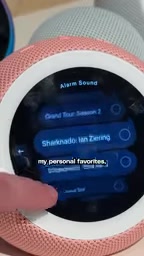
Echo Time offers a variety of alarm ringtones, and the introduction video specifically mentions a Top Gear host-style ringtone—"Wake up, wake up, up!" This slightly humorous ringtone makes getting up less resistible.
Is $200 for an Alarm Clock Worth It?
This is the question posed at the end of the introduction, and the one potential buyers care about most.
Functionally, Echo Time packs night mode, sunrise wake-up, kids' sleep mode, ultrasonic sleep monitoring, and personalized ringtones into a single bedside device. If you already have a smart speaker by your bed and have high standards for sleep quality, these features can indeed constitute differentiated value.
But it's not small, and the price is what it is. $200 is far beyond traditional expectations for the "alarm clock" category. Whether it's worth it depends on whether you see it as "an alarm clock" or "a sleep management terminal."
Amazon clearly hopes for the latter. It wants to enter the bedroom scenario with Echo Time, and the bedroom happens to be the space where users spend the most time in smart homes but where device penetration is relatively low. From this perspective, Echo Time is more like Amazon staking a claim in the sleep health赛道. As for whether consumers will buy in, it depends on whether the actual experience can justify the price.
Smart home "bedroom penetration" has long been lower than that of living rooms and kitchens—a commonly mentioned industry phenomenon. The reason is that bedroom scenarios are extremely sensitive to privacy, quiet, and sleep disruption; camera-based devices struggle to enter, and voice speakers are often deemed "unnecessary by the bed." Yet the bedroom is precisely the space where users spend the most time each day, and the bedtime and waking periods are golden windows for habit formation and health management. Manufacturers therefore tend to enter through "sleep health": redefining the device as a sleep monitoring and improvement terminal rather than a mere speaker or alarm clock. Whether this approach works depends on the accuracy of monitoring data, long-term user adherence, and whether users are willing to keep paying for "invisible improvements."
Key Takeaways
- Echo Time is Amazon's $200 smart alarm clock, positioned as a bedside device with no camera and a large circular screen.
- Night mode automatically removes blue light and dims the screen; the sunrise wake-up feature gradually simulates sunrise through colors and warm tones.
- Kids' sleep mode offers story time and animations to help children fall asleep.
- Ultrasonic technology detects breathing and micro-movements to determine the optimal wake-up timing.
- Multiple ringtones are available, including a Top Gear-style option.
- The $200 price and relatively large size are the main points of contention; value depends on the user's need for sleep management.
Related articles

Data Scraping, AI Proofs, and Open Source Contracts: This Week's Deep Dive into the Tech World
From the 3D model crawler controversy and OpenAI's Lean formal proofs to AI agents challenging Brooks' Law and Debian rejecting LLM review, this week's tech discussions center on openness and verifiability.

Build a Reasoning Model from Scratch: An 11-Hour Open-Source Course Breakdown
Sebastian Raschka releases a free 8-episode, ~11-hour video course teaching you to build a reasoning model from scratch with Python and PyTorch—from a small Qwen3 model through Verifier, Inference Time Scaling, GRPO, and distillation, with open-source code on GitHub.

An 11-Hour Reasoning Model Course in Practice: How Small Models Learn to Think
Starting from Sebastian Raschka's 11-hour reasoning model course and HN buzz, this analyzes small-model training, legal text version control, Anthropic data policy, and product reliability reviews.