An Exponential Tilt Perspective on RLVR: Stiemke Duality and the pass@k Crossing Bound

A theoretical paper uses exponential tilt and total positivity to give a tight bound on pass@k crossings in RLVR and a criterion for when pass@1 gains do not harm tasks.
The paper analyzes RLVR from an exponential tilt perspective: policy updates are equivalent to multiplicative weights updates on a shared policy, and policy sharing across prompts is precisely the root of inter-task interference. The first result uses Stiemke's alternative theorem to give a criterion—only when there is no strictly positive task weighting that equalizes policy fitness can an update that increases average reward avoid harming any single task, and a counterexample shows that per-task unique optimality is not sufficient. The second result proves that the pass@k difference curve is a totally positive kernel transformation of the per-task success rate CDF shift, that the number of crossings does not exceed the sign variation, and that the bound is tight. The authors further propose a constrained update with a per-task floor to trace the trade-off frontier between pass@1 and pass@k, provide pure-CPU reproduction code, and publicly solicit feedback on the modeling assumptions.
Reinforcement Learning with Verifiable Rewards (RLVR) has become the mainstream approach for improving the reasoning capabilities of large language models, but one fundamental question is often overlooked: when a policy improves on average reward, is it possible that it simultaneously harms performance on some tasks? A recent theoretical paper gives a precise answer from the perspective of exponential tilt and derives an upper bound on the number of times pass@k crosses as k varies. The work sparked discussion on Reddit about the modeling choices.
Core Modeling: Policy Sharing Is the Root of Interference
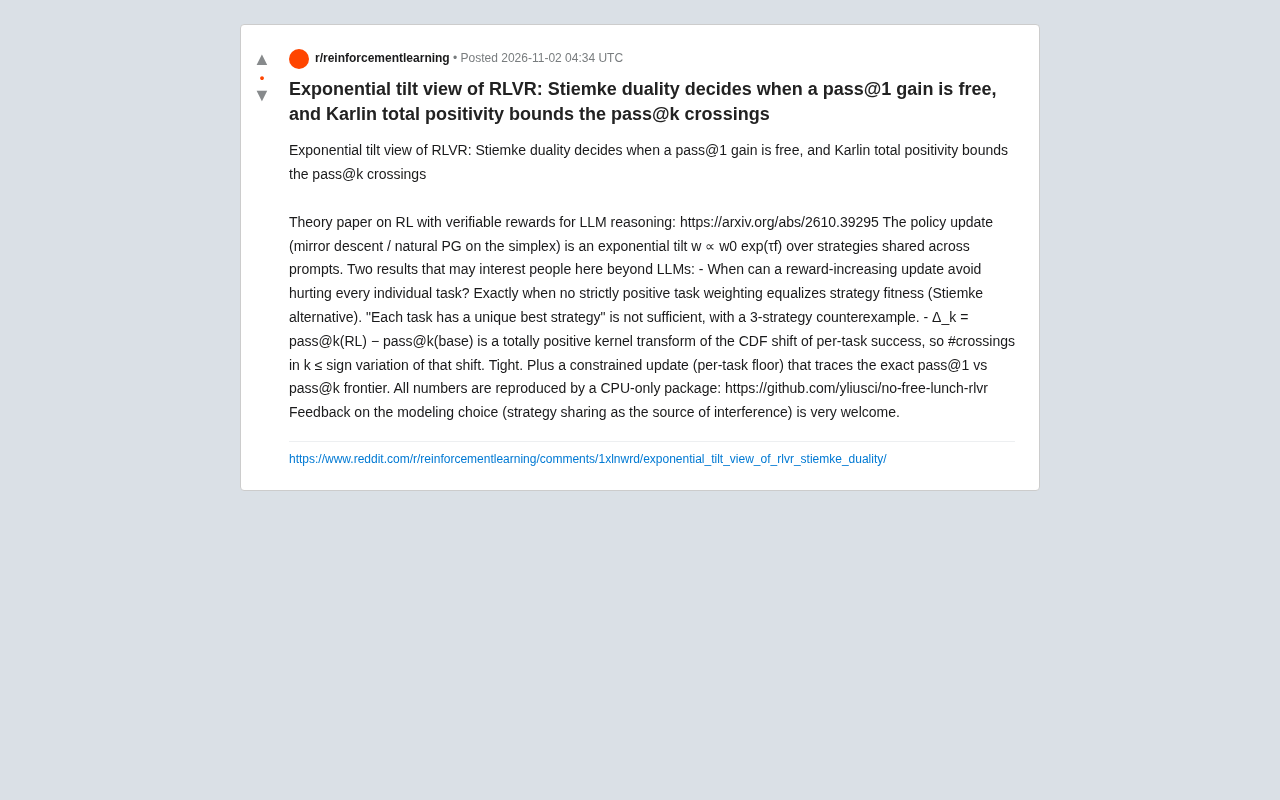
The paper treats policy updates (mirror descent / natural policy gradient on the simplex) as an exponential tilt of a shared policy: w ∝ w0 exp(τf). The key assumption is that the policy is shared across different prompts—the same policy weights must serve all tasks simultaneously. The authors explicitly point out that this "policy sharing" is precisely the source of inter-task interference, and it is also the modeling choice on which they most want feedback.
The value of this perspective lies in elevating the commonly observed RLVR phenomenon of "average reward rising but individual tasks degrading" from an empirical observation to an analyzable structural problem. The exponential tilt form gives the policy update a clear geometric meaning and also provides the mathematical foundation for the subsequent duality analysis.
Exponential tilt is a classical transformation in probability theory and statistical physics: given a base distribution (w_0) and a score function (f), the tilted distribution takes the form (w \propto w_0 e^{\tau f}), where (\tau) is a temperature parameter. In the context of policy optimization, if (f) is taken as the reward or advantage function, the exponential tilt is exactly equivalent to performing one step of mirror descent or natural policy gradient update on the policy—the goal being to maximize expected reward under a KL regularization constraint. The advantage of this form is that the update has a closed-form solution and geometrically corresponds to a multiplicative weights update on the simplex.
Stiemke's alternative theorem is a fundamental result in linear programming duality theory: for a matrix (A), exactly one of the following holds—there exists (x \ge 0, x \neq 0) such that (Ax = 0); or there exists (y) such that (A^\top y > 0) (strictly positive). It belongs to the same family of alternative theorems as Gordan's theorem and Farkas' lemma and is commonly used to determine the existence of solutions to linear systems. This paper borrows it to characterize "whether there exists a positive task weighting that equalizes the fitness of all policies," thereby transforming the Pareto improvement problem into a dual feasibility problem.
Stiemke Duality: When pass@1 Gains Are "Free"
The first core result of the paper answers "when can a reward-increasing update avoid harming every individual task." The answer is not as simple as the intuition "each task has a unique optimal policy." The authors give a counterexample: even if each task has its own unique best policy, there may still exist a positive task weighting that equalizes the fitness of the policies—in which case any update that increases average reward necessarily harms some tasks.
The rigorous criterion comes from Stiemke's alternative theorem: a reward-increasing update can avoid harming all individual tasks if and only if there is no strictly positive task weighting that equalizes policy fitness. In other words, whether pass@1 gains are "free" depends on the dual structure of the task-weight space, not on the local optimality of the tasks themselves. This conclusion has direct implications for reward design in RLVR: the way the task distribution is weighted substantially affects whether an update has the Pareto improvement property.
Karlin Total Positivity: A Tight Bound on pass@k Crossings
The second result focuses on the pass@k curve. Define Δ_k = pass@k(RL) − pass@k(base), i.e., the difference between the RL policy and the base model in the success rate at the k-th attempt. The authors prove that Δ_k is a totally positive kernel transformation of the per-task success rate CDF shift, so the number of crossings of the curve in k does not exceed the sign variation of that shift, and this bound is tight.
This conclusion borrows from Karlin's theory of total positivity and converts the shape constraint of the pass@k curve into a combinatorial invariant. The practical significance is: if the shift in the per-task success rate distribution has only a few sign changes, then the pass@k difference curve cannot oscillate repeatedly—this provides a theoretical explanation for the curve shapes observed when evaluating RLVR effects, and also shows that reporting only a single k value may mask systematic differences.
Total positivity was systematically developed by Samuel Karlin: a kernel (K(x,y)) is called totally positive if all its minors are nonnegative. The key property of totally positive kernels is variation diminishing: after applying the kernel transformation to an input function, the sign variation of the output function (the number of adjacent sign flips) does not exceed that of the input. This explains why the number of crossings of (\Delta_k) is limited by the sign variation of the per-task success rate CDF shift—pass@k is essentially an integral transformation of the CDF through a totally positive kernel. Karlin's classic book Total Positivity and the subsequent theory of variation diminishing are the mathematical foundations of this conclusion, and are also widely used in monotonicity analysis in reliability theory and queueing theory.
Constrained Updates and the pass@1–pass@k Frontier
The paper further proposes a constrained update scheme (per-task floor) that can precisely trace the trade-off frontier between pass@1 and pass@k. Combined with the two preceding results, this forms a complete picture: the unconstrained exponential tilt determines whether gains are free, total positivity gives the upper bound on the number of crossings, and the constrained update provides a controllable path for compromise.
The authors emphasize that all numerical results can be reproduced with a pure-CPU code package (no-free-lunch-rlvr), which lowers the barrier to theoretical verification. According to the original Reddit post, the authors publicly solicit feedback on the modeling choice of "policy sharing as the source of interference," indicating that the work is still at the stage of seeking community scrutiny.
Implications for RLVR Practice
The value of this theoretical work lies not in providing new training tricks but in giving criteria for judgment. When a team observes pass@1 improvement, the Stiemke condition suggests checking whether the task weighting falls into the "necessarily harmful" region; when the pass@k curve exhibits multiple crossings, the total positivity bound suggests that this shape is limited by the sign variation of the underlying CDF shift. For reasoning systems built with verifiable rewards, these conclusions push empirical tuning toward a decidable analytical framework.
It should be noted that this conclusion rests on the modeling assumption of policy sharing; in real systems, if task-specific adaptation is introduced (e.g., per-task LoRA or routing mechanisms), the interference structure changes. The authors themselves list this as an open point for discussion, and subsequent empirical testing is worth watching.
pass@k is a standard evaluation metric for tasks such as code generation: for each problem, sample (n) solutions, count the proportion with at least one that passes verification, and then make an unbiased estimate over (k). It measures the ability to "succeed within k attempts," reflecting a different capability dimension from pass@1 (single-attempt success rate). RLVR training often observes the phenomenon that pass@1 rises while pass@k (for large k) falls, i.e., the policy becomes more "sharpened" but less diverse. The sign variation bound in this paper is precisely a quantitative characterization of this phenomenon: if the overall shift in the per-task success rate distribution is simple in form (few sign changes), then the pass@k difference curve cannot oscillate frequently, and reporting a single k value easily masks this systematic shift.
One-line Summary
A theoretical paper uses exponential tilt and total positivity to give a tight bound on the number of pass@k crossings in RLVR and a criterion for when pass@1 gains do not harm tasks.
Paragraph Summary
This paper analyzes RLVR from an exponential tilt perspective: policy updates are equivalent to multiplicative weights updates on a shared policy, and policy sharing across prompts is precisely the root of inter-task interference. The first result uses Stiemke's alternative theorem to give a criterion—only when there is no strictly positive task weighting that equalizes policy fitness can an update that increases average reward avoid harming any single task, and a counterexample shows that per-task unique optimality is not sufficient. The second result proves that the pass@k difference curve is a totally positive kernel transformation of the per-task success rate CDF shift, that the number of crossings does not exceed the sign variation, and that the bound is tight. The authors further propose a constrained update with a per-task floor to trace the trade-off frontier between pass@1 and pass@k, provide pure-CPU reproduction code, and publicly solicit feedback on the modeling assumptions.
Related articles

AI Can Read Neural Network Weights Directly: Do Models Already Exceed Expectations?
A Reddit developer experiment shows language models can directly read neural network weights and infer their function. Astra, Opus 5.5, and Muse Spark 1.3 all passed the test, sparking discussion on model generalization and training sources.

India's Microdrama Market Explodes: EloElo Secures $80M Investment from NBCUniversal
EloElo secures $80M from NBCUniversal to boost StoryTV, its microdrama platform with over 33M monthly active users, as India's microdrama market draws global capital.

Acoustic Detection of Multi-Rotor UAVs: Fusing Handcrafted Features with Pre-Trained Embeddings
Study reveals data leakage from random splits in UAV acoustic detection, proposes source-disjoint protocol with stacked ensemble of handcrafted features and YAMNet embeddings, achieving 95.29% accuracy for low-cost drone detection.