Angebotsmeister: The German Craftsman's Tool That Turns a Spoken Description Into a Quote

Angebotsmeister lets German tradespeople speak a job description and instantly generate a compliant quote and invoice.
Angebotsmeister is an AI quoting tool designed specifically for Germany's skilled trades sector. Its core feature converts a tradesperson's on-site verbal description into a fully structured quote — complete with itemized line items, traceable price sources, and a PDF clients can accept online. Once accepted, a single tap generates the invoice, closing the loop from job intake to billing. With a fully German-language interface, free-to-start pricing, and a focus on the roughly 1 million German trade businesses that remain largely undigitized, its success will hinge on voice recognition accuracy, industry-appropriate pricing, and strict compliance with German VAT law.
From a Few Words on the Job Site to a Professional Quote
For Germany's skilled tradespeople (Handwerker), generating quotes and invoices is often the most frustrating administrative burden they face. After a long day on-site, they still have to sit down at a computer, break down client requirements into line items, fill in prices, format everything into a PDF, and send it off — a process that's both time-consuming and error-prone. Angebotsmeister is built to solve exactly this pain point: just describe the job out loud, and the app automatically generates a fully structured quote.
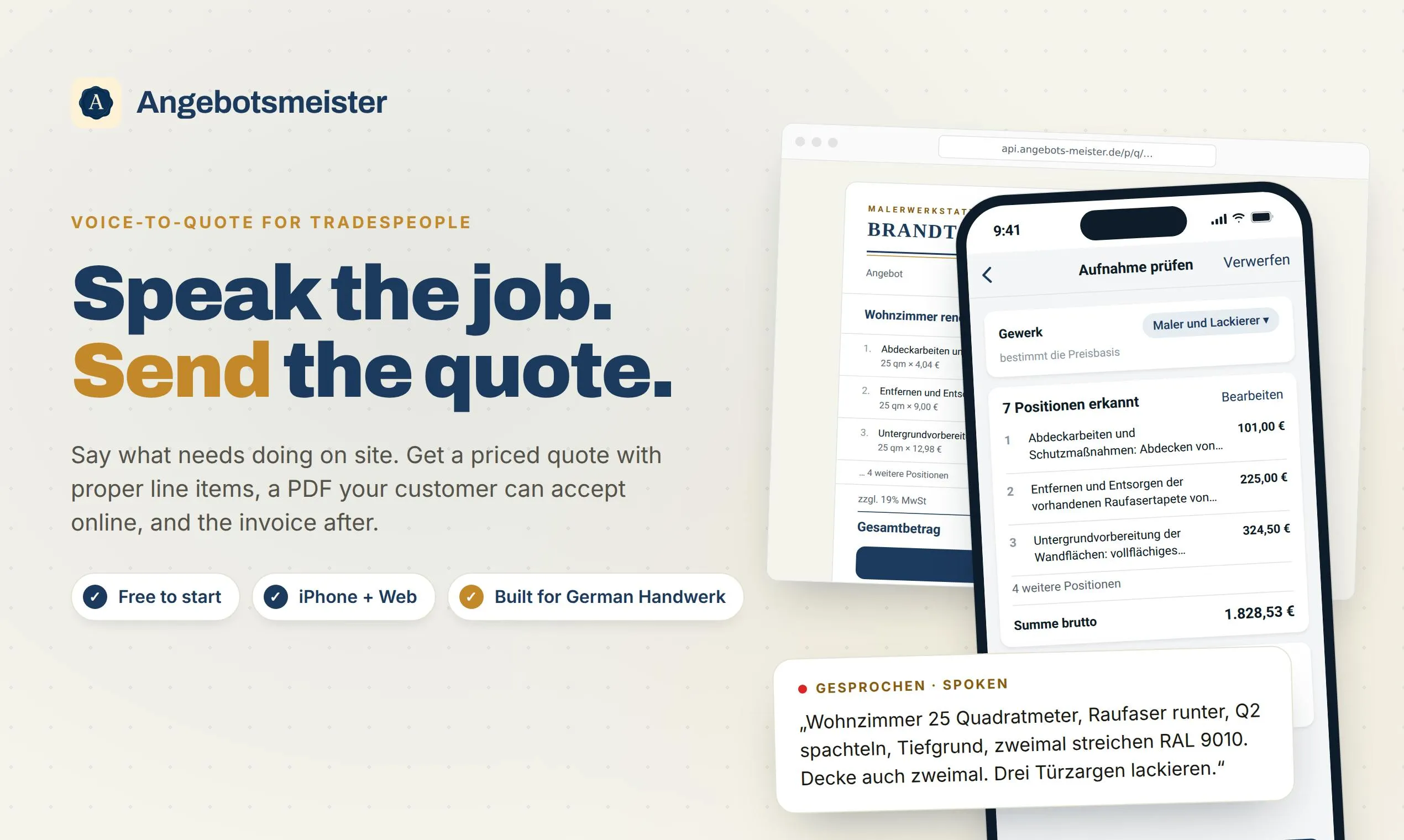
The product launched on Product Hunt with 64 upvotes, landing at #15 for the day, covering the Android, iOS, and Productivity categories. It was built by Daniel Winter. Its positioning is crystal clear: designed specifically for the German trade market, with a fully German-language interface and a free-to-start model.
Core Feature: A Complete Voice-to-Quote Loop
The product's core value lies in turning a spoken description into a ready-to-use business document. According to the official description, Angebotsmeister takes what a tradesperson says on-site and breaks it down into:
- Structured quote line items: converts a verbal description of the work into an itemized list;
- Traceable price sources: every line item shows where its price comes from, so clients understand the breakdown and tradespeople can verify it;
- Online-acceptable PDF quotes: clients receive a PDF they can confirm and accept directly online, eliminating back-and-forth emails.
Even more importantly, the handoff from quote to invoice is seamless — once a quote is accepted, a single tap generates the corresponding invoice. This compresses the entire front-end workflow — taking on a job, quoting, and invoicing — into a few simple actions, rather than a fragmented process spread across multiple tools and spreadsheets.
Why "Visible Price Sources" Matters
In the trade quoting context, clients frequently question how prices were calculated. Angebotsmeister's emphasis on "prices that show where they came from" makes pricing transparency a selling point — one that has real practical value in building client trust and reducing friction during negotiations. For tradespeople, it also lowers the risk of being challenged after the fact or being asked to redo work.
Precise Positioning in a Vertical Market
Angebotsmeister didn't try to become a general-purpose quoting tool. Instead, it chose to go deep in the German trade sector. This positioning reflects several strategic considerations.
First, Germany's skilled trades market is large and highly specialized — from plumbing and electrical work to carpentry, each trade has its own industry standards. Localization (a German-language interface, quote formats that match local conventions) is itself a competitive barrier. Second, voice input is particularly well-suited to job-site environments where hands are often occupied and typing is inconvenient — user motivation is naturally strong. Third, the free-to-start model lowers the barrier for small operators and sole traders, making it easier to accumulate early users quickly.
That said, going deep in a vertical also means the market ceiling is relatively well-defined. The product needs to build enough reputation and distribution within Germany to truly embed this "voice quote + one-tap invoice" workflow into tradespeople's daily routines.
Germany's skilled trades sector (Handwerk) operates under a strict professional certification system. Many trades — such as plumbing, electrical, and roofing — require a "Meisterbrief" (master craftsman certificate) to practice independently. The sector currently has around 1 million registered businesses in Germany, employs more than 5.5 million people, and generates roughly €700 billion in annual revenue, making it a critical pillar of the German economy. Yet the industry has historically been slow to digitize — many tradespeople still rely on paper documents or simple Excel spreadsheets for quoting and invoicing, and low administrative efficiency is a universal pain point. For this reason, German-language localization and compliance with German tax regulations (such as correctly handling the standard 19% VAT or the reduced 7% rate) aren't bonus features for tools like this — they're the baseline requirement.
Lessons for Similar Tools
From a product design perspective, Angebotsmeister represents a practical direction in "AI reducing administrative burden": rather than chasing flashy general-purpose LLM applications, it applies voice recognition and structured output to a specific, high-frequency workflow with a clearly defined pain point.
For tools like this, success rarely hinges on the model itself. What matters is: whether the voice-to-quote accuracy is high enough, whether the pricing structure reflects real industry practice, and whether the generated documents comply with local legal and tax requirements (such as Germany's VAT rules). These details determine whether tradespeople will move from "occasionally trying it" to "using it every single day."
German law sets explicit requirements for invoices and quotes. Commercial invoices must include an invoice number, full details of both parties, a tax number or VAT identification number (USt-IdNr.), itemized descriptions of services or goods, applicable tax rates and amounts, and more. Without these, clients may be unable to claim input tax deductions, leading to legal disputes. This means that a "voice-to-quote" tool aiming to succeed in the German market must produce documents that comply with the requirements of the Umsatzsteuergesetz (UStG) in both format and content — not just look locally adapted on the surface. This compliance bar creates an additional barrier to entry for competitors, and is central to the core value Angebotsmeister offers by focusing on the local market.
Summary
Angebotsmeister enters the German trade market with a clear product premise — "just say it and the quote is sent" — connecting the traditionally separate, cumbersome steps of quoting and invoicing into a smooth, end-to-end loop. Its highlights include the conversion of speech to structured documents, a transparent pricing design, and a low-friction free-to-start strategy. For anyone interested in vertical AI applications and productivity tools, this is a localized deployment case worth watching.
Related articles

Hermes Agent Beginner's Guide: A Self-Evolving AI Assistant
Hermes Agent beginner's tutorial: how to install and use the 41.7K-star self-evolving AI Agent. We break down its learning loop, three-tier memory, and Skill self-improvement, compare it with Claude Code and OpenClaw, and include WSL installation steps.

RAG Interview Essentials: Breaking Down the Full Offline Indexing and Online Retrieval Pipeline
A complete breakdown of the RAG retrieval-augmented generation workflow: offline document loading, chunking, vectorization, and indexing; online query rewriting, vector retrieval, reranking, and generation, plus core interview points and system optimization directions.

AI Large Models for Absolute Beginners: Principles and API Calling in Practice
From AI's evolution to large model training principles and core concepts like Token, Temperature, and Top-P, this article explains system prompts, Function Call, RAG, and memory with hands-on examples and four API call scenarios—ideal for beginners.