Anthropic Files ANT IPO Documents: $33.2 Billion Revenue and $89.5 Billion Compute Commitments

Anthropic files S-1 to list on Nasdaq as ANT: $33.2B revenue in nine months, $80.7B net loss, and $89.5B in locked-in compute commitments.
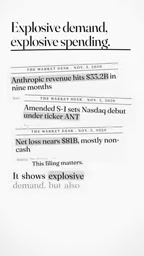
Anthropic filed an amended S-1 with the SEC to list on the Nasdaq Global Select Market under the ticker ANT. The filing shows $33.2 billion in revenue over nine months, up about 1,200% year-over-year, with Net Revenue Retention near 900%, indicating existing customers are deepening spending substantially. The $80.7 billion net loss is mainly due to fair value adjustments on convertible obligations, a non-cash book loss. More notable are $89.5 billion in future infrastructure and compute commitments and a $131.7 billion cash and short-term investment buffer. The IPO also reserves about $3.5 billion for Japanese investors, signaling global demand. The article identifies revenue growth, compute commitment absorption, and gross margin trajectory as the three key windows to watch post-listing.
Revenue Explosion: $33.2 Billion Over Nine Months
According to the filing, Anthropic generated $33.2 billion in revenue during the nine months preceding the filing, representing roughly 1,200% year-over-year growth. This growth rate is built on an already substantial base—according to a breakdown by the YouTube channel Centralix AI, an earlier initial filing showed $16.3 billion in revenue for the company's first six months.
The core metric supporting this growth is a Net Revenue Retention rate of nearly 900%. Put plainly, the average existing customer is spending about nine times what they spent a year ago. This is not a number inflated by new customer acquisition—it reflects existing customers deepening their usage as model capabilities improve.
Net Revenue Retention (NRR) is a core metric commonly used by SaaS and subscription-based businesses. It measures the retention and expansion of revenue contributed by the existing customer base over one year, excluding new customers. It is typically calculated by dividing the revenue from the same cohort of customers in the current period by that cohort's revenue in the prior period. An NRR above 100% means existing customers are expanding through upsells, upgrades, or increased usage; a figure near 900% indicates order-of-magnitude jumps in customer spending, which typically occurs in usage-based AI model services—customers call more tokens and deploy more use cases as model capabilities improve. This metric is critical because it strips out the noise of customer acquisition costs and directly reflects product stickiness and pricing power. For AI companies, high NRR also means revenue growth comes more from deep usage by existing customers rather than单纯 market expansion.
The Other Side of the Loss: What the $80.7 Billion Net Loss Really Means
In the same prospectus, Anthropic reported a net loss of $80.7 billion. That number looks frightening enough, but it needs to be broken down—the filing explicitly states that the loss was heavily affected by fair value adjustments on convertible obligations, rather than being a direct reflection of day-to-day operations.
This type of accounting treatment is not uncommon among high-growth tech companies: as the company's valuation soars, previously issued convertible instruments generate massive non-cash adjustments on the books. What's truly worth watching is not the loss figure itself, but the magnitude of the valuation jump it reflects.
Fair value adjustments on convertible obligations refer to book-value changes that arise when convertible bonds or similar instruments previously issued by the company are measured at fair value for accounting purposes. When a company's valuation rises sharply, the value of these instruments upon conversion to equity increases accordingly, requiring recognition of corresponding changes in liabilities or expenses, which creates non-cash book losses or gains. Such adjustments involve no actual cash outflow and do not reflect day-to-day operating efficiency. Therefore, when analyzing growth-stage tech companies, investors typically focus more on adjusted operating losses, gross margins, and cash flow. Understanding this helps distinguish valuation effects at the accounting level from true business profitability.
$89.5 Billion in Future Commitments: The Infrastructure Arms Race
More noteworthy than the loss is the future infrastructure and compute commitments Anthropic has already made—totaling $89.5 billion. This means servers, chips, and power have already been locked in before the IPO.

The scale of this commitment needs to be understood in an industry context. What AI companies are competing for today is not just model capability, but certainty of long-term compute supply. Locking in infrastructure early is both a necessary move to handle demand surges and a bet—if revenue growth slows, these commitments become a heavy burden.

At the same time, the company still holds $131.7 billion in cash and short-term investments, providing a buffer for this long-term race.
In the context of AI infrastructure, compute commitments typically refer to long-term procurement agreements signed with cloud service providers, chip suppliers, or data center operators, including reservations for accelerated chips such as GPUs/TPUs, server rack leases, and power capacity locks. Such agreements often carry take-or-pay or minimum purchase volume clauses, meaning the company must pay the agreed amount regardless of actual usage. Therefore, commitments worth tens of billions of dollars are both a means of ensuring supply certainty and a rigid off-balance-sheet burden. For investors, it's important to watch the maturity distribution of these commitments, how well they match revenue growth, and whether there are renegotiation or default costs if demand falls short of expectations.
Global Demand: $3.5 Billion Reserved for the Japanese Market
According to reports, Anthropic has reserved a $3.5 billion allotment for Japanese investors in the IPO. This arrangement suggests demand is global rather than limited to the U.S. domestic market.
For global enterprise customers, this signal is worth noting: Claude's commercialization is spreading from the U.S. to the rest of the world, and localized deployment and compliance arrangements in regional markets may accelerate accordingly.
What This Filing Means for the Industry
Anthropic's S-1 is essentially a snapshot of the AI industry's current state: demand can grow extremely fast, but infrastructure costs may expand even faster.
For businesses and investors watching the AI sector, there are three observation windows: whether revenue growth can be sustained, whether the $89.5 billion in compute commitments can be effectively absorbed, and how much gross margins will be compressed once infrastructure investments materialize. These three variables will determine the true quality of ANT after listing and will also provide pricing references for other AI companies preparing to IPO.
It should be noted that the information in this article comes primarily from a single YouTube channel's (Centralix AI) interpretation of the prospectus; specific financial details should still be based on the SEC's public filings.
An S-1 is a registration statement filed with the SEC before a U.S. IPO, containing detailed information on business model, financial data, risk factors, management discussion, and more—it is the most authoritative public document for outsiders to understand a company planning to go public. The Nasdaq Global Select Market is the most stringent of Nasdaq's three tiers, with higher requirements for financial metrics, liquidity, and corporate governance. An amended S-1 typically means the company is supplementing disclosures or updating data based on SEC feedback. Understanding the disclosure logic of an S-1 helps determine which numbers are legally mandated disclosures and which are media interpretations, enabling more accurate assessment of IPO pricing and subsequent performance.
Related articles

No Coding Required: He Shipped an App Store App by 'Cutting Features' and Nitpicking with AI
A game designer with zero frontend/backend skills shipped a dual-platform App Store app with AI—not via one-click generation, but by cutting scope and nitpicking like a demanding client.

What Is Harness Engineering? From Concept Origins to Enterprise-Level Agent Implementation
What is Harness Engineering? This article traces the concept's origins and analyzes enterprise-level Agent requirements for tool call fault tolerance, data security, tenant isolation, and memory gaps.
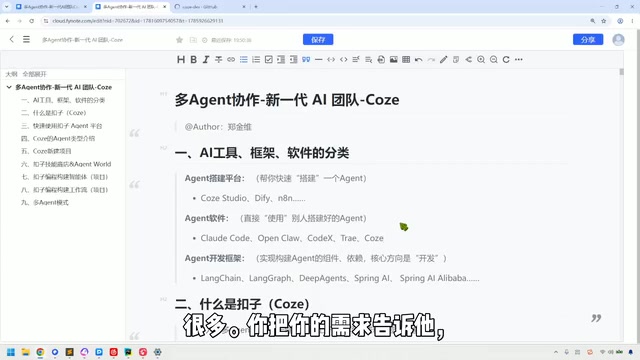
Coze in Practice: A Three-Tier Agent Classification and a Multi-Agent Collaboration Guide
A Bilibili tutorial breaks down the multi-agent collaboration toolchain into three categories: building platforms like Coze Studio and Dify, Agent software like Claude Code, and development frameworks like LangChain—plus a Coze demo of industry templates, three-platform interoperability, local Agent integration, and the trade-offs of credit consumption.