Anthropic Goes Public: Seven Founders Cash Out Nearly $2 Billion
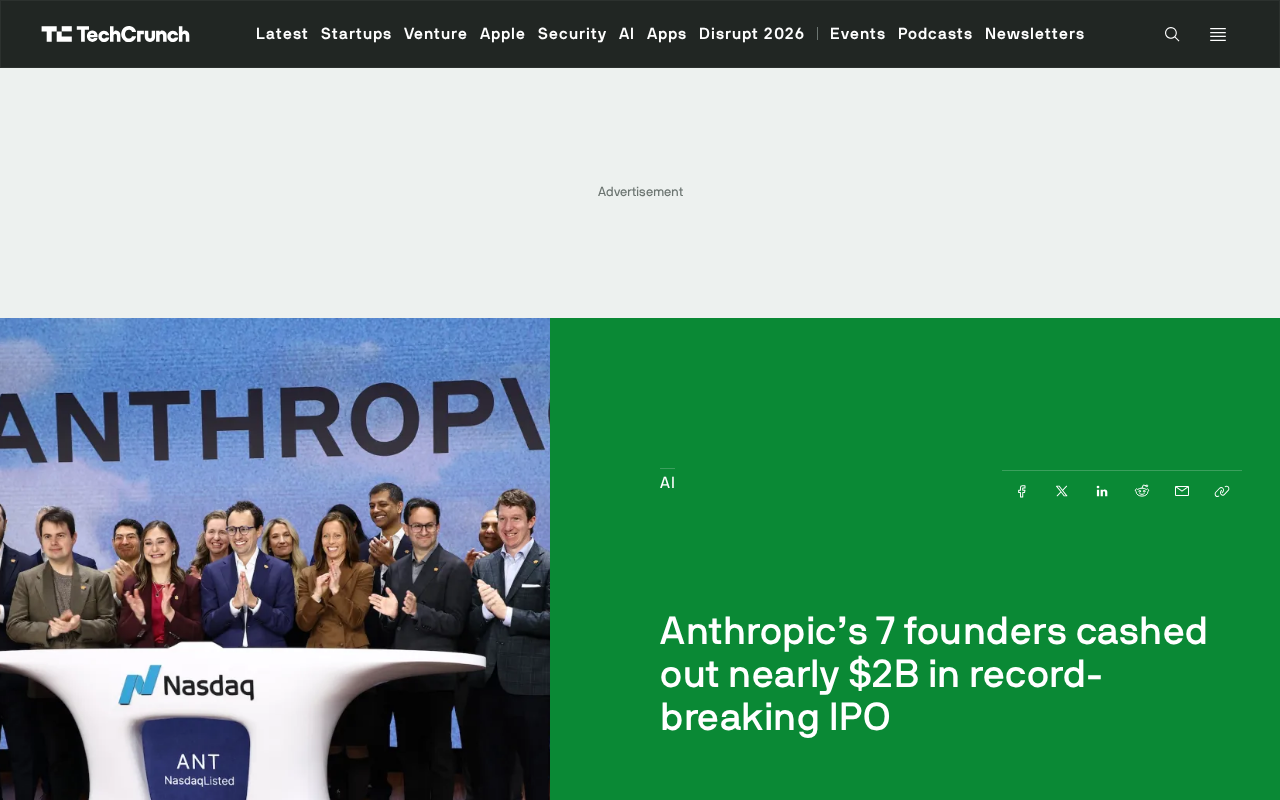
Anthropic's record IPO at $83/share: seven founders cash out nearly $2B, company raises nearly $105B.
Anthropic completed a record IPO at $83 per share, with seven co-founders each cashing out $280M—nearly $2B total—while the company raised nearly $105B. Simultaneous founder cash-outs and company fundraising mark this AI IPO wave, funding liquidity and compute expansion. The case offers a capitalization reference for AI unicorns, though large cash-outs may raise long-term commitment questions. Fund use, R&D, and commercialization pace are key value indicators.
AI company Anthropic has completed a record-breaking IPO, with seven co-founders collectively cashing out nearly $2 billion, drawing widespread attention to the capitalization path of AI startups. According to public information, at an issue price of $83 per share, each founder pocketed $280 million, while the company itself raised nearly $105 billion.
Founder Cash-Out Scale and Company Fundraising
The IPO was priced at $83 per share, a figure that thrust Anthropic into the capital market spotlight. Each of the seven founders cashed out $280 million, totaling close to $2 billion. At the same time, the company raised nearly $105 billion, demonstrating strong public market interest in leading AI enterprises.
The scale of collective founder cash-outs is rare in the history of tech company IPOs, especially against the backdrop of AI infrastructure still being in a period of heavy investment. This arrangement provides liquidity for the founding team while also reserving capital for the company's subsequent R&D and compute expansion.
Secondary Offerings and Primary Offerings in IPOs
Founder cash-outs are typically achieved through secondary offerings in an IPO, where founders sell existing shares they hold and the proceeds go to the individuals rather than the company's accounts; company fundraising, by contrast, comes from primary offerings, with funds flowing into the company for R&D, compute, and operations. The two run in parallel within the same IPO, a common arrangement in mature capital markets. In Anthropic's case, the seven founders' collective cash-out of nearly $2 billion belongs to the secondary offering portion, while the company's nearly $105 billion corresponds to the primary offering. This structure provides liquidity for the founding team and reduces the risk of concentrated personal holdings, while also allowing the company to replenish massive capital in one go. However, when the secondary offering proportion is too high, the market may interpret it as a signal that insiders lack confidence in long-term prospects.
A New Milestone in AI Capitalization
Anthropic's listing has been described as "record-breaking," reflecting that AI companies, after commanding high valuations in private markets, are accelerating their migration to public markets. Unlike early SaaS or consumer internet companies, AI companies' IPOs are often accompanied by enormous capital expenditure needs, with founder cash-outs and company fundraising proceeding simultaneously—a typical feature of this round of AI listings.
From an industry perspective, Anthropic's case provides a reference for other AI unicorns: at a stage of white-hot technological competition, achieving both team incentives and company capital replenishment through an IPO may become the choice of more and more AI companies. However, large founder cash-outs may also spark discussion about the company's long-term commitment, and the market's interpretation of such signals still needs time to be tested.
Capital Expenditure Characteristics of AI Infrastructure
Unlike early SaaS companies' asset-light, high-margin model, leading AI enterprises need to continuously invest enormous capital expenditure (capex), mainly for GPU cluster procurement, data center construction, and power infrastructure. Training frontier large models often requires tens of thousands of high-end accelerator cards, with a single training run costing tens of millions to hundreds of millions of dollars, and short model iteration cycles mean compute demand rises in steps. This makes it difficult for AI companies to cover investment with operating cash flow for a considerable period, forcing them to rely on external financing. IPOs thus become an important source of funding after venture capital and strategic investment. Anthropic's simultaneous founder cash-out and company fundraising is precisely a manifestation of this capital-intensive characteristic: the company needs long-term public market capital to support compute expansion, while the founding team also needs to realize partial liquidity at high valuations.
Market Reaction and Follow-Up Observations
Although the original article did not disclose the stock's first-day performance, the $83 per share pricing and the company's nearly $105 billion fundraising are enough to show institutional investors' enthusiasm. For investors focused on the AI sector, how Anthropic uses the funds, its R&D progress, and the pace of commercialization after listing will be key indicators for judging its long-term value.
The IPO also once again brings AI companies' governance structures and profit distribution to the fore. The seven founders' collective cash-out of nearly $2 billion is both a reward for early risk-taking and potentially a factor affecting the balance of the company's internal incentive mechanisms. What needs to be observed going forward is whether Anthropic can effectively convert public market funds into technological moats and revenue growth.
AI Company Governance and Dual-Class Share Structures
AI startups generally adopt dual-class share structures at IPO, using Class B or Class C shares with higher voting rights so that founding teams can maintain control of the company even after their ownership stakes are diluted. This arrangement is common among high-tech companies, aimed at withstanding short-term market pressure and safeguarding long-term technology roadmaps. However, founders also cashing out heavily in the IPO further dilutes their economic interests, which may intensify outside discussion about whether "control and interest alignment match." For Anthropic, after the seven founders collectively cash out nearly $2 billion, their remaining ownership stakes, voting arrangements, and board composition will directly affect the stability of corporate governance—governance details investors should watch when assessing long-term commitment.
One-line Summary
Anthropic completed a record-breaking IPO at $83 per share, with seven founders collectively cashing out nearly $2 billion and the company raising nearly $105 billion.
Paragraph Summary
Anthropic completed a record-breaking IPO at an issue price of $83 per share, with seven co-founders each cashing out $280 million—nearly $2 billion in total—while the company raised nearly $105 billion. The simultaneous large-scale founder cash-out and company fundraising has become a typical feature of this round of AI company listings, providing liquidity for the founding team while reserving funds for R&D and compute expansion. The article notes that this case offers a capitalization reference for other AI unicorns, but large founder cash-outs may also spark discussion about the company's long-term commitment. How the funds are used after listing, R&D progress, and the pace of commercialization are key indicators for judging Anthropic's long-term value, and its governance structure and profit distribution also merit continued observation.
Related articles

Daybreak Red Deployment Guide: A Reference Architecture for Supervised Security Investigation
A breakdown of the Daybreak Red reference architecture: security control design, deployment configuration process, and runtime monitoring for supervised security investigation.

Gemini 4 Neon Tops the Models Engineering Index
Gemini 4 Neon tops the Models Engineering Index, sparking Hacker News debate over ranking credibility and evaluation methods. Here's what it means for developers.

Apple's Self-Developed AI Agent: An Agent That Can Operate Your Mac Is Coming
Apple is reportedly developing an AI agent that can operate a Mac, targeting Meta Muse, Claude, OpenAI Dots, and others. This article analyzes Apple's system-level advantages, the competitive landscape, and likely rollout paths in the agent race.