Anthropic IPO Pricing: A Signal of AI Giants Going Public

Anthropic initiates IPO pricing as a leading AI lab moves toward public capital markets.
The article discusses Anthropic's IPO pricing. Since the source material is limited to a title and little engagement data, it avoids speculating on figures and focuses on the signal: a safety-focused research company entering public markets will have its business model and governance tested, while a leading lab's listing could provide a valuation anchor for AI and change how investors assess AI assets. It also notes community concerns about mission drift and public-market tolerance for high investment and long payback cycles.
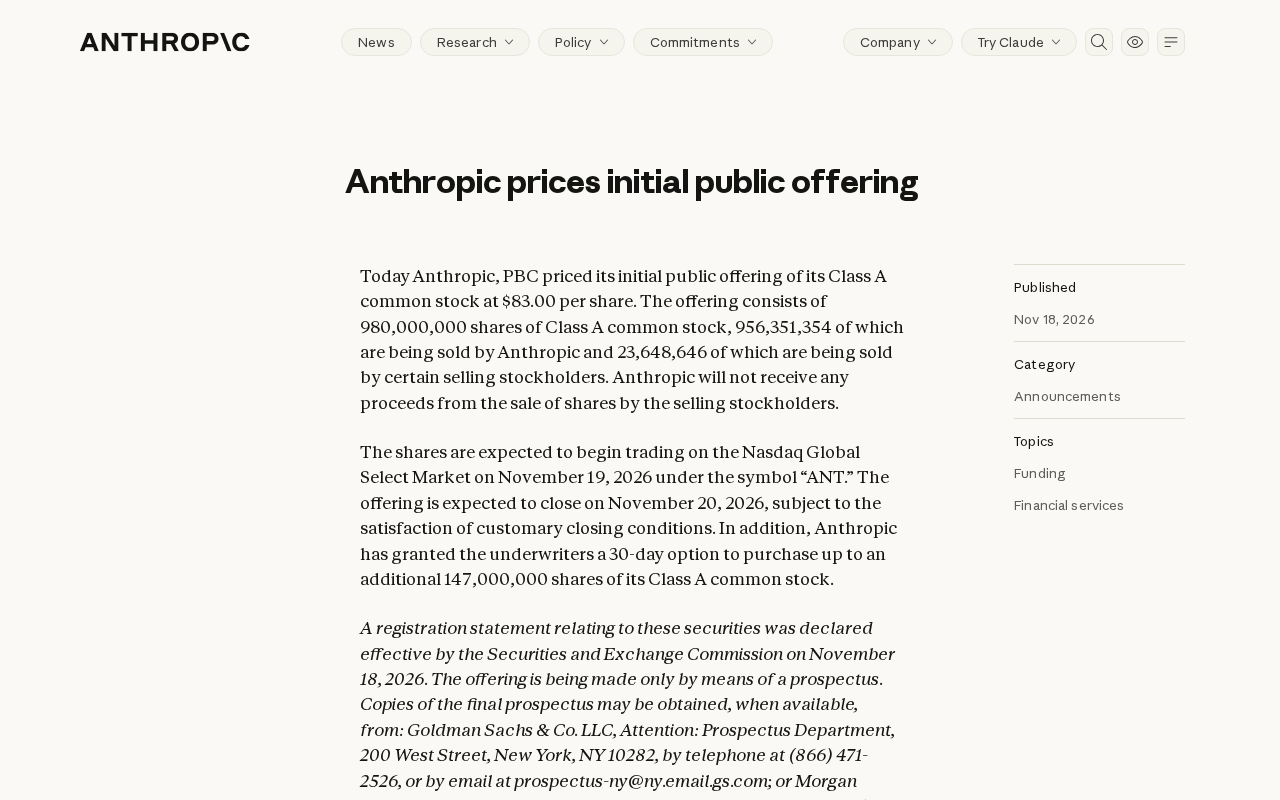
News that Anthropic has initiated pricing for its initial public offering (IPO) has sparked discussion on Hacker News. Although the original post only provided a title along with limited information—22 points and 4 comments—the move itself is enough to be seen as a key milestone in the AI industry's capitalization process.
What the Listing Signals
As the developer of the Claude series of models, Anthropic's IPO pricing means the company is moving from private markets to public capital markets. For a research-driven company built around AI safety as its core philosophy, going public is not just a fundraising mechanism—it is a public test of its business model and governance structure.
From an industry perspective, the listing of a leading AI lab will provide a valuation anchor for the entire sector. Previously, AI startups mostly relied on large private funding rounds, and public markets lacked a pure-play AI benchmark for direct comparison. Anthropic's pricing could therefore become an important reference point for investors reassessing AI assets.
IPO pricing refers to the process in which, before a company's initial public offering, the underwriters and the company determine the price range per share based on institutional investor indications of interest during the roadshow, comparable company valuations, and market conditions. Pricing usually occurs one to two weeks before official trading begins and is the result of the underwriting and book-building process within the IPO, not the final transaction price. Once pricing is set, the company calculates total proceeds and post-dilution valuation accordingly, but the stock price on the first day of trading may still deviate significantly from the offering price. For a capital-intensive AI company like Anthropic, the pricing process is essentially the public market's first concentrated vote on its long-term path to profitability.
A valuation anchor refers to a reference point in public markets that investors can use for horizontal comparison. Previously, pure large-model AI companies were almost all still in the private funding stage, with valuations derived from negotiations among a small number of institutions in the primary market and lacking price signals formed through continuous trading. Once a leading lab completes an IPO, its offering price, price-to-sales (P/S) ratio, and market capitalization will become the baseline for analysts evaluating comparable companies, which in turn will influence the funding pricing of unlisted AI companies. This is why a single company's pricing move is interpreted as a signal for the entire sector rather than merely a company-specific event.
What the Discussion Forum Is Focused On
The brief discussion on Hacker News (only 4 comments) indicates that the news is still in an early stage of dissemination, but a small number of comments does not mean the event is unimportant—IPO pricing often attracts broad attention only shortly before official trading. What the tech community may care about more is whether, after going public, Anthropic will adjust its safety-first approach under shareholder pressure, and how tolerant public markets will be of AI companies' high investment and long payback cycles.
These questions happen to touch on the core contradiction of AI commercialization. Research-oriented labs need to keep investing in compute, talent, and data, while public markets have clear expectations about the pace of profitability. The tension between the two will be amplified after listing.
The tension between a safety-first approach and shareholder pressure is typically referred to in the context of AI corporate governance as the risk of "mission drift." Research labs centered on AI safety often adopt profit caps or special corporate governance structures (such as benefit corporation status) to insulate themselves from short-term profitability pressure, whereas a public offering introduces public shareholders assessed on quarterly performance. This raises a practical question: safety investments, red-teaming, and evaluation delays before model releases appear in financial statements as expenses rather than revenue, and there is currently no precedent for whether public markets are willing to keep paying for this.
Impact on the AI Industry Landscape
If Anthropic's IPO proceeds smoothly, it will provide a reference capital path for other AI companies. Competition between the open-source model camp and closed-source commercial companies may also see new differentiation due to the involvement of capital markets—listed companies need more transparent information disclosure, which to some extent will change competitive strategies.
For developers and enterprise users, changes in a vendor's capital structure are worth watching. After going public, Anthropic may be more driven by market logic in API pricing, product roadmap, and enterprise partnerships, which will directly affect teams building applications on Claude.
What to Treat with Caution
The original material contains only a title and very little engagement data, and does not disclose key details such as the offering price, valuation, or fundraising size, so this article does not speculate on any specific figures. There are still variables between IPO pricing and the final listing transaction, and market conditions, regulatory review, and investor sentiment could all affect the outcome.
For readers following the AI industry, a more practical approach is to track subsequently disclosed financial data and business model details rather than making judgments based solely on pricing news.
One-line Summary
Anthropic has initiated IPO pricing, marking a leading AI lab's move toward public capital markets.
Paragraph Summary
This article centers on the news that Anthropic has initiated pricing for its initial public offering. Because the original material includes only a title and limited engagement data, the article does not speculate on specific figures and instead focuses on the signal: a research-driven company centered on AI safety entering public markets means its business model and governance structure will face public scrutiny; at the same time, the listing of a leading lab is expected to provide a valuation anchor for the entire AI sector and change how investors evaluate AI assets. The brief discussion on Hacker News reflects two concerns in the tech community: whether shareholder pressure after listing will shake Anthropic's safety-first approach, and whether public markets can tolerate the high investment and long payback cycles characteristic of AI companies. The article also notes that the listing will provide a reference capital path for other AI companies and may affect API pricing and product roadmaps for developers relying on Claude, while emphasizing that there are still variables between pricing and the final transaction and that subsequent financial disclosures should be tracked.
Related articles

Gemini 4 Neon Leak: A Potential Strong Contender Against Opus 5.5
A Hacker News thread suggests Gemini 4 Neon looks like an Opus 5.5 competitor. This article unpacks the product positioning behind this community signal, shifts in the top-model competitive landscape, and what it means for developers' model selection strategy.

Claude Fable 5.2's Self-Authored Short Film 'Fable' Sparks Discussion
A short film 'Fable,' credited to Claude Fable 5.2 for script, visuals, and directing, appears on Hacker News. This article analyzes the significance of full-pipeline AI creation, community reactions, and what it means for content creators.
Palo Alto Networks Acquires Applied Co…
Palo Alto Networks Acquires Applied Compute for $4.5 Billion
Palo Alto Networks announces $4.5B acquisition of Applied Compute. A look at the known facts, the directional signals in the target's name, and the M&A logic behind security vendors extending into the compute layer.