Anthropic IPO Prospectus Decoded: The $80.7 Billion Loss and the Mystery of the Largest IPO

Of Anthropic's $80.7B loss, $72.4B is a paper game; the real story is the revenue climb and a blank compute bill.
Anthropic's prospectus discloses an $80.7B half-year loss, but $72.4B stems from fair value changes of convertible derivative liabilities and SAFEs—non-cash accounting—leaving operating losses at $693M. Revenue jumped from $41M in 2023 to $16.3B in H1 this year, up 1,300%, with ~900% net revenue retention, though the prospectus warns against expecting sustained growth. Founder Dario Amodei has a Baidu AI lab background not listed in the prospectus, takes a hard line on China chip controls, and compute commitments appear as a blank. IPO valuation expectations have slid from $2T to $1.5T.
After Anthropic's IPO prospectus went public, the most eye-catching figure was undoubtedly the $80.7 billion loss for the half-year. But after reading through 300-plus pages, you'll find accounting tricks behind that number. What's truly worth examining is the company's growth path, the founders' backgrounds, and a compute bill that's written as a "blank."
From Baidu to OpenAI: The AI Journey of a Physics PhD
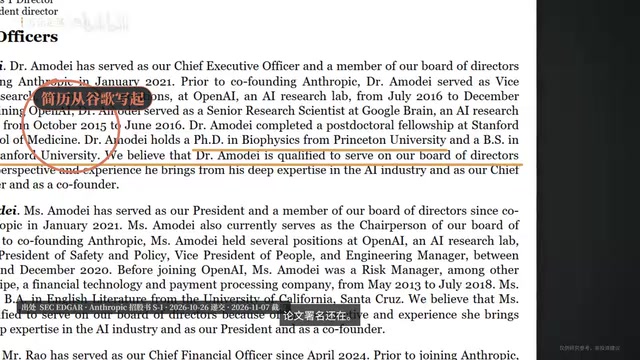
Anthropic's CEO, Dario Amodei, has an unusual résumé: a bachelor's in physics from Stanford, a PhD in biophysics from Princeton, and a postdoc at Stanford's School of Medicine studying brain neural circuits. In late 2014, he joined Baidu's AI lab in Silicon Valley, working under Andrew Ng on speech recognition. The system he worked on, Deep Speech 2, could understand both English and Mandarin and was already comparable to human transcription on standard benchmarks. He later recalled that his biggest takeaway from Baidu was witnessing how remarkably smooth the curve was: the bigger the model and the more data, the better the results. This is the phenomenon later known as the "scaling law."
After leaving Baidu, he went to Google Brain, and in 2016 joined OpenAI, rising to VP of Research. But the résumé in the prospectus starts from Google, with no mention of the Baidu stint. In late 2020, he left OpenAI, and in January 2021 co-founded Anthropic with his sister Daniela. Daniela holds a bachelor's in English literature, worked in risk management at Stripe, then served as VP of Safety and Policy at OpenAI, and is now Anthropic's President and Chair. The brother manages the models, the sister manages the company—one physics PhD and one literature graduate, together covering the quantitative and the eloquent. The co-founding team also includes the engineering lead for GPT-3, one of the authors of the scaling law paper, and a pioneer of interpretability research—arguably half of OpenAI's research department with a new nameplate.
Scaling Law: The scaling law describes a power-law relationship between model performance (such as loss reduction) and model parameter count, training data volume, and compute. That is, as scale increases, performance improves predictably. This empirical regularity was systematically summarized in the late 2010s and became one of the core beliefs of large-model R&D: as long as compute and data keep increasing, capabilities will steadily rise. The smooth curve Dario Amodei observed during his time at Baidu was an early empirical instance of this phenomenon; his later related work at OpenAI further popularized the scaling law and laid the underlying logic for Anthropic's "build bigger models" approach.
Four Steps in Five Years: The Revenue Curve from $41 Million to $16.3 Billion
The prospectus divides Anthropic's development into four stages. The first stage was the launch of its first commercial product, Claude, in Q1 2023, generating $41 million in revenue that year. The second stage was targeting enterprises—not competing on chatbot user numbers, but getting enterprises to plug the model directly into business processes, accessible through all three major cloud platforms: Amazon, Google, and Microsoft. The third stage was coding: the flagship product Claude Code, a coding agent, redefined how AI does work itself; programmers are the most discerning customers and the most willing to pay to save time. The fourth stage is compute: not betting on one vendor, but using chips from Amazon, Google, Nvidia, and AMD alike. As of the end of September, the company had about 5,300 employees, with revenue per capita exceeding $6.6 million over the past 12 months—equivalent to one person generating the annual revenue of a mid-sized public company.
Revenue growth is even more staggering: $41 million in 2023, $386 million in 2024, $4.6 billion in 2025, and $16.3 billion in the first half of this year—a 1,300% year-over-year increase. Net revenue retention is around 900%: enterprise customers who were already using it a year ago now spend an average of 9 times more. But the prospectus immediately pours cold water on this: it does not believe revenue will continue growing at a similar rate and cannot guarantee it; some revenue also came from customers later found to be violating usage policies, and after stricter screening in August and September, that revenue is expected to decline.
The Truth Behind the $80.7 Billion Loss: $72.4 Billion Is a Paper Game
The prospectus shows losses of $1.5 billion in 2023, $8.3 billion in 2024, $42 billion in 2025, and $80.7 billion in the first half of this year. The loss growth rate outpaces the revenue growth of many companies. But the second half of the same sentence immediately notes: these losses include fair value changes of convertible derivative liabilities and SAFEs, which amounted to $72.4 billion in the first half of this year. This means that some of the company's early financing was not a direct sale of stock, but money taken now with an agreement to convert to stock later. As the company's valuation rises, those future shares become more valuable, and in accounting terms the company owes investors more—with the difference recorded as a loss. By analogy: you borrow money from a friend and agree to repay with 10% of your house later. If the house price then rises tenfold, you haven't spent an extra cent, but your books show you owe more.
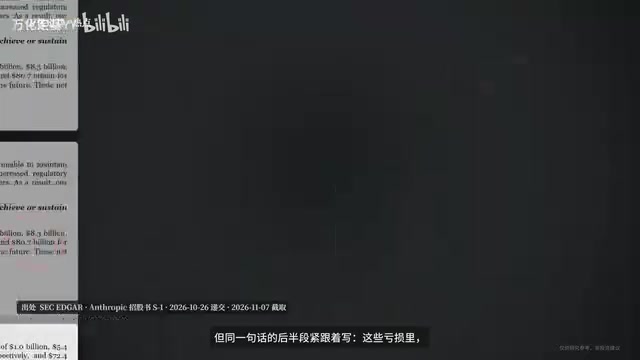
Excluding this item, operating losses were $550 million in 2023, $2.98 billion in 2024, $8.06 billion in 2025, and $693 million in the first half of this year. The first three years dug steadily deeper, then suddenly braked in the first half of this year. Of course, half a year cannot be directly compared to a full year—doubling it gives $1.4 billion—but it is indeed much smaller than last year. In other words, the money actually lost from doing business is far less scary than $80.7 billion.
Convertible Derivative Liabilities and SAFEs: A SAFE (Simple Agreement for Future Equity) is a tool commonly used in early-stage Silicon Valley financing. Investors put in money now, agreeing to convert it into equity at a certain discount or valuation cap in a future financing round; before conversion it is not counted as company equity. In accounting, such instruments are typically classified as derivative liabilities and measured at fair value; as the company's valuation rises, the fair value of the liability increases, and the difference is recorded in current profit and loss, creating a book loss without any cash outflow. The $72.4 billion loss in Anthropic's prospectus originates from this—a non-cash accounting result unrelated to cash consumed by operations.
Stance on China: Donated to Democrats, Yet Aligned with the Trump Team
Many Chinese observers care about the founder's attitude toward China. Public records from the U.S. Federal Election Commission show that in the 2020 election he donated to the Democratic National Committee and the Biden campaign fund, with individual amounts ranging from just over $2,000 to $10,000. David Sacks, AI advisor in the Trump administration, publicly criticized Anthropic as "woke," saying it uses safety as a pretext for regulation to erect barriers for itself. Dario responded that the company aligns with the government on key AI policy and mentioned having a good conversation with Trump in July of that year.
On China chip controls, his stance is even tougher. In January 2025, when DeepSeekAd went viral, he wrote a long article arguing that DeepSeek's progress does not mean chip controls have failed—controls are one of America's most powerful tools and should be tightened. The same month, he co-authored an article in The Wall Street Journal with Matt Pottinger (deputy national security advisor in Trump's first term), calling for tighter controls on chips to China. In September 2025, Anthropic announced that entities headquartered in China and other regions with more than 50% ownership cannot use its services, citing national security; reports said this could cost it hundreds of millions of dollars in revenue. The prospectus's risk factors also note that the U.S. may restrict AI companies' dealings with Chinese entities, and China may retaliate in kind.
The Biggest Number Is a Blank: The Compute Bill and Governance Structure
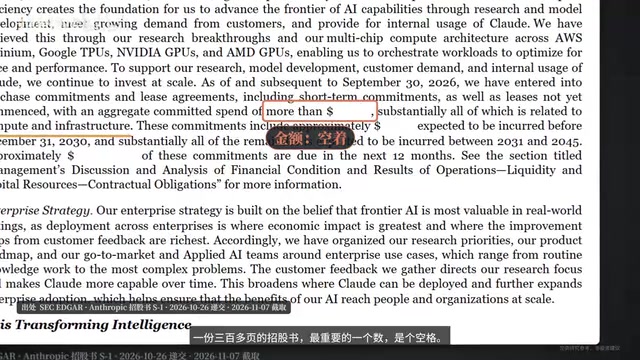
As of September 30, the company's total signed purchase commitments and leases exceed a dollar sign followed by a blank—the most important number in a 300-plus-page prospectus is empty. The original text also says many of these contracts are pay-regardless-of-use, like a gym membership you're charged for even if you don't go—except with many more zeros. On corporate structure, Anthropic is a Delaware public benefit corporation, legally required to balance shareholders' money, affected stakeholders, and the public benefit goals in its charter—"to responsibly develop advanced AI for the long-term benefit of humanity." There is also a long-term benefit trust composed of trustees who receive no economic benefits, participating in governance through special Class T shares. Before the IPO, 5% of shares are to be donated to a public benefit fund. Translated: buying its stock means buying a company whose charter states that making money is not the only goal.
Public Benefit Corporation (PBC): A PBC is a corporate form under Delaware law that requires a company, while pursuing shareholder financial returns, to state one or more public benefit purposes in its charter and to balance shareholder interests with those of affected stakeholders (such as employees, customers, and communities) and its public benefit mission. The board has a duty to consider these non-financial factors in decision-making, but a PBC is not a nonprofit—it can still raise funds and go public. Anthropic adopts the PBC structure, supplemented by a long-term benefit trust and special Class T share governance arrangements, intended to keep its mission institutionally binding after going public.
IPO Outlook: Valuation Expectations Slip, Largest IPO in Doubt
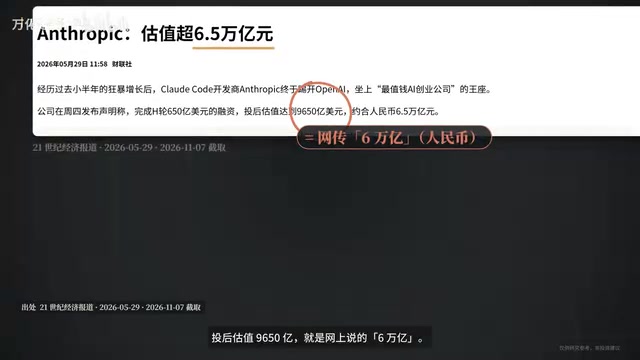
Under SEC rules, a prospectus must be public for 15 days before a roadshow can begin—earliest possibly December 10. But after the AI stock selloff on November 5, Reuters reported that potential investors were beginning to doubt whether the IPO could proceed in November as planned. Chinese financial media, citing foreign reports, said valuation expectations slid from $2 trillion all the way down to $1.5 trillion and were still considered expensive. The price of the largest IPO in history, like the blank in the prospectus, remains unknown.
This company has gone from zero to IPO-ready in five years. Revenue is up 13-fold, but it says itself not to expect that to continue. Of the $80.7 billion loss, $72.4 billion is a paper game. And the biggest numbers are still blanks. For investors, reading the prospectus matters more than reading the headlines.
One-line Summary
Of Anthropic's $80.7 billion loss, $72.4 billion is a paper game; the real story is the four-stage revenue climb, the founder's background, and a blank compute bill.
Paragraph Summary
Anthropic's prospectus discloses an $80.7 billion half-year loss, but $72.4 billion comes from fair value changes of convertible derivative liabilities and SAFEs—non-cash accounting—leaving actual operating losses at just $693 million. Revenue surged from $41 million in 2023 to $16.3 billion in the first half of this year, up 1,300% year-over-year, with net revenue retention around 900%, though the prospectus warns this is unsustainable. Founder Dario Amodei has a Baidu Silicon Valley AI lab background and worked on Deep Speech 2, not mentioned in the prospectus résumé. He takes a hard line on China chip controls and restricts China-linked entities from using its services. Total compute purchase commitments are replaced by a blank in the prospectus, and IPO valuation expectations have slid from $2 trillion to $1.5 trillion, leaving its outlook uncertain.
Related articles
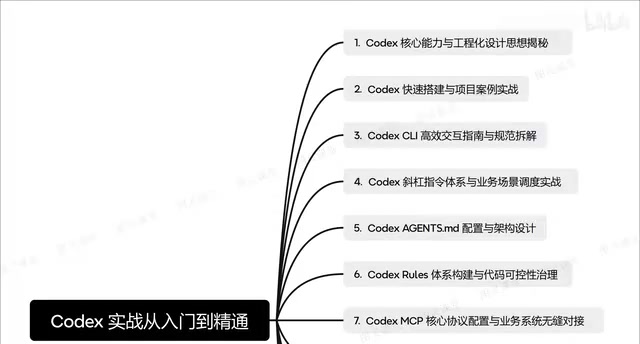
Codex in Practice: From Installation and Configuration to Multi-Agent Collaboration
Based on a Bilibili Codex course overview, this guide maps the full path of AI coding assistants from installation and agents.md context design to CLI commands, MCP integration, and multi-agent collaboration.

Claude Code Installation and Model Switching Guide for Users in China
How can developers in China install Claude Code reliably? This article compiles a Bilibili creator's hands-on solution: install via NPM, skip official login, use CC Switch to configure API Keys and freely switch between DeepSeek, Kimi, and other models to avoid account bans.
AI Supply Chain Security: What Canary Tokens Reveal
Starting from a Hacker News discussion, this article analyzes the role of canary tokens in AI supply chain security: how they detect abnormal access to model weights, training data, and credentials, as well as coverage blind spots and cost constraints during implementation.