Anthropic IPO's Biggest Winner: Amazon's Stake Far Outpaces VCs

Anthropic's biggest IPO winner isn't VCs but Amazon, holding a deep stake via convertible notes and compute ties.
Anthropic's IPO is seen as a venture capital feast, but after massive convertible note conversions, the real biggest beneficiary emerged: Amazon's stake far exceeds all VC firms. The article contrasts the billions VCs will earn with Amazon's gains, an order of magnitude larger, tracing the gap to fundamentally different investment structures—VCs enter early with limited equity stakes, while Amazon accumulated a massive position through multiple large injections plus note conversions. More deeply, Amazon acts as both compute supplier and strategic investor via AWS, forming an "investment + compute" dual binding that locks in long-term cloud revenue alongside equity gains. The case reveals AI infrastructure's return logic: the richest gains often flow to industrial capital providing both capital and compute, not traditional financial investors.
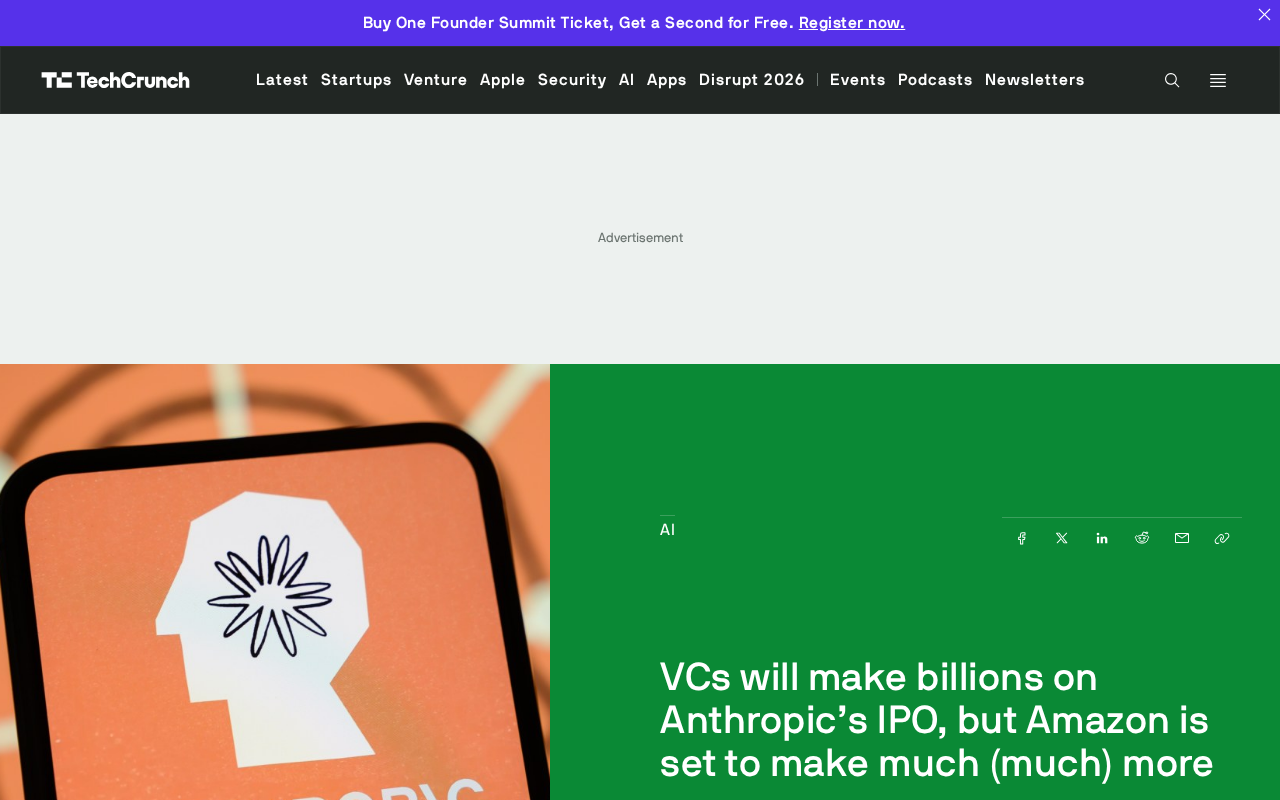
Anthropic's IPO is seen as a feast for the venture capital industry. But once the massive convertible notes were converted, the real biggest winner emerged: Amazon's stake far exceeds that of all VC firms.
Note conversions reveal the true ownership stake
According to the original report, Anthropic recently completed massive note conversions, an action that gave the outside world its first clear look at Amazon's actual ownership percentage in the AI company. Previously, Amazon's investment in Anthropic existed in the form of convertible notes, and the exact size of its stake was not fully disclosed. After the conversion, Amazon's position was described as "much (much) more"—far beyond market expectations.
The elegance of this structure lies in the fact that convertible notes allowed Amazon to inject capital in debt form early on, locking in a floor on investment returns while, as the company's valuation climbed, converting to reap enormous equity gains. For Amazon, this is not just a financial investment but a strategic positioning move in the generative AI race.
A convertible note is a hybrid financing instrument between debt and equity. The investor first injects funds as a loan, with an agreement that under specific conditions (such as the next funding round, an IPO, or maturity) it converts into company equity at a certain discount or valuation cap. For the investor, it offers the dual advantages of downside protection (principal and interest as debt) and upside participation (conversion gains) during a phase when the company's valuation is not yet determined or is rising rapidly; for the financing party, it provides capital with lower immediate dilution. In a sector like AI, where valuations grow in leaps and bounds, convertible notes are often used by large strategic investors to accumulate stakes in batches and with little fanfare, because the specific equity percentage need not be disclosed before conversion—only when the conversion is complete does the true size of the holding become visible.
Billions for VCs vs. tens of billions for Amazon
The article's title makes the core comparison clear: VCs will make billions of dollars on Anthropic's IPO, while Amazon's gains will be an order of magnitude larger. This gap stems from a fundamental difference in investment structure—VCs typically enter early with equity and hold limited stakes, whereas Amazon, through multiple large capital injections combined with convertible note conversions, has accumulated a position far larger than that of any single VC.
For the VC industry, Anthropic's IPO is still a landmark exit that validates the capital-return logic of the generative AI sector. But the real structural winner is the tech giant that is both an investor and a cloud service provider.
Cloud providers' dual "investment + compute" binding
Amazon's investment in Anthropic is not an isolated financial act. Through AWS, Amazon is also a key compute supplier to Anthropic. This dual binding of "investment + compute" allows Amazon to lock in long-term cloud service revenue in addition to equity gains.
This also explains why Amazon was willing to make a large bet in the form of convertible notes: the equity gains after conversion and the cloud business revenue create a compounding effect, and its overall return far exceeds that of a pure financial investor. For Anthropic, this structure brought stable compute guarantees and funding support, but it also means that control is concentrating toward a single strategic shareholder.
In the generative AI industry chain, hyperscale cloud providers play the dual role of compute supplier and strategic investor—a model often called "compute for equity" or a circular deal. Cloud providers supply AI companies with GPU clusters, data center capacity, and cloud credits; the AI companies commit to long-term compute purchases; and the cloud providers then inject cash in the form of investment, creating a closed loop in which capital and compute circulate. Supporters argue this accelerates the training and deployment of frontier models; critics worry that it blurs the line between revenue and investment, potentially inflating reported revenue and masking real market demand, and drawing regulatory attention to related-party transactions and market concentration. The relationship between Anthropic and AWS is a textbook example of this model.
Implications for AI startup financing
Anthropic's case offers a reference point for AI startups' financing strategies. When compute costs become a core expense, accepting strategic investment from a cloud provider—especially in the form of convertible notes—can secure resources without immediately diluting equity. But the price is that, at IPO, the largest financial returns may flow to strategic investors rather than early VCs.
For investors, this case is a reminder that in the AI infrastructure layer, the richest returns often go to industrial capital that provides both capital and compute, rather than traditional financial investors. In the wealth-creation story of Anthropic's IPO, the protagonist may not be VCs but Amazon.
Corporate venture and traditional VC differ structurally in how returns are distributed. Financial investors seek to exit after equity appreciation, and their stakes are typically diluted across multiple funding rounds; industrial capital can earn returns through non-equity channels such as supply chain contracts, purchase commitments, and priority supply rights—even if its equity is diluted, its overall return may still be higher. In addition, strategic investment often comes with exclusivity or priority clauses that affect a company's freedom in subsequent financing and partnerships. For founders, choosing strategic investment means trading part of their control and future financial returns for the resources that are scarcest right now—compute, capital, and distribution channels; for early VCs, it means paying attention to liquidation preferences and conversion terms in the agreements, so they are not overtaken at IPO by large strategic investors who come in later.
One-line Summary
Anthropic's biggest IPO winner isn't VCs but Amazon, which holds a deep stake through convertible notes and compute ties.
Paragraph Summary
Anthropic's IPO is seen as a feast for venture capital, but after the massive convertible note conversions were completed, the real biggest beneficiary emerged: Amazon's stake far exceeds that of all VC firms. The article contrasts the billions VCs will earn with Amazon's gains, which are an order of magnitude larger, noting that the gap stems from a fundamental difference in investment structure—VCs enter early with equity and hold limited stakes, while Amazon has accumulated a massive position through multiple large capital injections combined with convertible note conversions. The deeper reason is that Amazon, through AWS, simultaneously acts as compute supplier and strategic investor, forming a dual "investment + compute" binding that locks in long-term cloud revenue in addition to equity gains. This case reveals the return-distribution logic of the AI infrastructure layer: the richest returns often flow to industrial capital that provides both capital and compute, rather than to traditional financial investors.
Related articles

T3 Code: The Open-Source AI Coding Assistant's Comeback Story
T3 Code is an open-source AI coding assistant that unifies subscriptions like Codex and Claude, with powerful remote control and parallel task management.

Never Elected, Yet Ruled New York for 30 Years: The Ultimate Case Study in the Mechanics of Power
Robert Caro's biographies reveal how unelected Robert Moses ruled New York for 30 years through legal drafting and public authorities, and how Lyndon Johnson built leverage as a "powerless" Senate Majority Leader. Unpacking the underlying logic of accumulating and sustaining power.

The CPython 3.10 Recursion Trap and Synthetic Recovery in TokenGuard, an LLM Circuit Breaker
TokenGuard's author recounts a recursion crash caused by OrderedDict.pop in CPython 3.10 and introduces v0.3.0's Loop Nudge synthetic recovery, inline DLP scanning, and other new LLM agent circuit-breaker capabilities.