Anthropic Launches IPO at $1.4 Trillion Valuation, Debuts Office Suite to Challenge Microsoft on the Same Day

Anthropic kicks off IPO roadshow at ~$1.4T valuation, debuts office suite to challenge Microsoft.
Anthropic launched its IPO roadshow, planning to issue 825M Class A shares at $70-78 under ticker ANT, raising ~$64.3B at the upper end with a media-estimated valuation of ~$1.4T, led by Goldman Sachs and Morgan Stanley with a 30-day over-allotment option. On the same day, it launched Cloud Sheets and Cloud Whiteboards and upgraded Cloud Data, sending Microsoft down over 3% intraday and 2.2% at close as the market saw a direct challenge to Office. Fable 5.2, released the day before, cut prices to $8 per million input tokens and $40 per million output tokens, with the company claiming the lower tier matches OPUS 5.5's top tier at roughly half the cost. The article argues post-IPO revenue pressure will accelerate price cuts and enterprise suite releases, and developers can tier model calls by task difficulty to control costs.
Anthropic Launches IPO at $1.4 Trillion Valuation, Debuts Office Suite to Challenge Microsoft on the Same Day
The AI industry has hit a landmark moment. According to a Bilibili creator, Anthropic officially kicked off its IPO roadshow in the early hours of this morning Beijing time, planning to issue 825 million Class A shares at a price range of $70–78 per share, seeking to list on Nasdaq under the ticker ANT. At the upper end of the range, the offering would raise approximately $64.3 billion, with media estimates putting the fully diluted valuation at around $1.4 trillion.
This is more than just an IPO — it's an AI company pulling off a dual-track move on a single day: "going public to raise capital" and "expanding its product line." And the latter is aimed squarely at Microsoft's core turf.
IPO Timeline and Underwriting Lineup
According to media reports, the IPO schedule is remarkably tight: pricing as early as next Wednesday, with trading beginning Thursday. Goldman Sachs and Morgan Stanley are leading the underwriters, who also hold a 30-day over-allotment option to purchase up to an additional 124 million shares.
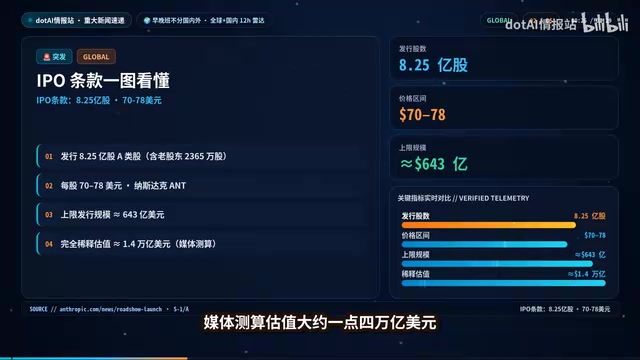
The structure of the offering — 825 million Class A shares — means Anthropic will maintain a relatively concentrated control structure after listing. If the $1.4 trillion valuation ultimately holds, it would place the company among the highest-valued tech firms globally. For a relatively young AI company, this pricing itself is a strong endorsement of the market's faith in AI infrastructure value.
Goldman Sachs and Morgan Stanley are regulars on large US IPOs, and this pairing typically appears on deals with massive fundraising scale and strong institutional demand. The over-allotment option further suggests the underwriters have some confidence in market demand — though final subscription results will still depend on market sentiment on pricing day.
Class A shares and dual-class structure: In US IPOs, Class A shares typically refer to common stock with one vote per share, while Class B shares are held by founders or management with higher voting rights per share (commonly 10 or even 20 votes). This dual-class structure allows a company to raise capital in public markets while the founding team retains control over major decisions. The article notes that Anthropic is issuing only Class A shares, meaning the publicly floated shares carry limited voting power and control remains concentrated among insiders. For investors, the risk of such a structure is that outside shareholders cannot exert substantive influence on corporate governance, but the advantage is that it prevents short-term capital pressure from interfering with long-term technology strategy.
Over-allotment option (greenshoe): The over-allotment option, commonly known as the "greenshoe," is a price-stabilization tool underwriters frequently use in IPOs. Within 30 days after listing, underwriters may purchase additional shares at the offering price up to a certain proportion of the original offering size (typically 15%). If the stock rises, exercising the option increases the amount raised; if the stock falls below the offering price, underwriters buy back shares from the market to support the price. The article mentions up to 124 million additional shares, roughly 15% of the original offering — a standard arrangement that reflects the underwriters' confidence in demand while providing a buffer against early price volatility.
Office Suite Launched Same Day, Microsoft Under Pressure Intraday
More noteworthy is the simultaneous product move. On the same day, Anthropic launched its spreadsheet product Cloud Sheets and digital whiteboard Cloud Whiteboards, and upgraded Cloud Data. After the news broke, Microsoft fell more than 3% intraday before closing down 2.2%.

The reaction shows the market views Anthropic's office suite as a direct challenge to the Microsoft 365 ecosystem. Spreadsheets and whiteboards are high-frequency tools in enterprise collaboration scenarios and core components of the Office suite. By choosing to release such products on the day of its IPO roadshow, Anthropic is sending a clear signal: it is not content to be just a model provider — it intends to extend into the enterprise application layer.
For Microsoft, the threat is not about feature-by-feature parity, but about how AI-native office tools could reshape enterprise procurement logic. If model capabilities become deeply integrated with office scenarios, enterprise customers' selection criteria will shift from "familiar interfaces" to "higher task completion efficiency."
How AI-native office suites differ from traditional Office: Products like Cloud Sheets and Cloud Whiteboards carry the "Cloud" name, but their positioning is not simply to replicate spreadsheets and whiteboards — rather, they embed large model capabilities into collaboration workflows: natural language formula generation, automatic summarization of spreadsheet data, intelligent conversion of whiteboard content into structured documents, and so on. Traditional Microsoft 365's advantage lies in interface familiarity and file format ecosystem, while AI-native tools sell on "task completion efficiency": users describe intent instead of performing manual operations, and the model executes. This explains the market's sharp reaction — if enterprise procurement criteria shift from "employee familiarity" to "output per task," Office's moat shifts from product stickiness to migration cost, and the latter is thinning in the face of AI-assisted migration tools.
Fable 5.2 Price Cut: A Continued Cost Strategy
The product moves don't stop at the office suite. According to disclosures, Anthropic released Fable 5.2 just one day before the IPO, cutting prices to $8 per million input tokens and $40 per million output tokens.

The official claim is that the lower-tier configuration matches OPUS 5.5's top tier while costing only about half as much per task.

The keyword for this pricing strategy is "cost halved." In a competitive landscape where model capabilities are gradually converging, inference cost becomes the core decision variable for enterprise-scale deployment. By cutting prices on the eve of its IPO, Anthropic is on one hand demonstrating the feasibility of commercialization to capital markets, and on the other paving the way for post-IPO revenue growth — lower unit costs mean a higher ceiling for call volume.
The creator's assessment is that revenue pressure will only intensify after listing, and the pace of price cuts and enterprise suite releases will likely accelerate. The logic holds up: public market demands for quarterly results will force Anthropic to adopt a more aggressive commercialization cadence.
Token pricing and inference cost: Large model APIs are billed by token, where a token is the basic unit of text processing — roughly part of an English word or a single Chinese character. Input tokens refer to the prompts and context users send to the model; output tokens refer to the model's generated responses. Because output involves character-by-character generation computation, its unit price is typically significantly higher than input. The article mentions Fable 5.2 at $8 input and $40 output per million tokens — output priced at 5x input, consistent with industry norms. For enterprises, the cost of scale deployment is mainly determined by call volume multiplied by unit price, so the statement "lower tier matches top tier at half the cost" essentially means compressing unit token cost to half that of competitors at equivalent task quality. This directly raises the ceiling of call volume customers can afford, and is a key chip for proving commercialization feasibility to capital markets ahead of the IPO.
Practical Advice for Developers
From a usage perspective, the creator's combination strategy is worth considering: use OPUS 5.5 for everyday coding, and switch to Fable 5.2 when hitting tough problems — the most cost-effective approach. The essence of this approach is tiered model invocation by task difficulty, reserving high-cost compute for scenarios that truly require complex reasoning while handling routine tasks with more cost-effective tiers.
For readers interested in AI infrastructure investment, ANT's pricing and first-day performance will serve as an observation window — it's not just a question of one company's valuation, but a market vote on the proposition of "whether AI companies can sustain ultra-high valuations."
As for whether to buy ANT, the creator offered three options in the video: type 1 to get on board, type 2 to wait and see, type 3 to buy only tokens. Behind this jest lies a divide between two types of participants — those betting on equity are wagering on long-term commercialization capability, while those betting on tokens care about immediate tool efficiency.
One-line Summary
Anthropic kicks off IPO roadshow at ~$1.4 trillion valuation, debuts office suite to challenge Microsoft.
Paragraph Summary
Anthropic officially launched its IPO roadshow, planning to issue 825 million Class A shares at $70–78 per share under ticker ANT, raising approximately $64.3 billion at the upper end with a media-estimated valuation of ~$1.4 trillion. Pricing could come as early as next Wednesday with trading Thursday, led by Goldman Sachs and Morgan Stanley with a 30-day over-allotment option. On the same day, Anthropic launched Cloud Sheets and Cloud Whiteboards and upgraded Cloud Data, sending Microsoft down more than 3% intraday and 2.2% at close as the market viewed it as a direct challenge to the Office ecosystem. Fable 5.2, released the day before the IPO, cut prices to $8 per million input tokens and $40 per million output tokens, with the company claiming the lower tier matches OPUS 5.5's top tier at roughly half the cost. The article argues that post-IPO revenue pressure will accelerate price cuts and enterprise suite releases, and developers can control costs by tiering model calls by task difficulty.
Related articles

AI Writes Your Code—Do You Still Need to Learn Git? Five Reasons
AI coding agents handle Git operations automatically—is it still necessary to learn Git? Five reasons: team communication, reviewing agent PRs, monitoring code changes, fallback when AI goes down, and the joy of learning—plus how the focus of learning Git is shifting in the agent era.
Anthropic Reportedly Prices IPO at $83 Per Share, Valuing Company at $1.5 Trillion
Anthropic reportedly prices IPO at $83 per share, above the expected range, with a fully diluted valuation of $1.5 trillion. This article analyzes the signal significance of the pricing and its impact on the AI industry's financing environment.
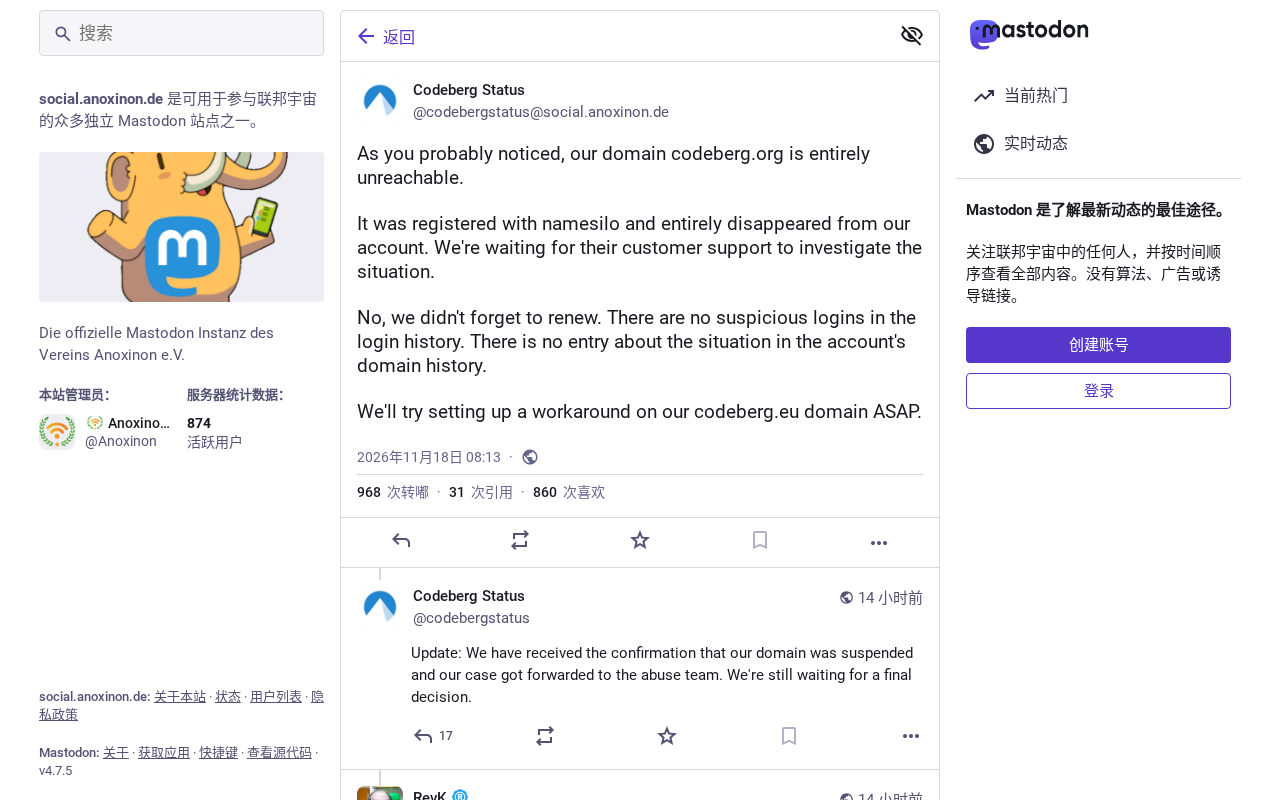
Open-Source Code Hosting Platform Codeberg Suffers Outage, Sparking Debate in Developer Community
Open-source code hosting platform Codeberg.org suffered an outage, sparking Hacker News debate over nonprofit platform stability and open-source infrastructure dependency risks.