Anthropic Launches IPO Roadshow: A Listing Signal from an AI Giant

Anthropic has launched its IPO roadshow, with the leading AI company entering the execution phase of going public.
According to news cited by Hacker News, Anthropic has launched a roadshow for its proposed IPO, marking the transition of the AI company behind Claude from rumor to execution phase in its listing process. A roadshow launch typically means financial audits, compliance reviews, and underwriting team assembly are essentially in place. The article argues that AI foundation model companies face a structural contradiction of enormous compute investment and an unclear path to profitability, with continuous fundraising pressure ultimately pushing leading companies toward public markets. Going public will require Anthropic to disclose key data including revenue, losses, customer concentration, and compute costs, and may push it to be more aggressive in enterprise contracts, API pricing, and cloud partnerships. The news had low engagement on HN, reflecting the tech community's greater focus on model capabilities rather than capital operations—but for investors and developers, subsequent pricing, subscription sentiment, and product strategy adjustments are worth continued tracking.
Title
Anthropic Launches IPO Roadshow: A Listing Signal from an AI Giant
Meta Description
Anthropic has launched a roadshow for its proposed IPO, marking the AI company behind Claude entering the execution phase of going public. This article analyzes the roadshow signals, listing motivations, and implications for the developer ecosystem and AI industry valuation logic.
Article Content
Anthropic is going public. According to news cited in the Hacker News discussion forum, the AI company behind Claude has launched a roadshow for its proposed initial public offering (IPO). The news picked up 9 points and 2 comments on HN—not particularly high engagement, but not insignificant either. For anyone watching the capital landscape of the AI industry, this is a signal worth taking seriously.
What a Roadshow Means
An IPO roadshow is the phase in a company's listing process where underwriters lead the company in pitching to institutional investors. When a company reaches this stage, it typically means that financial audits, compliance reviews, and the assembly of the underwriting team are essentially in place—the listing is no longer a matter of "rumor" but has entered the execution phase.
For Anthropic, this step means more than raising capital. As the developer of the Claude model series, it has been competing with OpenAI, Google, and others for model capabilities and developer ecosystem share. Going public means it will need to continuously disclose key data—revenue, losses, compute costs—to the public markets, and the increased transparency will in turn shape how the outside world judges the maturity of AI business models.
IPO roadshow is a series of promotional activities organized by underwriters before a company goes public, aimed at potential institutional investors. Management teams typically travel across multiple cities or hold online meetings over several weeks, presenting their business model, financial performance, and growth prospects to funds, pension funds, sovereign wealth funds, and other institutions. The goal is to build demand and test pricing ranges before the formal bookbuilding process. The quality of the roadshow directly affects the subscription multiple and the final offering price, making it a critical turning point in an IPO's journey from preparation to execution. After the roadshow concludes, underwriters determine the offering price range based on institutional feedback and open subscriptions, after which the stock is listed and traded on an exchange.
Why Now
AI foundation model companies broadly face a structural contradiction: compute investment for training and inference is enormous, and while revenue is growing fast, the path to profitability remains unclear. Private market capital can sustain them for a while, but the pressure of continuous fundraising will ultimately push leading companies toward the public markets.
The judgment conveyed by the roadshow launch is that Anthropic believes the current market window and its own financial narrative are sufficient to support a public offering. This has reference significance for the entire AI sector—if a leading model company can successfully complete a listing and achieve reasonable pricing, the valuation logic and exit paths of other AI companies will also be recalibrated.
The cost structure of foundation model companies is key to understanding their listing motivations. Training a frontier large model requires running on tens of thousands of GPUs for weeks to months, with a single training run costing tens of millions to hundreds of millions of dollars; inference costs grow linearly with user scale and require continuous investment to maintain service quality. At the same time, model capabilities iterate extremely fast, forcing companies to continuously invest in next-generation model R&D, creating a cycle of "fundraise—train—release—fundraise again." While private markets have abundant capital, individual deal sizes and valuation ceilings are limited, and investor patience for exit paths is wearing thin. Public markets can provide a larger capital pool and liquidity, but they also require companies to disclose detailed financial data and face quarterly scrutiny—this constitutes the core trade-off of going public.
The Cold Reception on HN
The news had low engagement on Hacker News—9 points and 2 comments—indicating it did not spark large-scale discussion in the tech community. This "coldness" can itself be interpreted: the tech community cares more about model capabilities, API pricing, and product experience, with relatively limited attention to capital operations.
But few comments doesn't mean low informational value. For investors and industry analysts, the roadshow launch is an important milestone for judging the pace of AI company IPOs; for developers, the more practical question is whether a post-IPO Anthropic will adjust its product strategy, pricing model, and open-source stance.
Hacker News' points and comment mechanism helps explain the "temperature" of this news. HN uses community voting for ranking—a post's points determine its visibility on the front page, while comment count reflects the controversy and depth of discussion around a topic. 9 points means the post quickly slides off the front page with limited exposure; 2 comments indicate the tech community lacks the motivation to debate it. This mechanism means HN's heat reflects more the "distribution of interest within the tech community" than the industry importance of the event itself. Capital operations news typically has low heat on HN, in sharp contrast to topics like model releases, API price cuts, and open-source projects.
Impact on Developers and Enterprise Users
Going public changes how a company behaves. Public market expectations for quarterly results may push Anthropic to be more aggressive in commercialization—adjustments could appear in enterprise customer contracts, tiered API pricing, and cloud partnership revenue sharing.
At the same time, increased transparency has positive effects. Prospectus and listing-related disclosure documents will give the outside world its first systematic look at Anthropic's revenue structure, customer concentration, and cost composition—data with direct reference value for assessing the long-term stability of the Claude ecosystem.
Variables to Watch
The roadshow launch is just one step in the process. Whether the offering can be completed as planned, what the pricing range will be, and how market subscription sentiment unfolds all remain unknown. The overall valuation environment of the AI sector, competitors' fundraising moves, and the intensity of regulatory scrutiny on AI companies will all influence the direction of this IPO.
What is certain is that with Anthropic taking this step, the dividing line between "private market funding" and "public market scrutiny" in the AI industry has become clearer. Further developments are worth continued tracking.
One-line Summary
Anthropic has launched its IPO roadshow, with the leading AI company entering the execution phase of going public.
Paragraph Summary
According to news cited by Hacker News, Anthropic has launched a roadshow for its proposed IPO, marking the transition of the AI company behind Claude from rumor to execution phase in its listing process. A roadshow launch typically means financial audits, compliance reviews, and underwriting team assembly are essentially in place. The article argues that AI foundation model companies face a structural contradiction of enormous compute investment and an unclear path to profitability, with continuous fundraising pressure ultimately pushing leading companies toward public markets. Going public will require Anthropic to disclose key data including revenue, losses, customer concentration, and compute costs, and may push it to be more aggressive in enterprise contracts, API pricing, and cloud partnerships. The news had low engagement on HN, reflecting the tech community's greater focus on model capabilities rather than capital operations—but for investors and developers, subsequent pricing, subscription sentiment, and product strategy adjustments are worth continued tracking.
Related articles
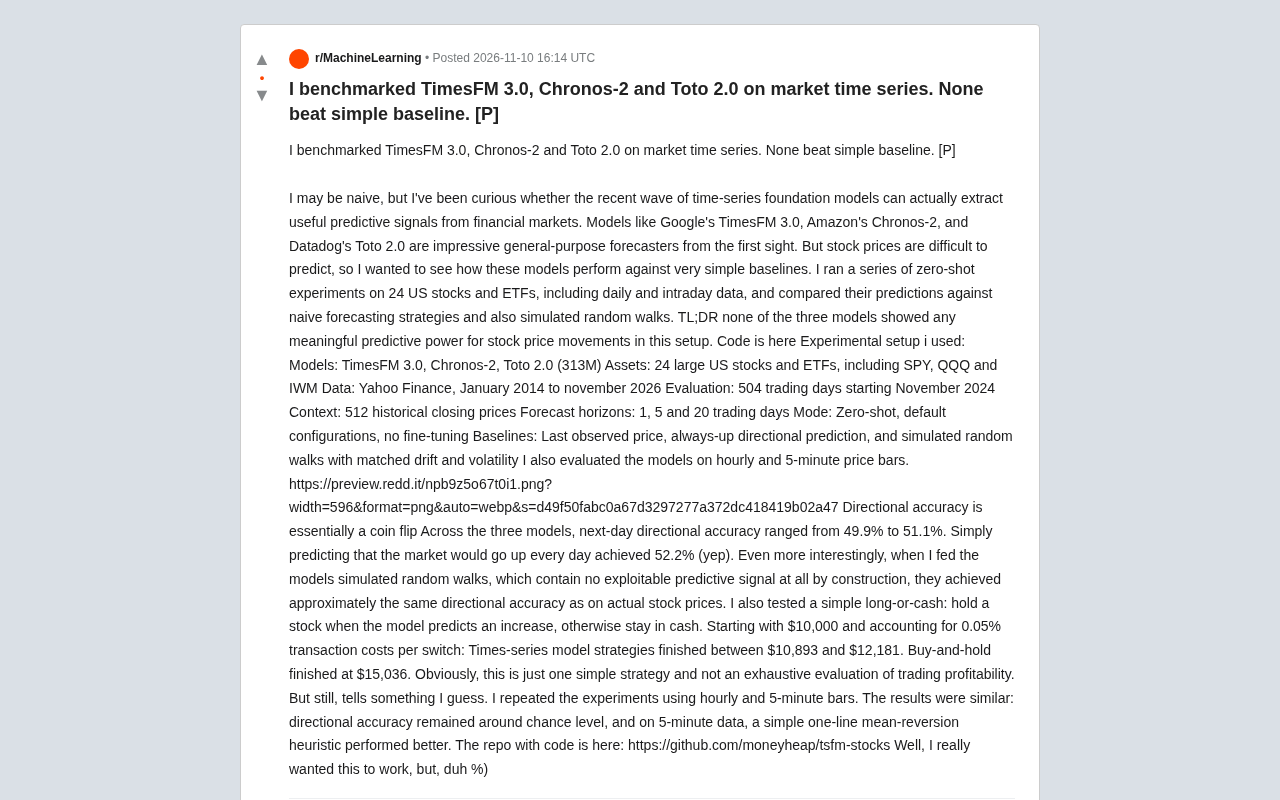
Putting TimesFM 3.0, Chronos-2, and Toto 2.0 to the Test: Time-Series LLMs Can't Beat Simple Baselines
A developer's zero-shot benchmark of TimesFM 3.0, Chronos-2 and Toto 2.0 on 24 U.S. stocks and ETFs: directional accuracy of just 49.9%-51.1%, and simulated trading underperformed buy-and-hold. Time-series foundation models show no edge over simple baselines on financial data.
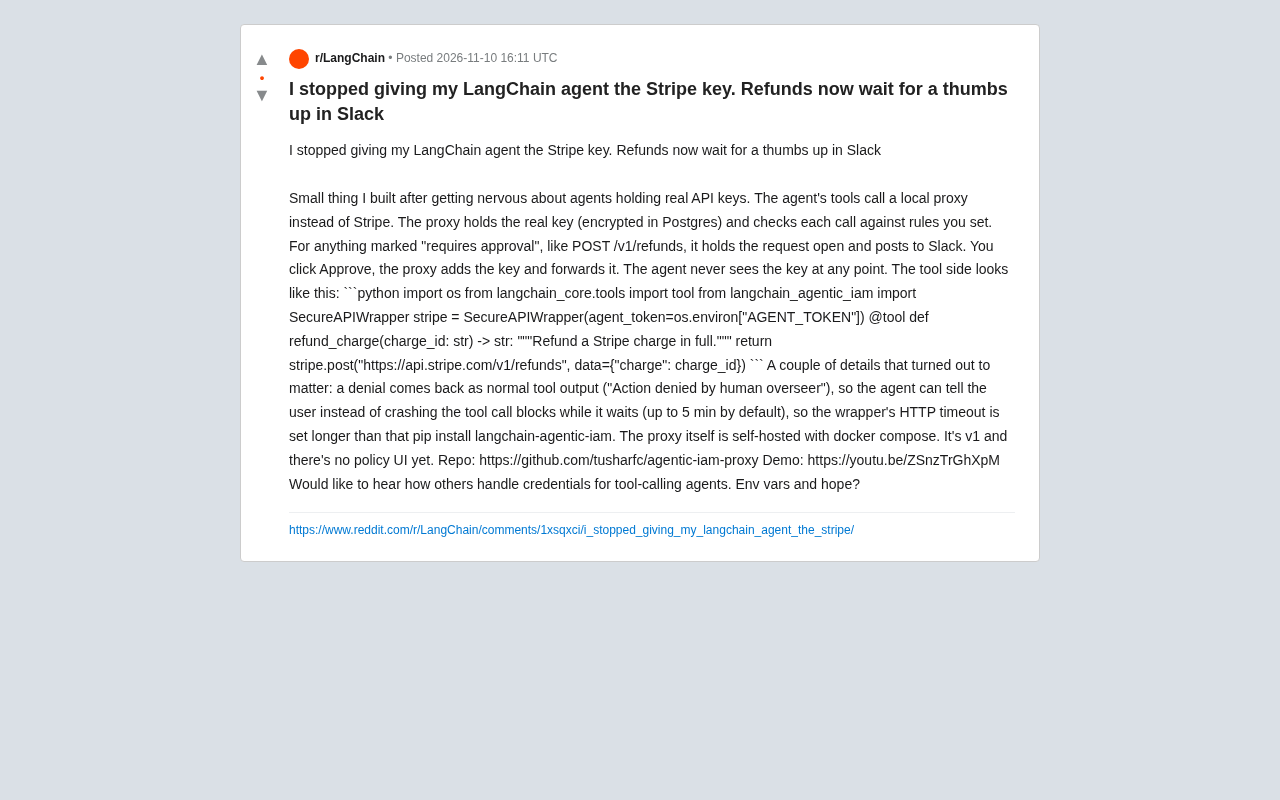
LangChain Agents No Longer Hold Stripe Keys: Refunds Require Slack Approval
A developer shares a credential management approach for LangChain agents: agents don't hold Stripe keys, and sensitive operations like refunds are forwarded through a local proxy and only executed after human approval in Slack, with code examples and engineering details.
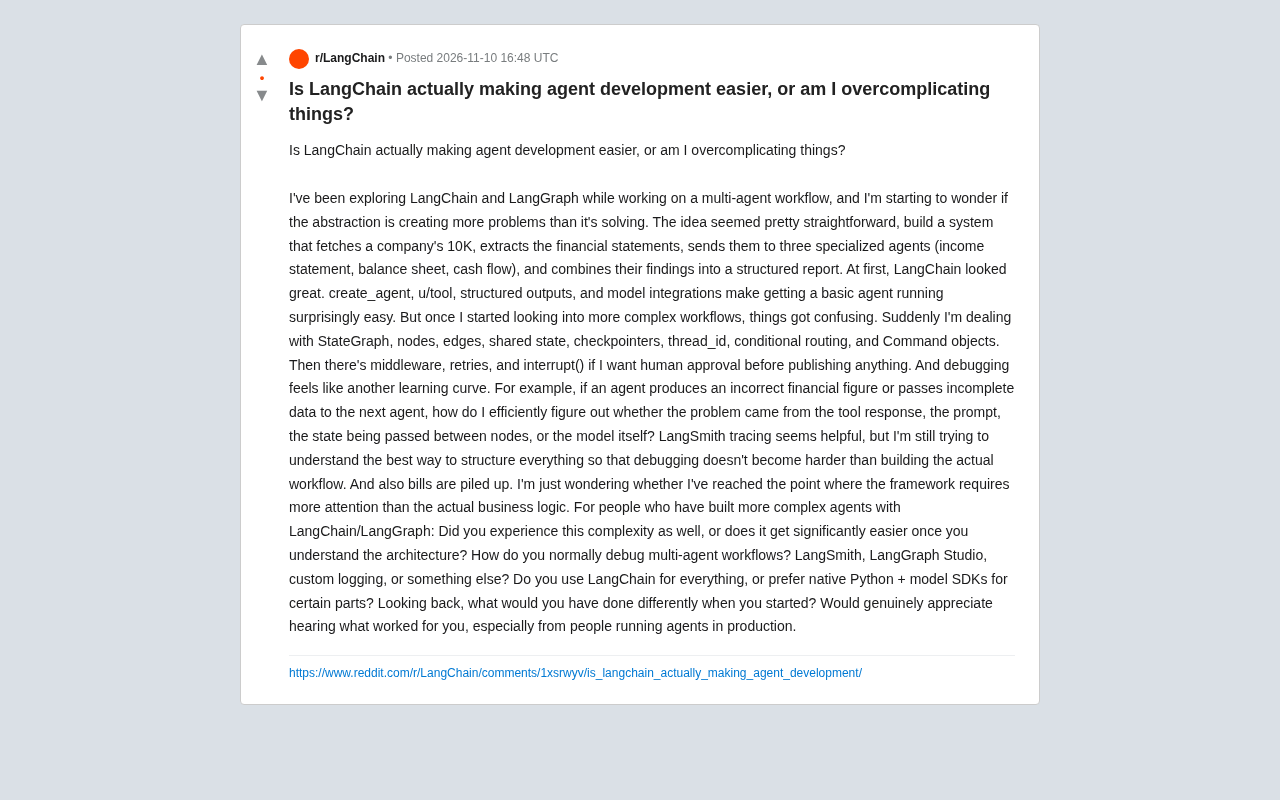
Does LangChain Really Make Agent Development Easier? A Developer Reflects on the Cost of Abstraction
A Reddit developer reflects on the abstraction cost of LangChain and LangGraph in multi-agent workflows: easy to start, but StateGraph, state management, debugging, and cost control add new complexity. The discussion covers debugging methods, whether to mix native Python + model SDKs, and production trade-offs.