Anthropic Officially Files S-1, Initiating IPO Process
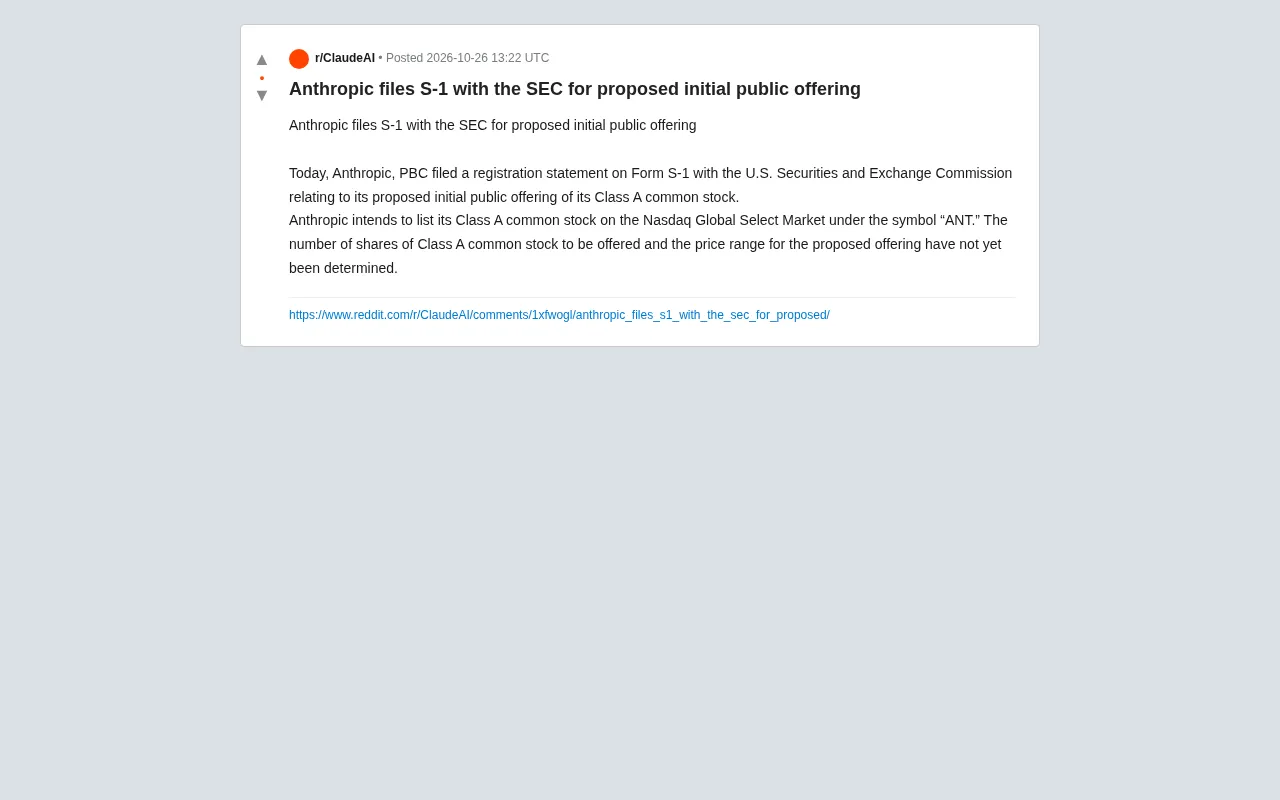
Anthropic has filed an S-1 with the SEC, initiating its IPO process and planning to list on Nasdaq under ticker ANT.
Anthropic, PBC has submitted a Form S-1 registration statement to the U.S. SEC, formally initiating its IPO process. The filing shows plans to list Class A common stock on the Nasdaq Global Select Market under ticker "ANT," though the number of shares and price range remain undetermined. The S-1 is the formal stepping stone for a company's listing, requiring disclosure of business model, financial condition, risk factors, and other core information; after submission, SEC review and effectiveness declaration are required before the roadshow and offering stages. Anthropic filed as a PBC, enshrining its social mission in legal documents, consistent with its "responsible AI development" positioning. The move is seen as an important signal of capitalization among leading generative AI companies and may trigger industry chain reactions, though how the company balances its long-term AI safety mission with short-term financial performance remains a key focus.
From Research Lab to Public Markets: Anthropic Takes a Key Step
According to information disclosed in the Reddit community, Anthropic, PBC (a public benefit corporation) has formally submitted a Form S-1 registration statement to the U.S. Securities and Exchange Commission (SEC), initiating its proposed initial public offering (IPO) process. The AI company, known for its Claude series of models, is taking a substantive step toward becoming a publicly traded company.
According to the publicly available S-1 filing, Anthropic plans to list its Class A common stock on the Nasdaq Global Select Market under the ticker symbol "ANT." However, the filing also explicitly states that the number of shares to be offered and the price range have not yet been determined. This means the specific size and valuation level of the IPO remain pending, subject to further rounds of market communication and regulatory review.
What Does the S-1 Filing Mean?
For readers unfamiliar with the U.S. stock market listing process, the S-1 is the "registration statement" a company submits to the SEC—essentially the formal敲门砖 (stepping stone) for an IPO. It requires the company to disclose core information such as its business model, financial condition, risk factors, management information, and equity structure. Anthropic's choice to file as a PBC (public benefit corporation) is noteworthy—the PBC structure allows a company to pursue shareholder returns while enshrining its social mission in its legal documents, consistent with its public positioning of "developing AI responsibly."
From a procedural standpoint, after the S-1 is submitted, the SEC will review it and provide comments, and the company must amend the filing accordingly. Only after the SEC declares the registration statement "effective" can the company formally launch its roadshow and stock offering. Therefore, the current stage is still some distance from the final listing, but the direction is clear.
Legal implications of PBC (Public Benefit Corporation): A PBC is a corporate form permitted in certain U.S. states (such as Delaware) that requires the company to state one or more public benefit purposes in its charter and to periodically publish a "benefit report" measuring its social impact. Compared with a traditional C-Corp, PBC directors are legally permitted to weigh shareholder interests alongside mission objectives in decision-making, rather than solely maximizing shareholder financial returns. However, a PBC does not exempt itself from securities disclosure obligations after going public, nor does it change the SEC's investor protection requirements. Anthropic's adoption of this structure means its "responsible AI" commitment is written into its corporate governance documents, but it also must prove to the public market that mission and commercial sustainability can coexist.
SEC review and the "effective" process: After the S-1 is submitted, it enters the SEC's review process. The regulator typically issues comment letters requesting clarification or additional disclosure, and the company responds with an amended S-1 (such as S-1/A). This back-and-forth may last for months. Only after the SEC declares the registration statement "effective" can the company conduct a roadshow and sell shares to investors. Therefore, filing the S-1 only represents the start of the process; there are still multiple stages—review, pricing, underwriting—before formal listing, and delays or withdrawals are possible.
Nasdaq and the Strategic Significance of the "ANT" Ticker
Choosing the Nasdaq Global Select Market rather than the NYSE is not uncommon among tech companies—Nasdaq has historically been a gathering place for technology and innovation companies. The ticker symbol "ANT" is concise and memorable, echoing the company name Anthropic. Although the ticker itself does not directly reflect valuation, a clear trading symbol helps build brand recognition among retail and institutional investors.
You may not have noticed that the S-1 filing did not disclose the offering size or price range, which is not unusual in the early stages of a tech company IPO. Typically, the company determines the range based on market feedback closer to the roadshow. Given Anthropic's position in the generative AI space, its valuation expectations will certainly attract significant market attention, but the specific figures can only be confirmed in subsequent filing updates.
Nasdaq Global Select Market is the highest of Nasdaq's three tiers, with stricter requirements for a company's financial metrics, liquidity, and corporate governance, typically attracting large technology companies. Listing here means Anthropic must meet higher disclosure and governance thresholds, but it is also more likely to be included in major indices and to attract institutional capital allocation. Compared with the NYSE, Nasdaq dominates tech company IPOs, and its electronic trading tradition and concentration of tech companies are important factors attracting Anthropic.
Potential Impact on the AI Industry's Competitive Landscape
Anthropic's initiation of the IPO process is an important signal of capitalization among leading generative AI companies. Previously, the major players in this field mostly raised funds through private financing, whereas going public means stricter financial disclosure and a broader investor base. For the AI industry as a whole, this could trigger a chain reaction—whether other AI companies will follow suit, and how the public market will price AI companies, will be key focal points for observation.
From a competitive perspective, the fundraising capacity brought by going public can support larger-scale model training and infrastructure investment, but it also means quarterly earnings pressure. How Anthropic balances its "long-term AI safety mission" with "short-term financial performance" will be an ongoing concern for investors and analysts.
Several Key Points Still to Be Clarified
Currently, the information disclosed in the S-1 filing remains limited. Core details such as the number of shares to be offered, the price range, the list of underwriters, and specific financial data have not been published. Following the general pace of U.S. IPOs, this information will be gradually supplemented in subsequent amended filings. For developers and enterprise users following Anthropic, the IPO itself does not directly affect daily use of Claude products, but changes in the company's capital structure may indirectly affect its product strategy and pricing logic.
Overall, Anthropic's filing of the S-1 is a landmark event in the capitalization process of the AI industry. The level of discussion in the Reddit community also shows that the developer community is paying close attention to this development. Further progress is worth continued tracking.
Related articles

T3 Code: The Open-Source AI Coding Assistant's Comeback Story
T3 Code is an open-source AI coding assistant that unifies subscriptions like Codex and Claude, with powerful remote control and parallel task management.

Never Elected, Yet Ruled New York for 30 Years: The Ultimate Case Study in the Mechanics of Power
Robert Caro's biographies reveal how unelected Robert Moses ruled New York for 30 years through legal drafting and public authorities, and how Lyndon Johnson built leverage as a "powerless" Senate Majority Leader. Unpacking the underlying logic of accumulating and sustaining power.

The CPython 3.10 Recursion Trap and Synthetic Recovery in TokenGuard, an LLM Circuit Breaker
TokenGuard's author recounts a recursion crash caused by OrderedDict.pop in CPython 3.10 and introduces v0.3.0's Loop Nudge synthetic recovery, inline DLP scanning, and other new LLM agent circuit-breaker capabilities.