Anthropic Races Toward the Largest IPO in History: A $80.7 Billion Half-Year Loss and the Truth Behind a $2 Trillion Valuation
Anthropic files for IPO: the $80.7B book loss is accounting, and the valuation debate is a SaaS vs. semiconductor model clash.
Anthropic filed for a Nasdaq IPO in October 2026, showing $16.29B half-year revenue and an $80.75B net loss, ~$72.4B from fair value changes on convertible notes and SAFEs. Adjusted operating profit was $1.62B with positive cash flow and inference margins of 70%+. But QoQ growth fell from 140% to 45%, OpenAI is counterattacking on price, and major customers are building in-house. A $500B non-cancelable compute commitment locks down financial flexibility. The bull-bear split is really about whether the model layer becomes SaaS or semiconductors.
An IPO Dubbed "the Most Absurd" — What's Really at Stake
On October 26, 2026, Anthropic officially filed its IPO application with the SEC under the ticker "ANT," planning to list on the Nasdaq Global Select Market with Goldman Sachs and Morgan Stanley leading the underwriting. The news instantly set off both investment and tech circles — not because of the listing itself, but because of the glaring numbers in the prospectus: $16.286 billion in half-year revenue and a net loss of $80.748 billion.
Many people's first reaction was "this company is insane," but reading through the SEC filing reveals the situation is far more complex than the headline suggests. Some institutions have called this IPO "the most absurd IPO of 2026," while others see it as a stress test for the AI bull market. This article doesn't discuss whether to buy — it does one thing only: break down the easily misunderstood data in the prospectus to see what the bulls and bears are actually fighting over.
The Accounting Truth Behind the $80.7 Billion Net Loss: Book Numbers ≠ Operating Reality
Where Does the Loss Come From?
Of the $80.748 billion net loss, approximately $72.388 billion comes from fair value changes on convertible note derivative liabilities and SVPSAFE instruments. Simply put, Anthropic's valuation rose from $183 billion to $965 billion over the past year, and early financing instruments must be remeasured at the latest fair value, which massively inflates the book loss. This money has no direct relationship to the company's actual cash outflows or how well Claude products are selling.
The fair value changes on convertible note derivative liabilities and SVPSAFE (Simple Agreement for Future Equity) instruments are key to understanding Anthropic's massive book loss. SAFE is a convertible instrument commonly used in early-stage Silicon Valley financing: investors put in money without a fixed valuation, and the investment converts to shares at an agreed discount upon the next funding round or IPO. In accounting terms, such instruments are initially recognized at fair value and must be remeasured at the latest valuation each reporting period. When the company's valuation soared from $183 billion to $965 billion, the conversion value of early-issued SAFEs and convertible notes rose sharply, with the difference recorded in current profit and loss, creating a book loss. This loss involves no cash outflow and doesn't affect daily operations — it's a non-cash accounting measurement result. When analyzing such companies, investors should focus on operating profit and cash flow rather than GAAP net income, which includes fair value changes.
What's the Real Operating Picture?
Looking at operating data, the operating loss for the first half of 2026 was $693 million, significantly narrowed from $2.14 billion in the same period last year. Excluding stock-based compensation and non-cash charitable donations, adjusted operating profit was $1.62 billion, and operating cash flow turned positive at $3.93 billion. More critically, inference gross margin improved from 38% a year ago to between 70% and 85% — economies of scale are truly kicking in. In the first half of 2026, Claude is no longer a "money shredder."
But this doesn't mean it has completely escaped its difficulties. Adjusted operating profit is not GAAP net income, and the positive operating cash flow partly comes from timing differences between customer collections and supplier payments. Fundamentals are improving, yet market disagreement has only grown more intense: if operations are improving, what exactly is the $1.5 trillion to $2 trillion valuation paying for?
The "Second Derivative" of Revenue Growth Has Changed, and So Has the Competitive Landscape
Explosive Growth and Sudden Deceleration
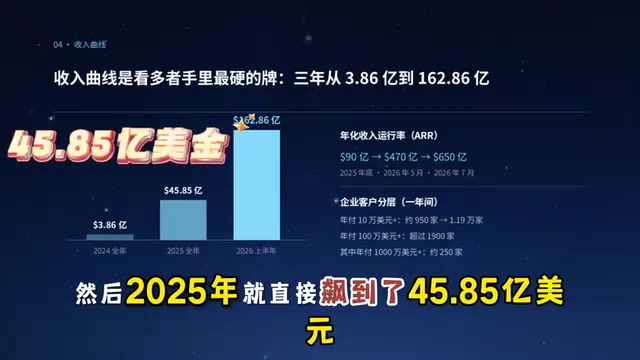
Anthropic's revenue curve is remarkably steep: $386 million for all of 2024, surging to $4.585 billion in 2025, and already $16.286 billion in the first half of 2026 — a year-over-year increase of over 1,300 percentage points. Enterprise customers have exploded similarly — customers paying over $100,000 annually grew from 950 a year ago to 11,900, those paying over $1 million annually exceed 1,900, of which about 250 pay over $10 million annually. Annualized revenue went from $9 billion at the end of 2025 to $47 billion in May 2026, further climbing to $65 billion in July.
But the second derivative of growth is changing: Q2 2026 revenue grew about 140% quarter-over-quarter, falling to around 45% in Q3. A 45% QoQ growth rate is still very high, but for companies valued on annualized revenue, changes in slope make valuation models extremely sensitive.
Annualized Revenue Run Rate is a valuation metric commonly used for SaaS and AI companies, calculated by multiplying revenue at a point in time (usually a month or a quarter) by 12 to extrapolate the annual revenue scale. For fast-growing companies, annualized revenue can reflect current business volume more timely than historical financials. But this metric has obvious limitations: it assumes the current revenue level will persist for a full year, ignoring seasonal fluctuations, customer churn, and growth rate changes. When the second derivative of growth (i.e., the rate of change of growth itself) reverses, annualized revenue quickly becomes distorted. Anthropic's annualized revenue soared from $9 billion at the end of 2025 to $65 billion in July 2026 — this curve is extremely sensitive in valuation models. Once QoQ growth falls from 140% to 45%, valuation multiples based on annualized revenue need to be significantly revised downward, which is one of the technical reasons for the huge valuation disagreement between bulls and bears.
OpenAI's Counterattack and Major Customers Building In-House
The competitive case is vivid. The CEO of HR software company Rippling revealed that in May 2026, 57% of its coding tasks were completed by Anthropic and only 16% by OpenAI; a few months later, the ratio completely reversed — OpenAI handled 52% and Anthropic only 18%. Rippling shifted most of its AI budget to OpenAI because OpenAI offered over 30% price cuts and a contract worth over $100 million annually. By contrast, Anthropic's pricing strategy is rigid — once usage exceeds the contract cap, discounts are immediately withdrawn, creating pressure on cost-sensitive customers.
A longer-term challenge comes from major customers building in-house. The prospectus explicitly mentions that top customers like Meta, Viron, and Cognition are reducing Claude purchases and ramping up in-house model development. When AI usage reaches tens of millions or even hundreds of millions of dollars annually, the returns from building in-house or using open-weight models become very attractive. Open-source solutions are increasingly cost-effective for mid-to-low-end tasks, and tiered procurement is becoming mainstream for enterprises.
Open-weight models refer to AI models whose parameters are publicly downloadable and allow users to deploy and fine-tune themselves, such as Meta's Llama series and Mistral. Unlike closed-source API services, open-weight models let enterprises run them on their own servers without paying per API call, with extremely low marginal costs. For mid-to-low-end tasks (such as routine code completion, document summarization, and customer service Q&A), open-source models after fine-tuning now approach closed-source models in performance but may cost only a fraction. This leads enterprises to adopt a tiered strategy when procuring AI capabilities: core high-value tasks use frontier closed-source models like Claude or GPT, while high-volume routine tasks migrate to open-source solutions. This tiered procurement directly squeezes the revenue space of Anthropic and OpenAI in the small and mid-sized customer market, and is an important backdrop to the prospectus's mention of major customers reducing purchases and increasing in-house development. The maturation of the open-source ecosystem is changing the competitive landscape and pricing power at the AI model layer.
The $500 Billion Compute Commitment: Long-Term Contracts That Lock Down Financial Flexibility
The prospectus discloses that Anthropic has committed to paying over $500 billion to six partners over the next 10 years, including at least $110 billion to Amazon Web Services, approximately $114.5 billion to Google, and $44.9 billion to Microsoft. Many contracts are non-cancelable — you pay whether you use the capacity or not. There's also separately disclosed equipment leasing: $125.2 billion over 5 years, excluding interest.
The problem lies in the maturity mismatch: about 80% of revenue comes from on-demand API calls, where customers can adjust usage at any time, making revenue highly unstable; compute spending, however, is rigid. If AI demand falls short of expectations, model efficiency improvements change the structure of compute demand, or commercialization revenue underperforms, these fixed costs cannot automatically decrease. The prospectus's risk disclosures also acknowledge that there have been instances where cloud providers could not deliver compute on time and in the agreed quantities, and that contracts cannot guarantee getting the desired resources — there are asymmetric risks on both the supply and demand sides.
The $500 billion commitment is not a current liability, but it makes Anthropic's financial room to maneuver after going public far narrower than a statement showing positive operating cash flow would suggest. Any significant shortfall in revenue growth could be amplified by the leveraged fixed-cost structure.

Valuation Disagreement: SaaS Logic or Semiconductor Logic?
The Bull Camp
Primary market investors and underwriters lean optimistic. The Series H private valuation has already reached $965 billion, surpassing OpenAI's previous round of $852 billion. Existing shareholders generally hope the IPO reaches $1.5 trillion to $1.7 trillion, with some expecting $2 trillion. The logic: Anthropic has captured 32% of the enterprise LLM market, surpassing OpenAI's 25%; 34.4% of US enterprises pay for Anthropic, exceeding OpenAI's 32.3% for the first time. If the AI model market is winner-take-all, enterprise leadership deserves paying ahead for future profit pools.
The Bear Camp
A well-known independent research firm set a fair valuation at $150 billion, calling this "the most absurd IPO of 2026" and arguing Anthropic has no viable business model. Its calculation: to justify a $2 trillion valuation, Anthropic would need to earn twice Nvidia's profit over the past year, and Nvidia's net income over the past four quarters already exceeds $190 billion. This firm has a track record of being bearish on VWork before it ultimately blew up, but it was also skeptical of Doordash, which subsequently performed well — its accuracy is not 100%.
Gil Luria, head of technology research at D.A. Davidson, believes ANT will inevitably be a highly speculative vehicle. His reasoning isn't about whether the company is good or bad, but that in this AI boom, the ones truly making steady money may not be model developers but dominant cloud service and infrastructure providers. He also notes that earlier this year Anthropic nearly captured the entire enterprise market, but OpenAI quickly caught up, and enterprises have begun controlling costs and mixing in open-weight models — that's the fundamental reason for the slowdown.
The Essence of the Disagreement
The bulls and bears are fighting over a fundamental question: will the AI model layer in the future be a business like enterprise SaaS — high retention, able to continuously raise prices, forming a stable profit pool — or a heavy-asset track like semiconductor manufacturing that requires constant large capital investment, is subject to cycles, and sees frequent leadership changes?
One side presents evidence of net revenue retention as high as 900%, showing extremely strong customer stickiness; the other points to the $500 billion fixed compute commitment and major customers building in-house, arguing this is a capital-intensive competitive landscape. The pricing disagreement is essentially about how much weight each side assigns to these two possible futures.

AI Safety Label and the Regulatory Puzzle: Governance Upgrade or Market Packaging?
Anthropic has had AI safety in its DNA since day one. Seven members of the founding team left to start the company due to disagreements over OpenAI's approach to safety, and the CEO frequently says in public that frontier research should be slowed down. The prospectus specifically lists legal risks from autonomous AI systems, safety failures, and potential losses not covered by insurance as risk factors.
On the regulatory front, Anthropic actively promotes its own AI regulation draft on Capitol Hill, recommending that the federal government have the authority to directly halt deployment when frontier models pose an imminent public risk. It also provided funding support to candidates favoring stronger AI regulation before the midterm elections. These actions reflect a sense of responsibility for technology governance on one hand, and on the other, invisibly build compliance barriers for the industry, giving top players more advantage.
2026 is a key inflection point: the EU AI Act has been implemented in phases, with violations for high-risk systems facing fines of up to €35 million or 7% of global annual turnover; there is no unified federal law in the US, but states have over 1,200 AI-related bills, of which about 150 have formally taken effect. The regulatory puzzle is extremely complex.
Market observers believe Anthropic may hope to use the strict information disclosure and external oversight of a public company to institutionally echo its own AI safety commitments by going public at this time. Whether investors buy in depends on whether they see it as a governance upgrade or market packaging.
Nasdaq Global Select Market and a Chilly IPO Environment
Anthropic is applying for the Nasdaq Global Select Market — the tier with the highest listing threshold on Nasdaq. The profitability standard requires total operating income over the past three fiscal years to exceed $11 million, and the market value/revenue standard requires average annual market value of no less than $850 million. Anthropic likely won't use the profitability channel, but its revenue and private valuation fully meet the market value and liquidity thresholds. Choosing the Global Select Market over the lower-tier Global Market is a signal: attracting broader institutional investors and preparing for future index inclusion.
But the overall IPO market in 2026 is chilly. According to BCA Research, US newly listed tech stocks this year have fallen about 23% on average from their first day of trading to now, with a weighted average IPO market return of 5.6%, significantly trailing the S&P 500's 13% and Nasdaq 100's 17% gains over the same period. SpaceX fell below its IPO price intraday for the first time in July; even after rebounding, its current price is still nearly half below its historical high. The Nasdaq 100 also dropped over 7% from its historical high in early October. Market sentiment is cautious, and investors are more demanding.
Anthropic's pricing and post-IPO performance will have chain reactions: if it successfully prices at a high valuation and holds steady, it will open the IPO door for subsequent AI infrastructure and model service companies; if subscriptions fall short or performance disappoints, negative sentiment will quickly transmit through the entire AI financing chain.

The Nasdaq Global Select Market is the highest-threshold of Nasdaq's three listing tiers, alongside the Global Market and Capital Market. The Global Select Market has strict financial and liquidity requirements, and companies must meet at least one of several standards covering profitability, market value, revenue, and cash flow. For example, the profitability standard requires total operating income over the past three fiscal years to exceed $11 million, and the market value/revenue standard requires average annual market value of at least $850 million with qualifying revenue. Choosing to list on the Global Select Market usually means the company hopes to attract more institutional investors, improve stock liquidity, and create conditions for future inclusion in indices like the Nasdaq 100. For a company like Anthropic with large revenue but not yet profitable, although it doesn't use the profitability channel, its private valuation and revenue scale are sufficient to meet market value and liquidity thresholds; actively choosing the highest tier sends a signal of governance and transparency to the market.
The Structural Signals Truly Worth Watching
In this SEC filing, the $80.7 billion net loss is mainly an accounting result, the $65 billion annualized revenue is already reflected in primary market prices, and whether the valuation range is $1.5 trillion or $2 trillion will only be determined after investment banks formally build the book. What's truly worth watching are two structural facts:
First, whether the operating leverage at the model layer can be sustained. Anthropic raised inference gross margin from 38% to over 70% in a very short time, with adjusted operating profit turning positive — something many SaaS companies can't achieve in a decade. But sustainability depends on whether it can withstand OpenAI's price cuts and the rising cost-effectiveness of open-source models — customers like Rippling can switch between models very easily, at lower cost than imagined.
Second, many contracts in the $500 billion compute commitment are non-cancelable, lasting 7 to 10 years, directly locking down financial flexibility. Once revenue growth slows, profit and cash flow will be compressed multiple times over by fixed costs, completely changing the risk profile in public markets.
The ANT IPO is not just about one company — it's more like a major exam for the entire AI industry. If the market is willing to give a model company that is still losing money, with slowing growth and huge compute commitments, a valuation of over $1.5 trillion, it amounts to casting a vote of confidence for the capital-intensive business model of frontier AI; if pricing is very low, it won't just affect this one company — the entire AI infrastructure narrative's valuation system in public markets could be repriced.
One-line Summary
Anthropic files for IPO: the $80.7 billion book loss is an accounting artifact, and the valuation disagreement is essentially a battle between SaaS and semiconductor business model paths.
Paragraph Summary
Anthropic filed for a Nasdaq listing in October 2026, with the prospectus showing $16.286 billion in half-year revenue and a net loss of $80.748 billion, of which about $72.4 billion comes from fair value changes on convertible notes and SAFE instruments — not actual cash outflows. Excluding this, adjusted operating profit was $1.62 billion, operating cash flow turned positive, and inference gross margin rose from 38% to over 70%. However, QoQ revenue growth fell from 140% in Q2 to 45% in Q3, and OpenAI's price counterattack and major customers building in-house are changing the competitive landscape. Many contracts in the $500 billion long-term compute commitment are non-cancelable, creating a maturity mismatch with on-demand API revenue and locking down financial flexibility. The essence of the bull-bear disagreement is whether the AI model layer will evolve into a high-retention SaaS model or a capital-intensive, cyclical semiconductor model. Against the backdrop of a chilly IPO market in 2026, ANT's pricing will serve as a stress test for the entire AI infrastructure valuation system.
Related articles

Microsoft WebIQ: Verifiable Real-Time Web Grounding for AI Agents
Microsoft WebIQ gives AI Agents real-time, citable web grounding across web, news, images, videos, and Places—164ms P95 latency, 50% fewer tokens, Scopes source control, and MCP integration.

Augmentable Gaussian Splatting: Building Photorealistic Simulation Environments for Robot Training
Team combines Gaussian Splatting with meshes to build photorealistic robot simulation environments, integrating MuJoCo Warp physics and Franka Panda for augmentable, relightable real-site simulation.

Gemini 4 Carbon Released: The Leap from Gemini 3 to Gemini 4 in Under a Year
Google releases Gemini 4 Carbon, less than a year after Gemini 3. In the official demo, Carbon reverse-engineered the Theme Park binary, added a new DeepMind-themed ride, and ported it to the web in one shot.