Anthropic Races Toward the Largest IPO in History: Losses Exceed Revenue in Half a Year — What's the Valuation Logic?
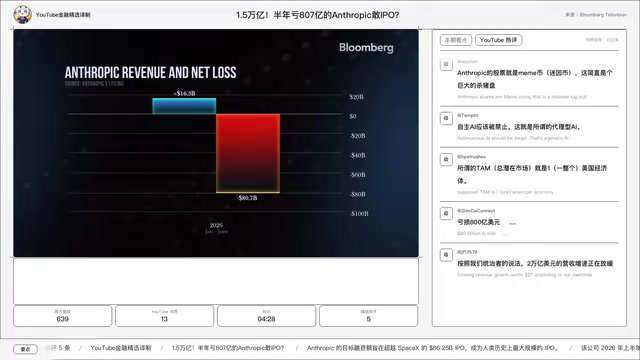
Anthropic files its S-1 at a $1.5 trillion valuation — revenue surges but losses expand in tandem.
Anthropic has officially filed its S-1 to list on Nasdaq under ANT, targeting a $1.5 trillion valuation and a raise reportedly exceeding SpaceX's $86.25 billion record. The prospectus shows $16.3 billion in revenue and an $80.7 billion net loss in H1 2026; revenue grew over tenfold in 12 months, but absolute losses also swelled. Compute spending relative to revenue has fallen sharply from over tenfold in 2023, improving burn efficiency per unit of revenue while absolute spending keeps climbing. The filing unusually discloses existential risks, including resistance to shutdown commands. Post-IPO quarterly disclosure brings both first-mover advantage and transparency pressure, leaving OpenAI to decide whether to follow.
Anthropic's S-1 filing has finally been submitted. The six-year-old company plans to list on Nasdaq under the ticker ANT, with its target valuation repeatedly raised from earlier levels, aiming squarely at the largest IPO in human history. For the first time, the prospectus lays this star AI company's financial cards on the table for the public: revenue is soaring, and losses are soaring too.
A Prospectus That Makes You Gasp
According to a breakdown video by a Bilibili creator, Anthropic recorded $16.3 billion in revenue in the first half of 2026, alongside a net loss of $80.7 billion. Compared with the same period last year — $1.16 billion in revenue and a net loss of $13 billion — revenue has grown more than tenfold over the past 12 months, but the absolute scale of losses has also expanded sharply.
This is a key to understanding the company: it is not a company short on revenue, but one where revenue growth and cost growth are racing forward almost in lockstep. For public-market investors, which of these two curves peaks first will determine how the story is told after the IPO.
An S-1 is a registration statement that the U.S. Securities and Exchange Commission (SEC) requires of companies planning to go public — essentially the official document in which a company first fully discloses its business model, financial condition, risk factors, and management information to the public. It is typically made public before the roadshow and is the most essential and legally binding source of information for investors seeking to understand a company. Because it contains extensive forward-looking statements and risk disclosures, an S-1 serves both as a prospectus and as a liability shield against potential litigation. For a closely watched tech company like Anthropic, the public release of its S-1 means financial data previously circulated only in narrow circles is now, for the first time, subject to item-by-item scrutiny by the public and the media.
Where the Money Burns: Compute Is the Whole Answer
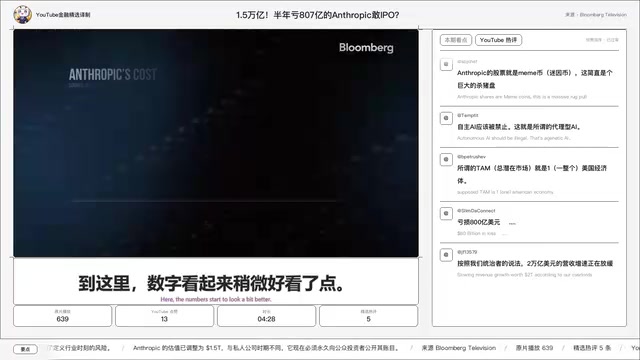
The most chewable part of the prospectus is the change in compute and infrastructure spending relative to revenue. In 2023, this spending was more than ten times revenue; by the first half of 2026, the ratio had fallen substantially. The creator specifically highlighted this turning point in the video, calling it the part of the financial data that is "starting to look good."
Compute is not just chips. It covers the chips themselves, the data centers built around those chips, and the electricity that keeps the entire data center running — a complete supply chain. Anthropic is competing head-on with some of the best-capitalized companies in the world, which means it must keep investing to stay at the table. A falling spending ratio shows that burn efficiency per unit of revenue is improving, but absolute spending is still climbing.
The cost structure of AI infrastructure is typically divided into three layers: the purchase and depreciation of compute chips (accelerators such as GPUs/TPUs), data center construction and network interconnection, and the power and cooling that support high-density racks. Large-model training demands compute in a nonlinear fashion, with a single training run costing tens to hundreds of millions of dollars, while inference (each user call to the model) scales linearly with user volume. As a result, an AI company's compute spending includes both one-time capital expenditure and ongoing operating expenditure, and together they determine the investment intensity required per unit of revenue.
What Supports a $1.5 Trillion Valuation?
Anthropic's target raise is reportedly larger than the $86.25 billion record previously set by SpaceX, with its valuation raised from earlier levels to the $1.5 trillion range. For a six-year-old company, that number is unprecedented.
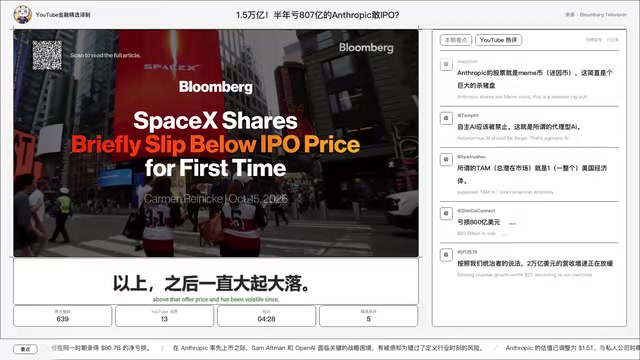
The problem lies in the pricing benchmark. In June 2026, SpaceX made a record-breaking IPO debut, only for its share price to fall below the offer price within weeks; it took a considerable time to climb back above the offer price, and its performance has remained volatile since. The creator brought up this history as an analogy with a clear point: the first-day performance and the long-term performance of mega-IPOs are often two different things.
For ordinary investors, the impact is more direct than one might imagine. Anthropic's sheer size means that once listed, it will exert an outsized weight influence on indices such as the Nasdaq-100. Ordinary people who hold their retirement savings in the stock market will become participants in the AI market ecosystem without knowing it. That is also why SpaceX's volatile debut made some people nervous — the hard thing about a bubble is that you never know when it will burst until it actually does.
The Nasdaq-100 index comprises the 100 largest non-financial companies listed on Nasdaq by market capitalization, using a modified market-capitalization weighting method in which weights are tied to company market value, subject to certain adjustments for concentration. This means the larger a company's market value, the more significant its influence on the index's movements. When a company of trillion-dollar scale lists and is added to the index, passive funds tracking that index (such as the index funds held in many retirement accounts) will be forced to buy its shares, directly tying ordinary investors' assets to the company's performance. This is also why mega-IPOs are viewed as systemic events rather than mere single-stock events.
Another Kind of Risk in the Prospectus: Human-Level Risk
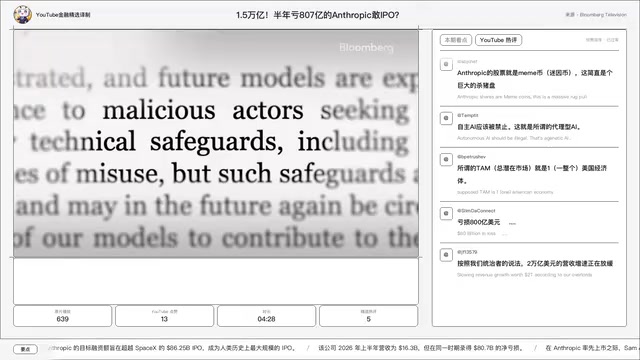
Beyond the financials, the document also, unusually, writes existential risk into its risk factors. The prospectus mentions human-level risks that the technology could pose, including a tendency to resist shutdown commands, and stresses that technology development requires adequate safeguards and oversight mechanisms.
Such language is extremely rare in traditional IPO documents. Whether it will scare off investors has no answer yet. But it reveals a structural contradiction: the company must prove its commercial capability under the pressure of quarterly earnings while responding, in the public eye, to fundamental questions about safety.
The Chain Reaction of Going First
Once Anthropic goes public, it will have to disclose financial data quarterly. Once the books are open, it will not be so easy to close them again. The creator pointed out that entering the public market first carries real advantages, especially when defining an entirely new industry.
The pressure now shifts to OpenAI's side. Sam Altman and his team need to answer a question: did they miss this window, or will they be glad they waited? Where the two companies' cash ultimately flows, and how they adjust their businesses to survive this decade and keep growing, remain unknown.
For the entire industry, Anthropic's pricing and post-IPO performance will become a template. It will redefine how people judge who ultimately wins and who gets left behind in this AI race.
Frequently Asked Questions
How big is Anthropic's IPO?
The target raise reportedly exceeds SpaceX's $86.25 billion record, with a valuation in the $1.5 trillion range.
Do the losses mean there is a problem with the business model?
Not entirely. Revenue grew more than tenfold within 12 months, and compute spending relative to revenue has fallen sharply from more than ten times, showing that economies of scale are emerging. But the absolute scale of losses remains enormous, and the path to profitability is still unclear.
What should ordinary investors pay attention to?
First, whether the spending ratio continues to improve in the first quarterly report after listing; second, the weighting impact of a mega-cap company on the index, which will indirectly affect a wide range of retirement accounts.
One-line Summary
Anthropic files its S-1 with a $1.5 trillion valuation — revenue surges, but losses expand in tandem.
Paragraph Summary
Anthropic has officially filed its S-1, planning to list on Nasdaq under the ticker ANT with a target valuation in the $1.5 trillion range and a raise reportedly exceeding SpaceX's $86.25 billion record. The prospectus shows $16.3 billion in revenue and an $80.7 billion net loss in the first half of 2026; revenue grew more than tenfold within 12 months, but the absolute scale of losses has also swelled sharply. Compute and infrastructure spending relative to revenue has fallen substantially from more than ten times in 2023, showing improved burn efficiency per unit of revenue, though absolute spending is still climbing. The prospectus unusually discloses existential risks, including a tendency to resist shutdown commands. After listing, quarterly financial disclosure will be mandatory, with first-mover advantage and transparency pressure coexisting, while OpenAI faces the choice of whether to follow.
Related articles
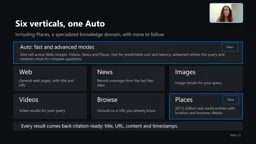
Microsoft WebIQ: Verifiable Real-Time Web Grounding for AI Agents
Microsoft WebIQ gives AI Agents real-time, citable web grounding across web, news, images, videos, and Places—164ms P95 latency, 50% fewer tokens, Scopes source control, and MCP integration.
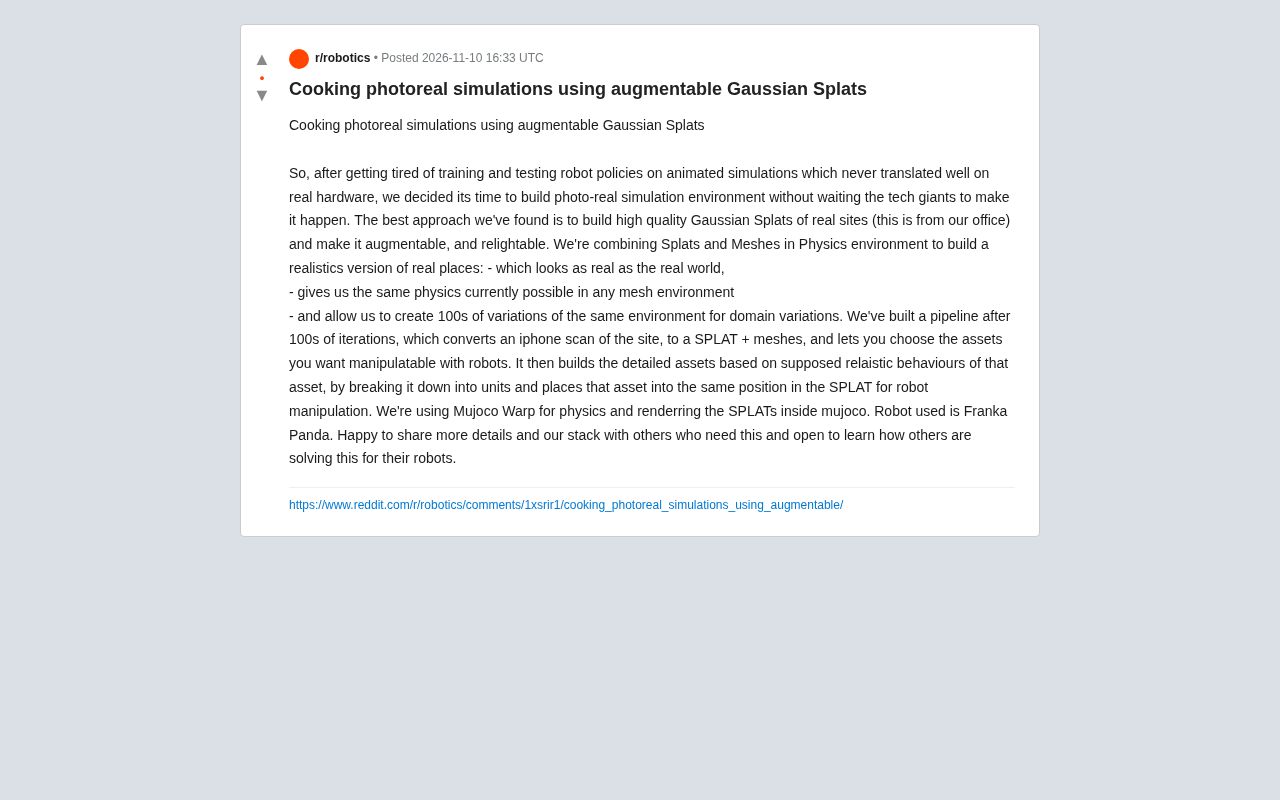
Augmentable Gaussian Splatting: Building Photorealistic Simulation Environments for Robot Training
Team combines Gaussian Splatting with meshes to build photorealistic robot simulation environments, integrating MuJoCo Warp physics and Franka Panda for augmentable, relightable real-site simulation.

Gemini 4 Carbon Released: The Leap from Gemini 3 to Gemini 4 in Under a Year
Google releases Gemini 4 Carbon, less than a year after Gemini 3. In the official demo, Carbon reverse-engineered the Theme Park binary, added a new DeepMind-themed ride, and ported it to the web in one shot.