Anthropic S-1 Breakdown: A $16.3B Revenue vs. $600B Compute Commitment Bet

Anthropic's S-1 reveals a bet between $16.3B in revenue and $600B in compute commitments, with market divergence on whether growth can cover long-term bills.
Anthropic's 400-page S-1 shows explosive growth: $16.3B in H1 revenue, a first $974M operating profit in Q2, gross margin rising from 40% to 85%, and NRR of 900%. But the real debate centers on its $600B+ in future compute commitments spread over a decade or more. With $1.32T in cash and third-party vehicle financing for TPUs, the company admits it is essentially uninsurable and warns of slowing growth—leaving the market split on whether fast growth can outrun the bills.
Anthropic S-1 Breakdown: A $16.3B Revenue vs. $600B Compute Commitment Bet
A 400-page S-1 filing lays out the most unvarnished picture of Anthropic yet: on one side, $16.3 billion in half-year revenue and 85% gross margins; on the other, over $600 billion in compute commitments. Wall Street spent a full day leafing through it page by page looking for surprises, and found that what really deserves scrutiny isn't how much the company is earning now, but how many bills it has already signed that it hasn't yet paid.
According to cross-readings of this filing across multiple tech commentary programs on Bilibili and YouTube, the market's and the venture community's divergent judgments on Anthropic almost entirely converge on the same equation: can the imagined space for future growth cover the long-term commitments already written down in black and white?
Performance: A Growth Curve That's Nearly Vertical
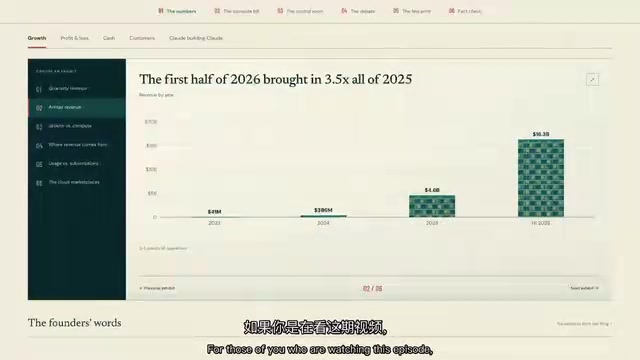
Anthropic disclosed in its S-1 that first-half revenue reached $16.3 billion, while full-year 2025 revenue was $4.6 billion. According to figures it shared with investors, third-quarter revenue was $16.8 billion, though that line in the S-1 was left blank and remains unconfirmed.
Signals on profitability are more noteworthy. Anthropic recorded $974 million in operating profit in the second quarter—its first profitable quarter, and on a GAAP basis. First-half gross operating margin reached 85%, up sharply from 40% for all of 2025, indicating that economies of scale are materializing.
But expenses swelled in tandem. R&D, sales, and administrative spending rose along with revenue, ultimately pulling operating margin to negative 4.3%. The $80 billion net loss in the first half looks frightening, but $72 billion of it comes from accounting treatment of convertible debt—a paper loss driven by a rising share price, with no cash outflow involved.
S-1 filing is the registration statement that the U.S. Securities and Exchange Commission (SEC) requires companies to submit when conducting an initial public offering (IPO), named after Form S-1 under the Securities Act of 1933. The document requires disclosure of detailed information including the company's business model, financial condition, risk factors, management compensation, shareholder structure, and use of proceeds, and typically runs hundreds of pages. Unlike the subsequent 10-K annual reports and 10-Q quarterly reports, the S-1 is the legal document through which a company first presents its operating condition comprehensively to public investors, and the accuracy and completeness of its disclosures are subject to strict legal constraints. For tech companies, the risk factors section of an S-1 is often the most informative part, because it requires the company to list all adverse factors that could affect the business in a nearly self-critical tone. The reason Anthropic's 400-page S-1 prompted Wall Street to study it page by page is precisely that it marks the first time the market can examine this AI company's true financial picture against the standard of legally mandated disclosure.
Customer Structure: Moving from a Few Large Clients Toward Diversification
Revenue quality is one of the biggest questions surrounding this document. Anthropic's answer: as of September, it had more than 11,900 customers spending over $100,000 annually, of which more than 1,900 spend over $1 million annually. Net revenue retention reached 900%, meaning the average customer expanded spending ninefold within a year.
Compared with roughly 1,500 enterprise customers spending over $100,000 annually last December, that number is now close to 12,000—an order-of-magnitude expansion of the customer base. Revenue concentration is also declining: at the end of the first quarter, the top five customers contributed about 36% of revenue; that share has now dropped to 21%.
There's also an easily overlooked detail—48% of revenue flows through distribution partners such as Google and AWS, which take a considerable cut, something not fully disclosed before.
Net Revenue Retention (NRR) is one of the most critical operating metrics for SaaS and subscription businesses. It measures the multiple by which the same cohort of customers changes its spending over a year, calculated as: revenue generated by the beginning-of-period customer cohort at period end ÷ beginning-of-period revenue × 100%. An NRR above 100% means existing customers are expanding consumption; above 120% is typically considered excellent, while the 900% Anthropic disclosed means the average customer expanded spending ninefold within a year. This figure is astonishing because it reflects the reality that enterprise customer usage is growing exponentially as AI model capabilities improve—customers are migrating more workloads to Claude, not merely paying higher prices. But a caveat: extremely high NRR often appears in very early stages with a tiny base, and as the customer base expands from 1,500 to nearly 12,000, the metric will most likely decline gradually. Investors need to distinguish between "early explosive expansion" and "sustainable long-term retention" when interpreting it—the latter is the variable that truly matters in valuation models.
Compute Commitments: Where Investors Really Diverge
Since 2023, Anthropic has invested a cumulative $19.2 billion in compute, including $8.9 billion in the first half. One counterintuitive data point: about 70% of the compute budget is used for internal work rather than serving external customers. The company also says 90% of its code is now written by Claude, and the value of internal Claude usage, converted at API prices, already exceeds its payroll.
What really sparked discussion is future commitments. Anthropic has signed future compute spending commitments on the scale of hundreds of billions of dollars, with the non-cancelable portion covering major commitments to Google, Amazon, Microsoft, and Broadcom; total signed commitments exceed $600 billion.
But these contracts are spread over more than ten years, with some running as long as 20 years. Amortized annually, the scale falls in the tens of billions range—not unmanageable relative to its current revenue growth rate. In the letter accompanying the S-1, Anthropic's founders described this compute spending as something that "may at first glance appear irresponsibly large," but insisted it is "bold and rational."
The company also warns that compute costs could rise significantly, and that compute partners such as Google and AWS may not always remain aligned with Anthropic's long-term interests—contracts exist, but as AI competition intensifies, they may not be honored as agreed. This is also why Anthropic has begun building its own data centers to reduce reliance on potential competitors.

Jevons Paradox was proposed by the 19th-century British economist William Stanley Jevons. It originally referred to the fact that after steam engine efficiency improved, total coal consumption rose rather than fell—because lower unit costs stimulated broader use cases. In the AI compute economy, this paradox is used to explain the relationship between falling token prices and revenue growth: when per-token cost falls due to higher hardware throughput, if the demand growth stimulated by price cuts is fast enough, total compute revenue and profit may actually rise. Anthropic's optimists base their case on exactly this logic—if per-GPU throughput improves faster than token prices fall, per-GPU revenue can keep growing, thereby supporting the return expectations behind its massive compute commitments. The article mentions that after the release of Opus 4.5, quarter-over-quarter growth jumped from 48% to 132%, seen as real-world confirmation of this paradox: stronger model capabilities unleashed previously suppressed demand, so price cuts did not erode total revenue. But this logic holds only if demand elasticity is large enough and competitors cannot seize market share with faster price cuts.
Cash and Debt: The Confidence and Concerns Behind $1.32 Trillion
Anthropic holds $1.32 trillion in cash and cash equivalents. The company has raised a cumulative $1.41 trillion historically, almost all of which is still sitting in the bank earning interest—$1.1 billion in interest income in the first half, about 6.5% of total revenue.
On the debt side, Anthropic owes Amazon $6.2 billion in convertible notes and retains the option to borrow an additional $77 billion from Amazon, Broadcom, and Google, plus a $15 billion revolving credit facility from Morgan Stanley as an emergency channel. The more significant financing method is through third-party vehicles set up with investment-grade partners: two vehicles with Broadcom—$35 billion and $63 billion—to finance TPU purchases, with structures arranged by Apollo and Blackstone.
How rating agencies will view this is a question without an answer for now. One investment-grade portfolio manager commented that Anthropic has very strong liquidity and extremely large future obligations, and that at current leverage levels its balance sheet can support an investment-grade rating, but the final outcome depends on how rating agencies view its commitment timeline, short operating history, and circular counterparty relationships.
Third-Party Vehicle Financing is a structured financing arrangement in which a company does not borrow directly but instead partners with investment-grade financial partners to set up special purpose vehicles (SPVs), which raise financing and purchase assets (such as TPU chips), and the company then uses those assets through long-term contracts. The two vehicles Anthropic set up with Broadcom ($35 billion and $63 billion) fall into this category, with structures arranged by Apollo and Blackstone. The advantage of this arrangement is that the debt does not appear directly on Anthropic's balance sheet, helping it maintain its own credit rating; at the same time, leveraging the financing capacity of investment-grade institutions such as Apollo and Blackstone allows it to complete massive purchases at a lower cost of capital. But the risk is that the debt of these vehicles ultimately remains tied to Anthropic's long-term payment obligations, and rating agencies will treat it as "hidden leverage" when assessing it. In addition, circular counterparty relationships (i.e., Anthropic is both a compute buyer paying Broadcom and Broadcom may be a shareholder or customer of Anthropic) add complexity to the financial structure, which is also a factor rating agencies need to weigh carefully.
Risk Disclosure: From "Uninsurable" to Slowing Growth
In over 90 pages of risk disclosure, Anthropic included catastrophic risks, climate change, and public backlash against data centers. The most candid item is the company's view that it is essentially uninsurable—the text states that no single insurer, nor even the entire insurance industry, is likely to have the underwriting capacity or expertise commensurate with this risk exposure.
A more specific item is slowing growth. Anthropic says revenue grew about 1,000% over the past year but does not expect that pace to continue; third-quarter growth was about 45% quarter-over-quarter—still strong—but the company says it has essentially no confidence in future growth rates.
Market Positioning: No Ads, Enterprise Business Only
Anthropic did not give a clear total addressable market, instead estimating the value of global knowledge work in 2025 at $40 trillion and citing IDC forecasts that AI investment could deliver cumulative global economic impact by 2031, while believing the actual impact could be even larger.
In the competitive landscape, Anthropic lists only OpenAI and Google as direct competitors. In the founders' letter, they pledge that Claude will not introduce advertising: once advertising enters the company's revenue targets, pressure to optimize engagement time grows, and they choose not to bring that pressure into Claude.
Divergence and Consensus
What emerges as consensus across multiple interpretations: Anthropic's cash reserves and expansion efficiency exceed most expectations, and the S-1 overall leaves Wall Street feeling more settled than before the disclosure. D.A. Davidson's head of technology research said this will be the first opportunity for investors to directly invest in a company driving the AI economy—a significant moment.
Divergence centers on the risk of delivering on long-term commitments. The optimistic camp's logic is that falling token prices don't necessarily depress revenue—if per-GPU throughput improves fast enough, per-GPU revenue may actually rise, and Anthropic's revenue and margins can climb in tandem with token price cuts. Some analysts cite the jump in quarter-over-quarter growth from 48% to 132% after the release of Opus 4.5 as a real-world Jevons Paradox.
The skeptical camp argues that the equation hasn't changed before or after the S-1 disclosure. Some put it bluntly: investors' real decision is simply to buy or not to buy, and most had already made up their minds before this week—just as with SpaceX and the future OpenAI IPO, believers believe and skeptics don't.
Final Thoughts
This prospectus doesn't offer an easy answer. It shows a company that achieved order-of-magnitude expansion in an extremely short time, and at the same time a list of contracts that bets the next decade on compute. Setting aside all the details, what ultimately determines Anthropic's IPO performance is still that simple yet hard-to-answer question: how long can high-speed growth last, and who will ultimately pay those bills already signed?
One-line Summary
Anthropic's prospectus reveals a bet between $16.3B in revenue and $600B in compute commitments, with market divergence focused on whether growth can cover long-term bills.
Paragraph Summary
Anthropic's 400-page S-1 shows explosive growth: $16.3 billion in first-half revenue, a first-ever $974 million operating profit in Q2, gross margin rising from 40% to 85%, customers spending over $100,000 annually growing from about 1,500 to nearly 12,000, and net revenue retention of 900%. But what really divides the market is its over $600 billion in future compute commitments, spread over more than ten years, which the founders call "bold and rational." The company holds $1.32 trillion in cash, has raised $1.41 trillion cumulatively, and is also financing TPU purchases through third-party vehicles. Its risk disclosure admits the company is essentially uninsurable and warns of slowing growth. Market consensus is that its cash reserves and expansion efficiency exceed expectations, while divergence centers on whether high-speed growth can last long enough to cover long-term compute bills—optimists counter with the Jevons Paradox, while skeptics say believers will always believe.
Related articles

Codex in Practice: From Installation and Configuration to Multi-Agent Collaboration
Based on a Bilibili Codex course overview, this guide maps the full path of AI coding assistants from installation and agents.md context design to CLI commands, MCP integration, and multi-agent collaboration.

Claude Code Installation and Model Switching Guide for Users in China
How can developers in China install Claude Code reliably? This article compiles a Bilibili creator's hands-on solution: install via NPM, skip official login, use CC Switch to configure API Keys and freely switch between DeepSeek, Kimi, and other models to avoid account bans.
AI Supply Chain Security: What Canary Tokens Reveal
Starting from a Hacker News discussion, this article analyzes the role of canary tokens in AI supply chain security: how they detect abnormal access to model weights, training data, and credentials, as well as coverage blind spots and cost constraints during implementation.