Anthropic's IPO Balancing Act: How to Take Wall Street's Money Without Being Captured by Capital

Anthropic seeks to use an elaborate governance architecture to insulate itself from Wall Street pressure in its IPO and protect its AI safety mission.
As Anthropic pursues an IPO, it faces a structural conflict between public-market pressure for short-term returns and its mission to "develop AI safely." The report says the company is designing a multi-layered governance mechanism—including control arrangements, mission-lock provisions, and independent safety oversight—that seeks to draw boundaries around Wall Street's influence while bringing in capital. The article reviews precedents such as OpenAI's nonprofit parent and the public benefit corporation (PBC) form, and notes that the IPO will put these paper designs to the test under real market pressure. If the plan works, it could become a template for frontier AI labs going public; if the provisions are diluted, it would become a cautionary case of mission compromising with capital.
AI safety leader Anthropic is facing a classic dilemma: on one side, the massive public-market capital that an IPO would bring; on the other, its founding mission to "develop AI safely for the benefit of humanity." According to tech outlet The Verge, Anthropic is designing an elaborate governance mechanism that seeks to embrace Wall Street without letting shareholder-return pressure erode its safety底线—its safety bottom line.
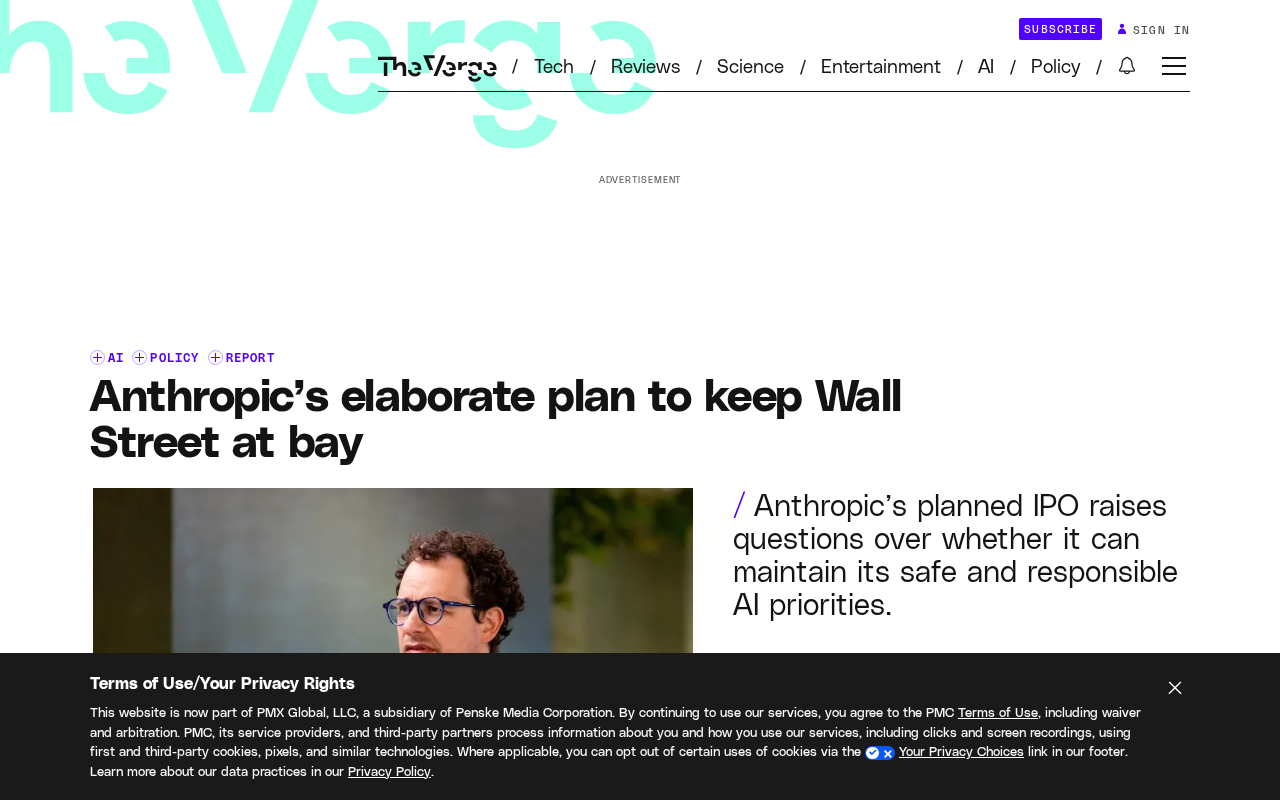
The Structural Tension Between Public Markets and the Safety Mission
Anthropic's situation is somewhat ironic. The stronger Claude—the core product of this company that bills itself as "responsible AI"—becomes, the greater the potential risks: from misuse and loss of control to societal impact, each of these points to decisions that require long-termism rather than quarterly-earnings-driven thinking. Yet the essence of public markets is short-term return orientation: shareholders expect a predictable growth curve, while safety research often means deliberately slowing the pace of commercialization and turning down high-margin but high-risk customers.
This tension is not unique to Anthropic, but it may be the first leading AI company to write "mission lock" into its listing structure. The report notes that Anthropic has explicitly stated it does not want to compromise its core mission, while also acknowledging that "more capable models bring greater risk"—a sentence that is itself a confession of the contradiction.
An Elaborately Designed "Wall Street-Proof" Governance Architecture
According to the report, Anthropic's response is a multi-layered corporate governance design aimed at retaining the founding team's control over key decisions while bringing in outside capital. Such arrangements typically include tools like dual-class share structures, mission-lock provisions, and independent safety oversight committees, making it difficult for short-term financial pressure to feed directly into decisions about model releases and safety investment.
Looking at industry precedents, this "mission-first" architecture is not new—OpenAI uses a nonprofit parent to control its for-profit entity, and Anthropic itself has adopted the public benefit corporation (PBC) form. But an IPO would put these paper designs to the test under the real pressures of public markets: when stock prices fluctuate, activist investors arrive, and quarterly guidance becomes the norm, whether the governance provisions can truly block demands to "accelerate commercialization" remains unknown.
Demonstration Value for the AI Industry's Financing Path
If Anthropic's plan proves viable, it could become a template for frontier AI companies going public. Leading AI labs today generally face a mismatch between massive compute investment and the commercialization return cycle, and public markets are an almost unavoidable source of funding. How to build an institutional firewall between financing needs and safety commitments will determine whether the next generation of AI companies is "tamed by capital" or "tames capital."
Conversely, if the governance provisions are gradually diluted after listing, it would also become a cautionary case: how long can a mission statement hold up against capital structure. The report's headline uses the phrase "keep Wall Street at bay," which itself implies a defensive posture—not rejecting capital, but drawing a red line that capital must not cross.
The mismatch between compute investment and return cycles at frontier AI labs is the key background for understanding their financing predicament. Training frontier large models requires sustained investment on the scale of billions of dollars in compute, data, and talent costs, while the growth curve of commercialization revenue (such as API calls and subscriptions) often lags and is uncertain. This "heavy investment first, slow returns later" model conflicts with public markets' expectations of predictable profitability, leading many labs to rely on venture capital or strategic investment. Although an IPO can provide large-scale long-term capital, it also introduces quarterly performance guidance and shareholder-return pressure, thereby amplifying the tension between safety commitments and the pace of commercialization.
Open Questions
Currently, public information remains at the level of an outline of the plan; key details such as specific provisions, voting-rights allocation, and veto mechanisms for safety decisions have not yet been disclosed. These details are precisely the core of judging whether the "elaborate plan" is a substantive constraint or public-relations narrative. For observers, signals worth tracking next include: the wording of governance provisions in the prospectus, the composition of the independent directors, and where the safety team sits in the organizational reporting line.
Background Notes
Dual-class share structure is a corporate governance arrangement common in tech company IPOs: the company divides its stock into classes with different voting rights, typically with founders and insiders holding Class B shares with multiple votes per share (such as 10 votes), while Class A shares held by public-market investors carry only 1 vote per share. This design allows the founding team to retain control over major decisions even after their ownership stake is diluted, with typical examples including Google, Meta, and Snap. The controversy is that it may weaken accountability to management and raise agency-cost concerns.
Public Benefit Corporation (PBC) is a corporate form permitted under the laws of some U.S. states that requires a company to write a clear public-benefit mission into its charter while pursuing shareholder financial returns, and to publish regular public-benefit reports. When making decisions, the board must balance shareholder interests with the established mission rather than focusing solely on profit maximization. Anthropic's adoption of this form is intended to provide a legal anchor for its safety mission.
One-line Summary
Anthropic seeks to use an elaborate governance architecture to insulate itself from Wall Street pressure in its IPO and protect its AI safety mission.
Paragraph Summary
As Anthropic pursues an IPO, it faces a structural conflict between public-market pressure for short-term returns and its mission to "develop AI safely." The report says the company is designing a multi-layered governance mechanism—including control arrangements, mission-lock provisions, and independent safety oversight—that seeks to draw boundaries around Wall Street's influence while bringing in capital. The article reviews precedents such as OpenAI's nonprofit parent and the public benefit corporation (PBC) form, and notes that the IPO will put these paper designs to the test under real market pressure. If the plan works, it could become a template for frontier AI labs going public; if the provisions are diluted, it would become a cautionary case of mission compromising with capital. Specific provisions have not yet been disclosed, and their substantive binding force remains to be seen.
Related articles

iPhone Duo Transformed into a Windows 98 Gaming PC: Hands-On Test and Experience
XDA tests turning the iPhone Duo foldable into a Windows 98 gaming PC using RetroArch and DOSBox Pure with virtual 3DFX, running Unreal Tournament, Half-Life, and Quake 3, plus Windows XP feasibility and limits.

Type-Safe Keep Rules in R8 and DEX Optimization in Practice
Google Play requires over 25% DEX optimization. This article explains the R8 configuration analyzer, Jetpack Keep type-safe annotations, and the Android CLI validation tool to help Android developers narrow keep rules, improve shrinking/optimization/obfuscation, and reduce ANRs.

Why Are Old Buildings More Beautiful Than New Ones? Pulitzer Prize-Winning Author Reveals an Overlooked Economic Truth
Pulitzer Prize-winning author Robert Caro found that poorer countries built more beautiful buildings. He reveals how cheap skilled craftsmen created the intricate details of old New York architecture, and how rising labor costs changed architectural aesthetics.