Anthropic's Trillion-Dollar IPO Pricing Logic: AI Asset Valuation Anchor and Supply Chain Transmission

Anthropic's trillion-dollar IPO pricing anchor depends on growth realization, transmitting to the computing chain and Hong Kong AI assets.
Anthropic's prospectus discloses a $70-78 offering range with a fully diluted valuation cap of approximately $1.4 trillion, pricing on November 18 and listing on November 19. As of October 2026, annualized run rate is approximately $81 billion; of the $104 billion net loss in the first nine months, approximately $94.3 billion is non-cash fair value changes, leaving an operating loss of only $1.26 billion. Industrial parties including Google and NVIDIA subscribe to $26 billion in non-voting Class N shares at the offering price, but Amazon's absence and lack of lock-up limits the endorsement effect. CITIC's valuation assumptions depend on revenue realization from 2026 to 2030; the offering valuation was cut from a rumored near $2 trillion to just over $1 trillion due to three discounts: slowing competition, computing costs, and open-source model diversion. The report treats this IPO as the anchor for the AI sector; recovery in Hong Kong AI and the U.S. computing chain depends on pricing acceptance, monthly run rate, and giant capital expenditures all staying on track simultaneously.
Anthropic's IPO process is becoming a key reference point for the AI industry's valuation system. The yet-to-be-listed company updated its prospectus on November 10, 2026, disclosing a price range of $70 to $78 per share, with pricing planned for November 18 and listing on Nasdaq on November 19 under the ticker ANT. On a fully diluted basis, the valuation cap is approximately $1.4 trillion. A core question follows: what supports this trillion-dollar pricing anchor, and how will it transmit to the tradable computing power chain and Hong Kong AI assets?
Offering Structure: What It Means for Industrial Capital to Subscribe at the Offering Price
According to the S-1 filing submitted on November 10, 2026 (originally written as SEA, likely a transcription error for S-1), Anthropic plans to offer 825 million Class A shares, including approximately 801 million newly issued shares and approximately 24 million shares sold by existing shareholders, plus a 30-day over-allotment option for up to approximately 124 million shares. Goldman Sachs and Morgan Stanley serve as lead underwriters.
More noteworthy is the concurrent placement arrangement: Google and NVIDIA each approximately $10 billion, AMD approximately $2.5 billion, Microsoft, Broadcom, and Micron each approximately $1 billion, and TSMC approximately $500 million, totaling $26 billion in non-voting Class N shares subscribed at the IPO offering price. Industrial parties locking in $26 billion at the same offering price—does this count as valuation endorsement? The answer is only half yes—the amount and the list do shore up the reliability of the lower end of the range, but Amazon is absent from the list, and these shares are not subject to underwriter lock-up agreements. The industrial parties' computing ecosystem binding considerations outweigh pure financial judgment.
Valuation needs to be viewed across different bases: with approximately 13.09 billion total shares, the offering range corresponds to approximately $916 billion to $1.02 trillion, with a fully diluted cap of approximately $1.405 trillion. Compared with the $965 billion from the last private round in May 2026, only the upper end of the circulating $1.2 to $1.4 trillion wide range matches the public basis. Calling it a valuation requires core evidence, and what the report values most is growth data.
S-1 Filing and Class N Shares
The S-1 is the registration statement required by the U.S. Securities and Exchange Commission (SEC) for initial public offerings. A company planning to go public must disclose in it core information including business model, financial data, risk factors, equity structure, and use of proceeds. It is the primary basis for investors to judge pricing rationality. The "SEA" mentioned in the article should be a transcription error for S-1.
Class N shares typically refer to a class of common stock with no or low voting rights. The Class N shares Anthropic places with industrial parties carry no voting rights, meaning subscribers such as Google and NVIDIA can only share in financial returns and cannot interfere with corporate governance. Such arrangements are common among high-valuation tech companies, bringing in strategic capital while avoiding control dilution.
Over-Allotment Option (Greenshoe Mechanism)
The article mentions "a 30-day over-allotment option for up to approximately 124 million shares," meaning underwriters may purchase additional shares at the offering price within 30 days after the offering, not exceeding 15% of the original offering size. This mechanism is used to stabilize the stock price in the early trading period: if demand is strong, additional shares can be issued to increase fundraising; if the stock falls below the offering price, underwriters can buy back to support it. This is standard IPO practice and does not change fundamental judgments, but it does affect short-term float and pricing stability.
Growth Fundamentals: $81 Billion Run Rate and the Huge Accounting Loss
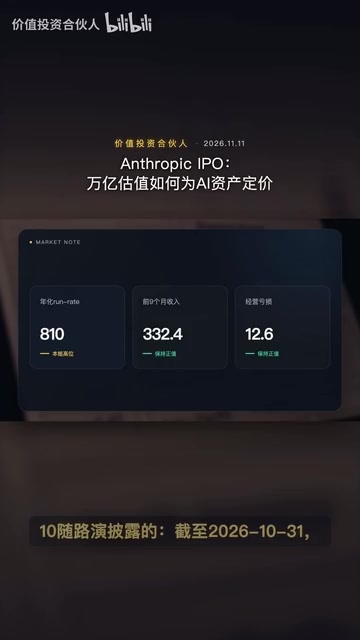
Official figures show that as of October 31, 2026, the annualized run rate was approximately $81 billion, about $10 billion more than the approximately $70 billion single-month figure at the end of September; revenue for the first nine months of 2026 was $33.24 billion, up approximately 1,200% year-over-year. Net loss for the same period was $104 billion, of which approximately $94.3 billion came from fair value changes in convertible bonds and derivative instruments—non-cash items. The actual operating loss was $1.26 billion.
This is critical for valuation judgment: the huge reported loss is mainly an accounting matter, and the operating-level cash burn is relatively manageable against the $81 billion run rate. CITIC's valuation level calculation assumption chain is: year-end 2026 ARR of $100 billion corresponds to approximately 12x PAR; 2026 revenue of approximately $55 billion at approximately 20x PS; 2027 ARR of approximately $220 billion with full-year revenue of $160 billion, bringing PS down to 8 to 9x; and a further step assuming 2030 revenue of $400 billion and adjusted net margin of 24%, corresponding to 12 to 14x PE. Compared with the approximately 6 to 13x PS range for leading software and internet companies in 2027, Anthropic's multiple is not high, but every tier is built on the premise that revenue forecasts materialize.

With such rapid growth, why did the offering valuation get cut from the rumored near $2 trillion to just over $1 trillion? The report gives three downward revision reasons: first, competition slowed in a single quarter of Q3 2026, the growth curve is not smooth, and investors demand a discount for visibility; second, large model inference has real computing costs, and high computing commitments include floor mechanisms—if growth slows in 2027, margins cannot return to Q2 2026 levels; third, competition—OpenAI and Google are catching up, and the report's own sample statistics claim that approximately 70% of token usage has already flowed to open-source models. All three are sell-side judgments, and this is how the discounted data level is derived.
Run Rate (Annualized Run-Rate Revenue) and ARR
Run rate is an annualized metric calculated by multiplying the most recent month's revenue by 12, reflecting current growth momentum rather than realized revenue. The article states that as of October 31, 2026, the run rate was approximately $81 billion, implying monthly revenue of approximately $6.75 billion. ARR (Annual Recurring Revenue) emphasizes the sustainability of subscription-based revenue. The two bases are different and cannot be used interchangeably.
Why Fair Value Changes Cause Huge Losses
Of Anthropic's $104 billion net loss, approximately $94.3 billion comes from fair value changes in convertible bonds and derivative instruments. The company previously issued convertible bonds or instruments with conversion rights. When the company's valuation rises sharply, the fair value of these instruments soars, and accounting rules require recognizing this as a loss. This is a non-cash, non-operating book adjustment that consumes no cash and does not reflect main business profitability. Excluding it, the operating loss is only $1.26 billion, which is indeed manageable relative to the $81 billion run rate. Understanding this distinction is key to judging Anthropic's true financial condition.
Sector Transmission: The IPO Is the "Anchor" for AI Assets, Not an Isolated Event
What the report really wants to discuss is not how one company is priced, but treating this IPO as the anchor for the entire AI sector. The market backdrop: according to media reports, the Philadelphia Semiconductor Index fell for 8 consecutive trading days in mid-October 2026, cumulatively about 15.7%, and was about 24% below its stage high; on November 5, 2026, the Nasdaq fell 5.52% in a single day, the Philadelphia Semiconductor Index fell more than 12% intraday, and NVIDIA fell 9%. The report's judgment is that after a sharp selloff, chips have been cleared and sentiment is already pessimistic; if the IPO roadshow and new models bring marginal positives, the rebound will be relatively quick—this is a sell-side view at the tactical level, not a calculation conclusion.
The repeatedly appearing "Feibao 5.2" in the report is a transcription distortion; the real product is Cloud Fable 5.2, released on November 9, 2026. The third-party evaluation cited by the report gives it approximately 65 points, higher than the previous best of approximately 60 points, with API prices cut by 20%, output speed increased by 30%, and a long-cycle case demonstrating thousands of agents collaborating for 30 hours to complete a formal mathematical proof. The release timing is tightly aligned with the roadshow window and is essentially part of the offering narrative; scores should be based on third-party leaderboards.

For mainland audiences, what can actually be traded is mainly the U.S. computing power chain and Hong Kong AI. On U.S. hardware, the report recommends allocating along computing assets with high data center exposure and sufficient pullback, noting that valuations of equipment and EDA leaders have returned to low percentiles since 2020 or 2022, provided the IPO drives sentiment recovery and short-term computing power remains tight. For Hong Kong stocks, look at the coordinates: Futu data shows Zhipu (02513.HK) closed at HK$482 on November 10, 2026, up 11.11%, with a total market cap of approximately HK$235 billion; MiniMax (00100.HK) closed at HK$73.10 that day, up 10.11%, with a 52-week high of HK$1,330 and a deep pullback from its listing high.
Zhipu's buyback of up to HK$4 billion is directly treated by the report as a positive. The timing needs to be clarified first: the buyback was announced on the evening of November 10, 2026, later than the November 9 report date, so it is an update after the report and not a basis for the report. The announcement states a buyback of up to HK$4 billion, capped at 1% of issued shares, and the company says it will not trigger a mandatory offer. CITIC's interpretation is that based on HK$4 billion and the 1% cap, the stock price can support continuous buybacks below HK$820, while the November 10 close was only HK$482—demonstrating sufficient sincerity. Considering that Zhipu has raised approximately HK$70 billion or more in cumulative net proceeds since listing and mainly uses cloud vendor leasing models for computing power, this money does not affect computing expansion.
On specific target upside: CITIC forecasts Zhipu's 2027 ARR in the $4.8 to $10 billion range; in the optimistic case, at 13x 2027, it gives a market cap target of approximately RMB 416.2 billion, and in the pessimistic case, at 13x PS, it is still close to RMB 260 billion. The institution says this corresponds to at least 50% upside. Note two points: this is a sell-side forecast, and realization requires both earnings estimates and multiples to hold; there is also an exchange rate difference between the institution's RMB basis and the Hong Kong dollar market cap.

How large is the revenue base gap between domestic model companies and overseas peers? The report estimates that the combined text model ARR of major domestic model companies is less than $10 billion, arguing that the low base itself is a source of elasticity. For the overseas side, be clear about the basis: the circulating extrapolation of approximately $180 billion by the end of 2026 can only be treated as an unverified rumor; the attributable third-party forecast is approximately $115 billion from FutureSearch, so the gap multiple can only serve as directional reference, not a precise coordinate.
Philadelphia Semiconductor Index and PS/PE Valuation Multiples
The Philadelphia Semiconductor Index (SOX) tracks 30 major global semiconductor companies and is a core indicator for observing sentiment in the computing power chain. The article mentions that in mid-October 2026 it fell for 8 consecutive trading days by approximately 15.7% and was about 24% below its stage high, indicating a short-term correction in market expectations for AI computing demand.
PS (price-to-sales) and PE (price-to-earnings) are the core tools in the article's valuation calculations. PS = market cap/revenue, suitable for high-growth, not-yet-profitable companies; PE = market cap/net profit, suitable for stable, mature profitability stages. CITIC's assumption chain gradually declines from approximately 20x PS in 2026 to 8 to 9x PS in 2027, then to 12 to 14x PE in 2030, essentially assuming Anthropic transitions from a high-growth loss phase to a mature profitable phase. Each multiple tier requires revenue and profit realization in the corresponding year; otherwise the valuation anchor will loosen.
Three Hard Observation Points and Conditions for the Main Thesis to Hold
The report and disclosures point to three hard observation points: first, the pricing on November 18, 2026, and the subscription heat at the November 19 open, plus where the opening price sits relative to the $70 to $78 range, directly test real demand; second, Q4 2026 earnings guidance from tech giants on 2027 capital expenditures, plus the quality of Zhipu's and MiniMax's next-generation flagship model releases in November-December 2026, determines whether the domestic model narrative can continue; third, the renewal window for enterprise AI deployment in Q1 2027, and the reshaping of computing rental prices after new-generation compute cards ship.
The conditions for this main thesis to hold can be compressed into one sentence: the IPO pricing is accepted by the market, monthly run rate and giant capital expenditures stay on track, and only then can the recovery of Hong Kong AI and the computing power chain be sustained. Conversely, if any link in this chain breaks—pricing falls below the range, monthly increment shrinks to a few billion dollars, giants cut capital expenditures—the revaluation narrative must be reset. This anchor prepays the high growth from 2027 to 2030 into the offering valuation; whether the anchor is stable ultimately depends on growth realization. (This article is based on public information analysis and does not constitute investment advice.)
Related articles

AI Writes Your Code—Do You Still Need to Learn Git? Five Reasons
AI coding agents handle Git operations automatically—is it still necessary to learn Git? Five reasons: team communication, reviewing agent PRs, monitoring code changes, fallback when AI goes down, and the joy of learning—plus how the focus of learning Git is shifting in the agent era.
Anthropic Reportedly Prices IPO at $83 Per Share, Valuing Company at $1.5 Trillion
Anthropic reportedly prices IPO at $83 per share, above the expected range, with a fully diluted valuation of $1.5 trillion. This article analyzes the signal significance of the pricing and its impact on the AI industry's financing environment.
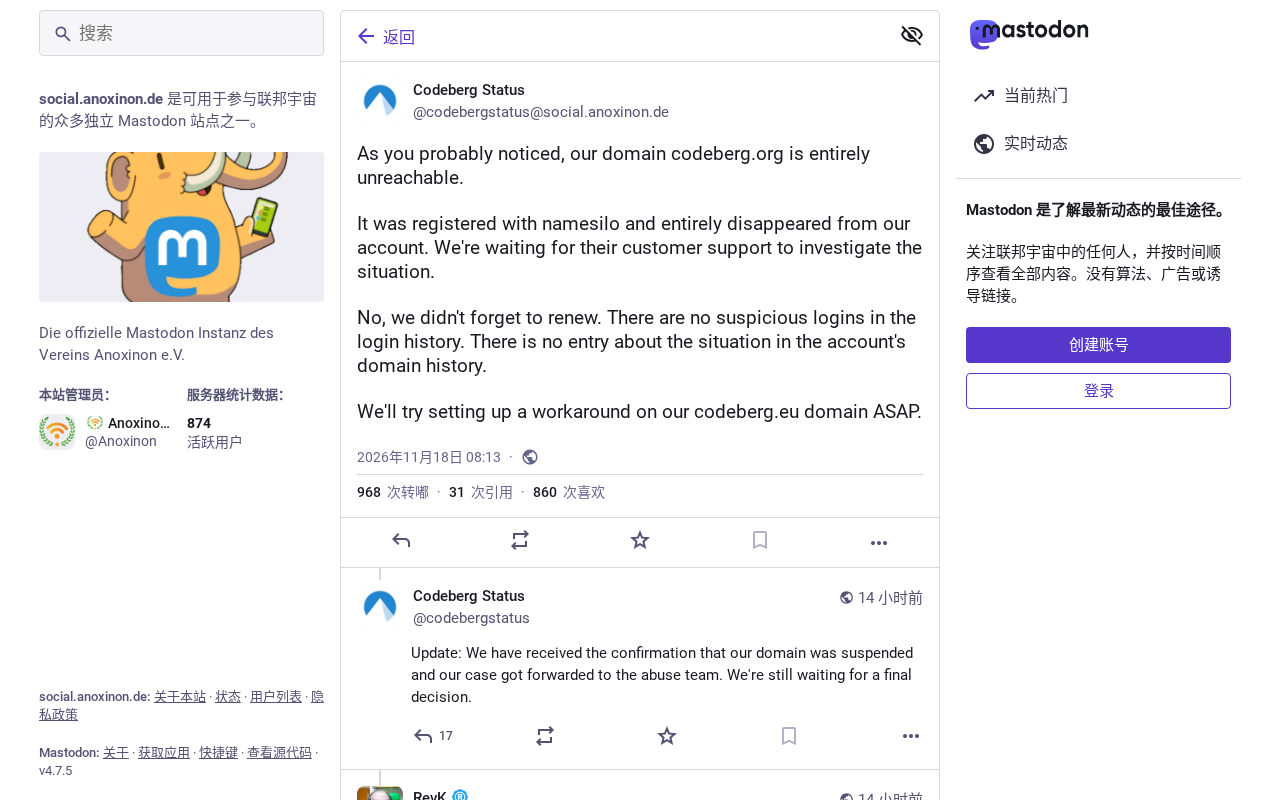
Open-Source Code Hosting Platform Codeberg Suffers Outage, Sparking Debate in Developer Community
Open-source code hosting platform Codeberg.org suffered an outage, sparking Hacker News debate over nonprofit platform stability and open-source infrastructure dependency risks.