AO3 Maintenance Outage Sparks Discussion: Fan Community Dependence and Resilience
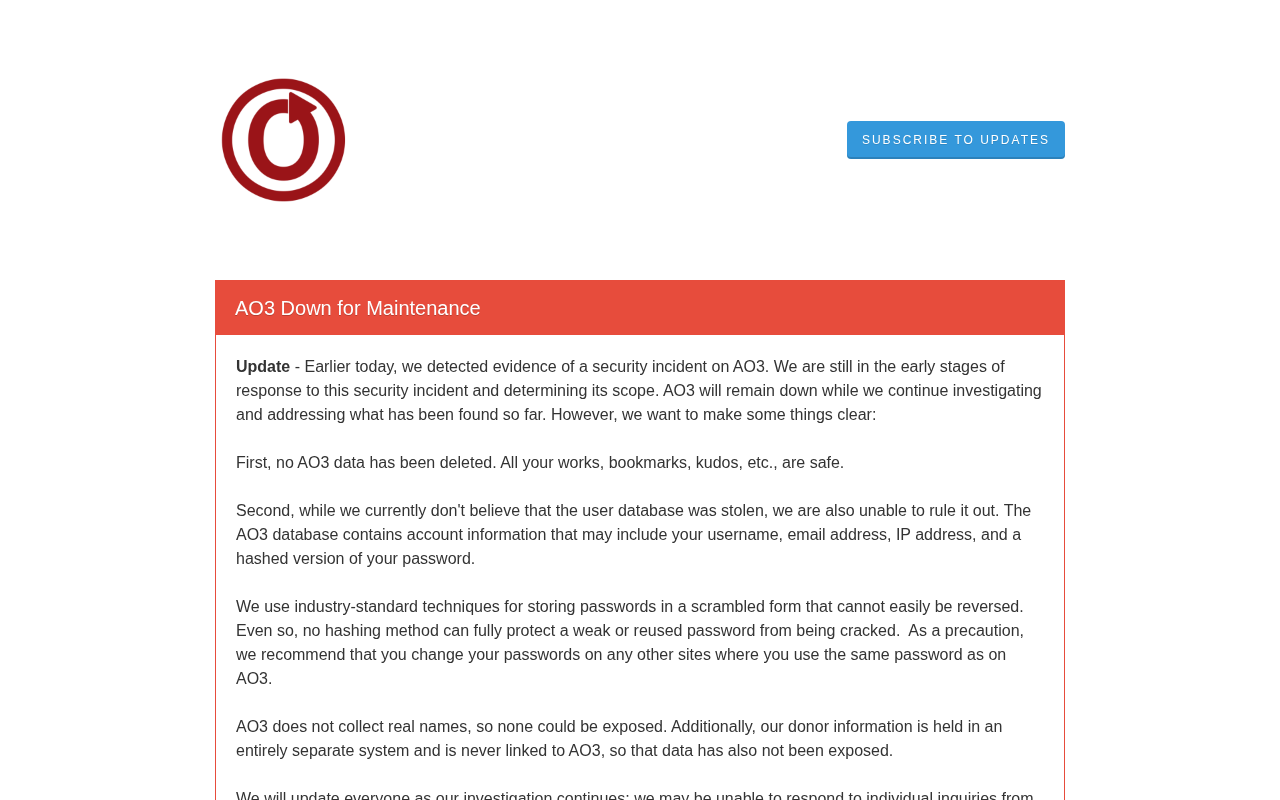
AO3 planned maintenance draws attention on Hacker News, reflecting the community value of nonprofit technical infrastructure.
A planned maintenance of AO3 (Archive of Our Own) gained 58 points and 8 comments on Hacker News. Although information is limited, it reflects the tech community's ongoing interest in nonprofit platform infrastructure. AO3 is operated by OTW, built on open-source software and maintained by volunteers, with an architecture emphasizing scalability and content durability. The maintenance event shows the fan community's high dependence on platform availability and also triggers discussion in the tech community about the fragility of centralized platforms, decentralized alternatives, and open-source governance. Due to the lack of official details, the analysis is mainly based on community reaction and background knowledge, but the event itself highlights the common challenges facing nonprofit digital public infrastructure in terms of sustainability, transparency, and community resilience.
Event Recap: Why a Planned Maintenance Draws Attention
A post titled "AO3 Down for Maintenance" appeared on Hacker News and quickly gained 58 points and accumulated 8 comments. Although the information is limited, the phenomenon itself is intriguing: why would a service interruption at a nonprofit fanfiction hosting platform enter the view of Hacker News, which is primarily composed of tech professionals?
According to the post title and source platform information, this outage was labeled as "maintenance," meaning it was not a sudden failure but a planned system operation. In tech communities, planned maintenance typically does not spark much discussion, but this AO3 maintenance still received some attention, reflecting the platform's importance among a specific user group and the tech community's curiosity about its infrastructure.
The Technical and Community Foundation of AO3
AO3 is operated by the nonprofit organization OTW (Organization for Transformative Works), built on open-source software, and has long relied on volunteer maintenance. Its architecture emphasizes scalability and content durability, which is relatively rare in the fanfiction creation space. Hacker News discussants often have a natural interest in open-source projects, nonprofit technical infrastructure, and community-driven models, and AO3 is precisely a combination of these characteristics.
Based on the comment interactions under the Hacker News post (8 comments in total), it can be inferred that the discussion may have revolved around maintenance duration, data security, platform architecture, or alternatives. Although the specific comment content is unavailable, given the typical style of tech communities, such posts often trigger reflection on the fragility of centralized platforms and exploration of decentralized or self-hosted alternatives.
OTW (Organization for Transformative Works) is a nonprofit organization founded in 2007 dedicated to protecting the legitimate rights and interests of fan creations and derivative works. In addition to AO3, it also operates the fan wiki Fanlore, the academic journal Transformative Works and Cultures, and legal advocacy projects. OTW's governance structure is led by a board of directors composed of volunteers, with funding primarily from user donations. This model allows it to maintain a high degree of community autonomy and independence in content policy outside of commercial platforms. AO3's codebase is also open source, with its core architecture based on Ruby on Rails, and it employs a custom tag system (tag wrangling) to organize massive amounts of works, which is an important technical feature that distinguishes it from general content platforms. Understanding OTW's nonprofit nature and volunteer culture helps grasp the logic behind AO3's maintenance decisions, which prioritize long-term sustainability over short-term commercial interests.
The Maintenance Event from Multiple Perspectives
Since the original material contains only the title and a small amount of metadata, lacking official announcements, user feedback, or technical details, the analysis in this article is mainly based on available information and background knowledge of the platform. Without multi-source cross-verification, we cannot confirm the specific cause, duration, or scope of impact of the maintenance.
However, from the community reaction (58 points, 8 comments), it can be inferred that AO3's availability has a practical impact on some users. In the fanfiction creation community, AO3 is not only a reading platform but also a hub for interaction between creators and readers, and service interruptions directly affect creation publishing and community communication. The tech community may be more concerned with the engineering challenges behind maintenance, such as how to complete upgrades without affecting massive amounts of work data.
Planned maintenance in engineering practice typically refers to a pre-announced system downtime window used for deploying updates, migrating data, or upgrading hardware. Unlike sudden failures, planned maintenance allows teams to operate under controlled conditions and notify users in advance through status pages, social media, and other channels. For a platform like AO3 that hosts millions of works and has considerable daily visits, maintenance often involves tasks such as database index rebuilding, storage expansion, or security patch application. The tech community's concerns about planned maintenance often include: whether announcements are timely and transparent, whether maintenance windows are chosen during low-traffic periods, and whether rollback plans are complete. These considerations are in line with change management principles in site reliability engineering (SRE), which also explains why Hacker News readers would take an interest in a seemingly ordinary maintenance.
Platform Reliability and Community Resilience
Although the specific details of this maintenance are unknown, AO3's long-term operational record shows that its team has a mature process for planned maintenance. For creators and readers who rely on AO3, short interruptions are usually acceptable, but frequent or prolonged outages may raise concerns about platform reliability.
From a broader perspective, AO3's maintenance event reminds us that the sustainability of nonprofit digital public infrastructure depends on community support and technical transparency. The tech community's attention to such events may perhaps drive more discussion about open-source governance and platform resilience.
Digital public infrastructure refers to systems operated by non-market forces (governments, nonprofit organizations, or communities) that provide foundational digital services to the public, such as Wikipedia, public library digital collections, and AO3. Such infrastructure is characterized by its value increasing with user scale, but operating funds and manpower are often limited, and sustainability depends on donations, volunteer service, and transparent governance. Unlike commercial platforms, they are less influenced by advertisers or shareholder pressure, but they also face risks such as volunteer attrition, accumulated technical debt, and funding fluctuations. Discussions around such platforms often involve the concept of "platform resilience," i.e., the ability of a system to maintain core services and recover quickly when facing interruptions, attacks, or resource shortages. AO3's maintenance event can therefore be seen as a micro-case for observing the governance and resilience building of nonprofit digital infrastructure.
Conclusion
This planned maintenance of AO3 received some attention on Hacker News. Although the information is limited, it reflects the tech community's ongoing interest in nonprofit platform infrastructure. For the fan community, AO3's stable operation is crucial; for tech observers, its operating model and maintenance practices provide a case worth studying. In the future, as the platform grows, how to balance maintenance needs with user experience will be a long-term challenge for AO3 and similar platforms.
Related articles
Salesforce Acquires Rune for $375M: AI Logistics Tech Bolsters Defense Business
Salesforce reportedly acquires defense tech startup Rune for $375M. Rune's AI logistics tech will strengthen Salesforce's Missionforce defense platform, continuing its M&A spree.

Why Fair Use Benefits Everyone in the AI Era
Starting from a Hacker News discussion, this article analyzes the legal logic and controversies of the fair use principle in AI training and content creation, and its dual impact on creators and the tech ecosystem.

Mistral Large 4 Open-Sources a Trillion Parameters, Microsoft Offers Voluntary Severance to 60,000 Employees
Mistral Large 4 open-sources a trillion-parameter multimodal model with a coding agent score of 48; SanDisk earnings show AI inference reshaping NAND demand; Google Gemini adds in-app file editing, OpenAI raises Codex quotas, and Microsoft offers voluntary severance to 60,000 employees.