Apple Acknowledges iPhone Duo Inner Screen Defect: Foldable Durability Under Scrutiny Again

Apple acknowledges bright-line and cracking issues in a small number of iPhone Duo inner screens, renewing focus on foldable reliability.
Apple publicly responded for the first time to iPhone Duo inner-screen failures, acknowledging that a small number of devices have an issue affecting the inner display, typically a bright line running from center to right along with cracks. The article notes that such failures point to damage to the OLED panel or flex cable in the folding area—a common challenge for foldables in materials, hinges, and quality control, one that Samsung, Huawei, and others also faced early on. Apple limits the scope with wording like "small number" and "issue" but discloses no cause, affected batches, or repair plan. For users, official acknowledgment is usually a precursor to a special repair program, so preserving evidence and contacting official support is advised. The article argues foldables still need time to mature, and public acknowledgment by leading manufacturers helps drive industry durability standards.
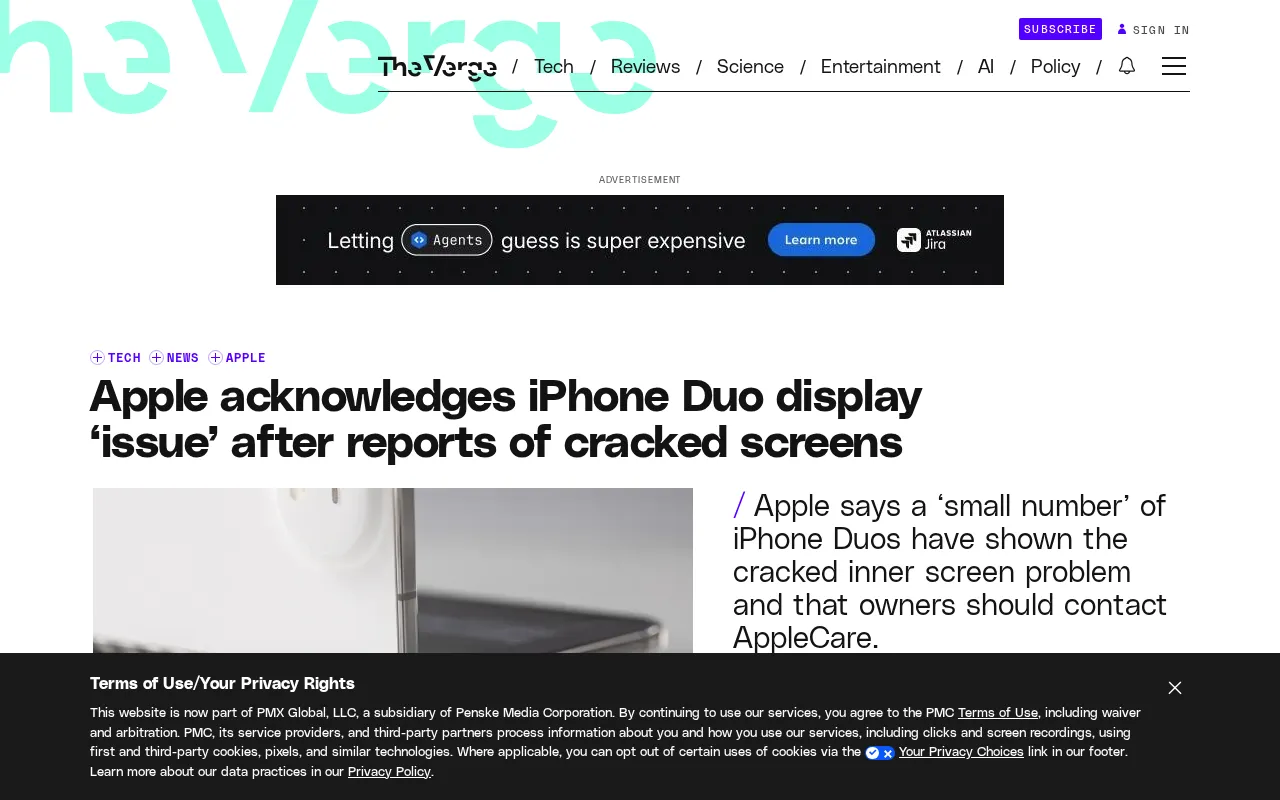
The durability of foldable phones' inner screens has long been a focus of the industry. Apple recently broke its silence, acknowledging that some iPhone Duo devices have an "issue" with the inner screen, after users reported cracks and bright lines running across the display.
Apple's Official Response: A Small Number of Devices Affected
According to Bloomberg and 9to5Mac, after receiving multiple reports of iPhone Duo inner screens cracking and breaking, Apple said in a statement that it has noticed a "small number of iPhone Duo devices" have an "issue affecting the inner display." These failures typically manifest as a bright line running from the center to the right side of the screen, with some devices also showing cracks.
Apple's wording deserves a closer read—"small number" and "issue" both confirm the existence of the defect and limit the scope of impact to a limited batch. This phrasing is not uncommon in Apple's historical statements, but it does not mention the specific cause of the failure, the production batch of affected devices, or whether a free repair program is involved.
For a high-end foldable product, the inner screen is one of the most expensive and complex components. Apple's choice to publicly acknowledge rather than stay silent suggests that the number of user reports has reached the threshold requiring an official response.
The Achilles' Heel of Foldables: Why the Inner Screen Is Fragile
A foldable phone's inner screen must maintain display integrity through repeated folding, which places extremely high demands on materials science and structural engineering. Unlike traditional slab phone screens, foldable inner displays typically use ultra-thin flexible glass or polymer film covers, whose impact and deformation resistance is naturally weaker than rigid glass.
Judging from the "bright line from center to right" described by users, the failure mode points to damage to the display panel or the flex cable near the folding area. Bright lines are typically a classic symptom of pixel row or column driver failure in OLED panels, while cracks may stem from stress concentration in the hinge area or foreign object intrusion.
This is not a predicament unique to Apple. Samsung, Huawei, and other manufacturers all encountered similar inner-screen reliability issues in early foldable products, and only improved gradually after multiple generations of iteration. As Apple's attempt in this category, the iPhone Duo is clearly still going through this "required course."
Ultra-Thin Glass (UTG) is one of the mainstream solutions for foldable inner screen covers, typically around 30 microns thick, requiring chemical thinning and strengthening to balance foldability and hardness. UTG's advantages are a feel close to traditional glass and high optical transmittance, but its impact resistance is significantly weaker than ordinary cover glass, and tiny scratches can expand into cracks under repeated folding stress. Another approach is polymer films such as transparent polyimide (CPI), which fold better but tend to develop creases and have poorer scratch resistance. Regardless of the material, reliability depends heavily on the hinge's bend radius design and foreign-object protection—which is why foldable inner-screen failures tend to concentrate near the folding area.
Bright-line failures in OLED panels are not uncommon in the display industry. OLED uses a pixel array driven row by row and column by column, with row and column driver circuits usually connected to the panel edge via COF (Chip-on-Film) or flexible cables. When a flex cable suffers bending fatigue, stress concentration, or micro-cracks that interrupt a driver signal path, the corresponding entire row or column of pixels cannot light up or turn off properly, appearing on screen as a bright or dark line running across the display. Unlike ordinary bright dots or dead pixels, bright lines usually mean damage at the driver link level and typically cannot be fixed via software, requiring replacement of the entire display module—one of the technical reasons why foldable repair costs remain high.
What Should Users Do?
For iPhone Duo users who have already experienced inner-screen failures, Apple's statement is a positive signal—official acknowledgment is usually a prerequisite for launching a repair program. The original text mentions "If your iPhone Duo……", hinting that targeted handling may follow, though specific details have not yet been disclosed.
Affected users are advised to preserve evidence of the failure (photos or video) and contact Apple's official support channels as soon as possible. Given the high cost of foldable repairs, confirming whether the issue falls under warranty or a special repair program will directly affect users' repair expenses.
In consumer electronics, there is usually a process between "official acknowledgment of an issue" and "launching a repair program." Manufacturers generally need to first complete failure attribution, determine the scope of affected batches, then assess whether it is a design defect or manufacturing defect, before possibly rolling out special programs such as extended warranty, free repair, or replacement. During this period, users should keep purchase receipts, failure photos and videos, and record when the failure appeared and under what usage scenarios—these materials often have practical value when later asserting warranty rights. If the device is still within the standard warranty period, it is advisable to go through official channels rather than third-party repair to avoid affecting eligibility for subsequent special programs.
Foldables Still Need Time to Mature
Apple's acknowledgment of the iPhone Duo inner-screen issue sounds a warning bell for the foldable category. From a technical perspective, inner-screen reliability involves multiple links—materials, hinge design, manufacturing processes, and quality control—and any weak point can be amplified in users' daily use.
For Apple, this is a trust test for its foldable product line; for the industry, public acknowledgment by a leading manufacturer actually helps promote the establishment of durability standards for foldables. When choosing foldable devices, consumers should consider not only form-factor innovation but also manufacturers' after-sales commitments and repair policies.
The adoption of foldables will not stop because of a single defect, but every public acknowledgment is a true footnote to this category's march toward maturity.
One-line Summary
Apple acknowledges that a small number of iPhone Duo inner screens have bright-line and cracking issues, drawing renewed attention to foldable reliability.
Paragraph Summary
Apple publicly responded for the first time to iPhone Duo inner-screen failures, acknowledging that a small number of devices have an issue affecting the inner display, typically manifesting as a bright line running from the center to the right side of the screen along with cracks. The article analyzes that such failures point to damage to the OLED panel or flex cable in the folding area—a common challenge for the foldable category in materials, hinges, and quality control, one that Samsung, Huawei, and others also experienced in early products. Apple limits the scope with wording like "small number" and "issue" but does not disclose the cause, affected batches, or a repair plan. For users, official acknowledgment is usually a precursor to a special repair program, so it is advisable to preserve failure evidence and contact official support. The article argues that foldables still need time to mature, and public acknowledgment by leading manufacturers helps drive industry durability standards.
Related articles

T3 Code: The Open-Source AI Coding Assistant's Comeback Story
T3 Code is an open-source AI coding assistant that unifies subscriptions like Codex and Claude, with powerful remote control and parallel task management.

Never Elected, Yet Ruled New York for 30 Years: The Ultimate Case Study in the Mechanics of Power
Robert Caro's biographies reveal how unelected Robert Moses ruled New York for 30 years through legal drafting and public authorities, and how Lyndon Johnson built leverage as a "powerless" Senate Majority Leader. Unpacking the underlying logic of accumulating and sustaining power.

The CPython 3.10 Recursion Trap and Synthetic Recovery in TokenGuard, an LLM Circuit Breaker
TokenGuard's author recounts a recursion crash caused by OrderedDict.pop in CPython 3.10 and introduces v0.3.0's Loop Nudge synthetic recovery, inline DLP scanning, and other new LLM agent circuit-breaker capabilities.