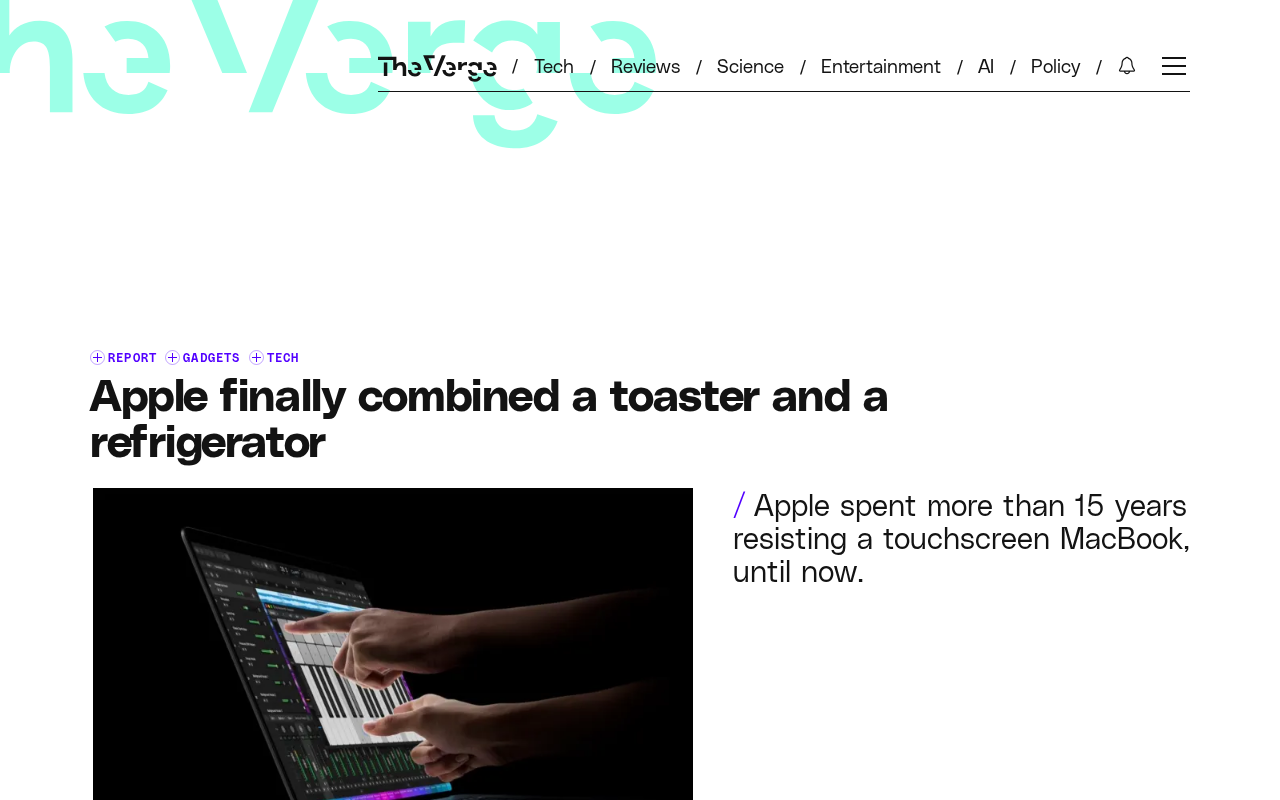
Apple Finally Merges the "Toaster" and the "Fridge": The Touchscreen MacBook Is Here

Apple breaks a 15-year stance to launch a touchscreen MacBook, but key details are missing—success hinges on interaction design.
After roughly 15 years of rejecting the touchscreen MacBook, Apple has officially announced one. CEO John Ternus described the experience as "you have to touch it to believe it," hinting at an undisclosed interaction solution. The article notes Apple's earlier refusal was a product philosophy issue: macOS's keyboard-and-mouse logic inherently conflicts with touch logic, and simply adding a touchscreen would only yield a half-baked experience. The "toaster + fridge" metaphor highlights the risk of forced combination while reminding us Apple excels at reintegrating seemingly incompatible things. Since the original lacks substantive details like price, size, release date, and software adaptation, actual experience can't be assessed yet. Success hinges on natural division of labor between touch and keyboard/mouse, genuine macOS touch adaptation, and a compelling reason to pay more.
A "Different" Response, 15 Years in the Making
For the past 15 years, Apple's stance on the touchscreen MacBook has been one of clear refusal. And then yesterday, Apple announced the launch of a touchscreen MacBook—officially "Thinking Different" for once. At the event, CEO John Ternus put it this way: "You have to touch it yourself to believe it." The problem is that most of us, myself included, haven't touched it yet.
This "haven't touched it" is no joke. The touchscreen MacBook has been agonized over inside Apple for far too long, and outside expectations have been repeatedly raised, lowered, and raised again. Now that the product is real, the most worthwhile discussion isn't "Apple finally did it," but "why now, what did they make, and will it once again redefine touchscreen laptop interaction"—though a complete answer isn't yet possible.
From Resistance to Entry: Has Apple's Product Logic Changed?
The Long "No" Was Never a Technical Problem
Apple's previous rejection of the touchscreen MacBook wasn't about being unable to build one. The bigger reason was product philosophy: macOS interaction is built on keyboard, mouse, and trackpad, and simply adding a touchscreen tends to produce a half-baked experience where "your fingers can't reach and it feels awkward to use." What Apple rejected in the past was, in fact, a touchscreen without a supporting software ecosystem and interaction guidelines.
The underlying difference in interaction between macOS and iPadOS is the key context for understanding Apple's long refusal of the touchscreen MacBook. Since its inception, macOS's interaction model has been built around "indirect input": the cursor serves as a proxy for the finger, and a large number of interface elements—menu bars, context menus, hover states—depend on the concept of "pointer position." A touchscreen, by contrast, is "direct input": the finger is both cursor and target, and hover states simply don't exist physically. This means bringing macOS to a touchscreen isn't as simple as adding a touch driver layer—it requires redesigning a large set of interaction paradigms that depend on hover and precise clicking. Apple's past reluctance was, to a large extent, a reluctance to introduce a "second input language" into macOS that conflicts with existing conventions.
The "Yes" Today Requires a New Answer
Ternus's line—"you have to touch it to believe it"—implies Apple believes it has found some solution capable of supporting a touch experience. What that solution is, the original article doesn't elaborate. But one thing is certain: if all Apple were doing was adding a touchscreen to the MacBook, it wouldn't have waited 15 years, nor would it have wrapped it in language like "Think Different." The real point of interest in the touchscreen MacBook is whether touch operation and macOS will form a new logic of Apple's own—rather than simply porting the iPad's touch experience onto a laptop.
"Think Different" was an advertising slogan Apple launched in 1997, created by TBWA\Chiat\Day, accompanied by ads featuring black-and-white portraits of "unconventional thinkers" like Einstein, Picasso, and John Lennon. It later became a core symbol of Apple's brand spirit, emphasizing going against the grain and challenging industry consensus. That Apple uses this phrase to frame the touchscreen MacBook is itself a rhetorical self-reference: an acknowledgment that it once stood against the majority and is now actively reversing course. For observers, the weight of this phrasing exceeds that of the product itself—it implies Apple sees this shift not as a compromise but as a proactive redefinition.
What the "Toaster + Fridge" Metaphor Reveals
"Combining a toaster and a fridge" is a slightly tongue-in-cheek metaphor: forcing two mature categories together doesn't necessarily produce a good product—it may end up pleasing no one. Applied to the touchscreen MacBook, the metaphor fits well—the keyboard-and-trackpad logic of a laptop and the logic of a touchscreen are, after all, two different things.
But viewed from another angle, the metaphor also points to Apple's greatest strength: making things that seemingly shouldn't be combined into something people want to use. Historically, Apple has been questioned many times with "others did this long ago," only to redo an entire category through experience integration. If the touchscreen MacBook succeeds, the reason won't be "it added a touchscreen" but "after adding it, the division of labor between keyboard/mouse and fingers became natural."
The phrase "toaster-fridge" has a specific origin in tech commentary: it's often used to describe the product approach of "forcibly merging two mature products with unrelated functions," and was initially used mostly to criticize the cobbled-together feel of smart home or 2-in-1 devices. In the laptop context, the core contradiction it points to is the difference between "form fusion" and "interaction fusion": the former physically attaches a touchscreen, while the latter establishes a clear division of labor between fingers and keyboard/mouse. Historically, the Surface series and some Windows touchscreen laptops have suffered the awkwardness of "having a touchscreen but users rarely using it," precisely because form fusion preceded interaction fusion. The metaphor is therefore not just a joke but a precise name for the hurdle the touchscreen MacBook must clear.
No Conclusion Yet
To be candid: the information provided in the original article is extremely limited. Beyond "Apple announced a touchscreen MacBook" and "Ternus said you have to touch it to believe it," there are no substantive details about size, price, release date, specific interaction methods, or the scope of software adaptation. This means any judgment at this stage about "whether it's worth buying" or "whether it's good to use" lacks a factual basis.
What can be discussed are the criteria for judging it: whether touch on the MacBook solves the problem of "when your hand should leave the trackpad and when it should tap the screen directly"; whether macOS has been genuinely adapted for touch rather than merely made compatible; and whether Apple offers a reason people would be willing to pay more for it. These three points will determine the success or failure of the touchscreen MacBook more than any spec.
Editor's Observation
That Apple has broken a stance it held for 15 years is itself a signal: laptop input methods may be entering a new round of adjustment. But "announcing the launch" is only the starting point. What truly determines the significance of this matter is whether that line—said after touching it—actually holds up. Until then, maintaining cautious expectation is more appropriate than rushing to take sides.
One-line Summary
Apple breaks a 15-year stance to launch a touchscreen MacBook, but key details are missing—success hinges on interaction design.
Paragraph Summary
After roughly 15 years of rejecting the touchscreen MacBook, Apple has officially announced such a product. CEO John Ternus described the experience as "you have to touch it to believe it," hinting at an undisclosed interaction solution. The article notes that Apple's earlier refusal was not a technical issue but a product philosophy: macOS's keyboard-and-mouse logic inherently conflicts with touch logic, and simply adding a touchscreen would only yield a half-baked experience. The "toaster + fridge" metaphor highlights the risk of such a forced combination while also reminding us that Apple excels at reintegrating things that seemingly shouldn't be combined. Since the original article lacks substantive details such as price, size, release date, and software adaptation, the actual experience cannot be assessed at this stage. The criteria for judging success are: whether the division of labor between touch and keyboard/mouse is natural, whether macOS is genuinely adapted for touch, and whether Apple can offer a reason people would be willing to pay more.
Related articles

Why Does Self-Play AI Always Get Crushed by Cheap Units? An RTS Developer's Account of the Dilemma
An independent developer trained an RTS commander AI with pure self-play, only to find it dominated historical versions but was crushed by human players using cheap tier-1 units. This article analyzes the causes of self-play strategy collapse, explores solutions such as exploiters, diversity rewards, and reward design, and introduces the open Bot Kit and AI league plan.
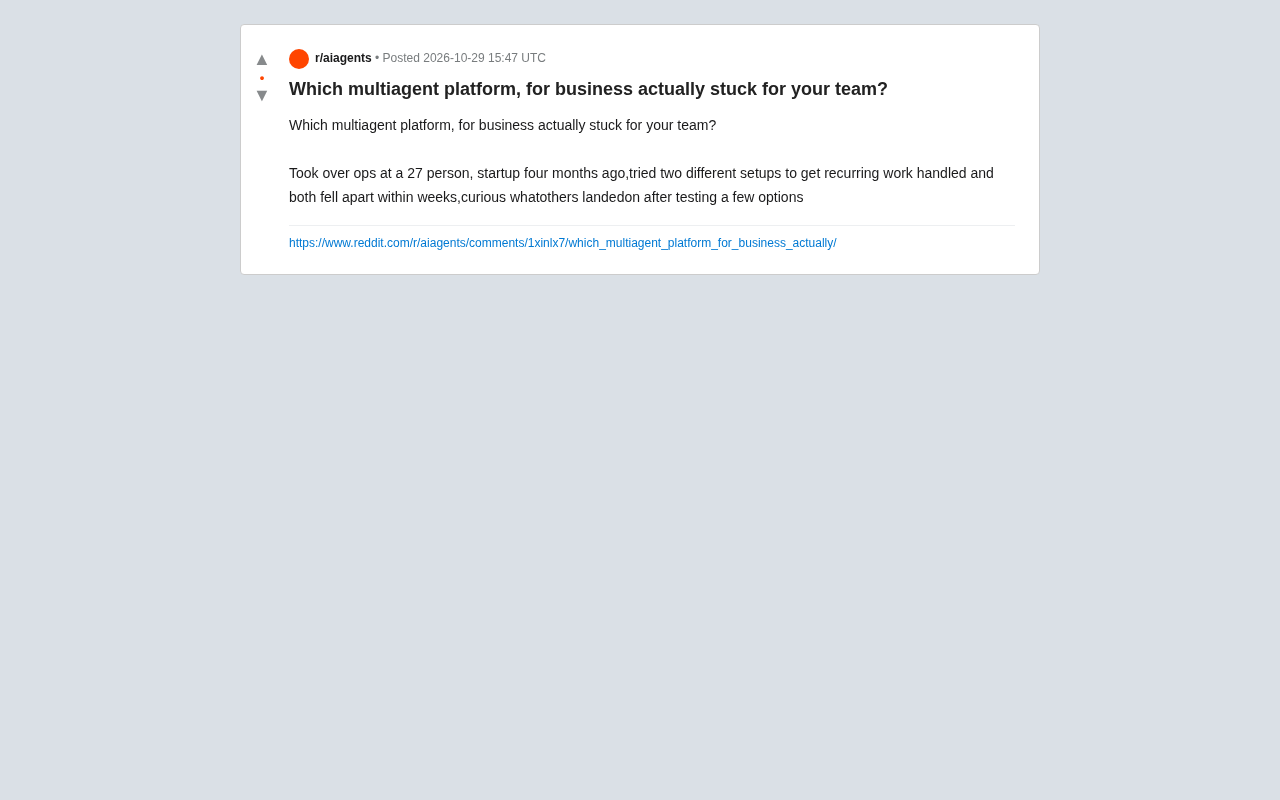
Which Multi-Agent Platform Wins? A Small Team's Battle Scars and Selection Considerations
A 27-person startup's ops lead tried two multi-agent platforms in four months and both failed. This article analyzes why small-team deployments break down, and offers selection guidance on integration depth, observability, and progressive rollout.

Thrive Holdings Takes ADT Private in $7.6 Billion Deal
Thrive Holdings acquires ADT for $7.6 billion in an all-cash take-private deal expected to close in Q1 2027. Analysis of the deal structure, ADT's asset value, and impact on the smart home security industry.