Apple's Touchscreen MacBook Is Coming: Can a Late Innovation Win From Behind?

Apple may launch a touchscreen MacBook; success hinges on system-level touch adaptation, not hardware.
The article discusses rumors that Apple will launch a touchscreen MacBook, noting that touch laptops have existed in the Windows camp for years but have limited presence due to weak interaction design and overlap with keyboard/mouse use. Apple is known for winning from behind; its opportunity isn't adding a touchable screen but whether macOS can leverage iPadOS touch experience for deep system- and ecosystem-level adaptation. The real challenge is balancing touch and keyboard/mouse efficiency in professional software and whether developers must maintain two interaction logics. Microsoft's Surface has explored for years without a perfect solution. If Apple merely copies Windows, it will be mediocre; if it redefines laptop touch interaction, it could win from behind.
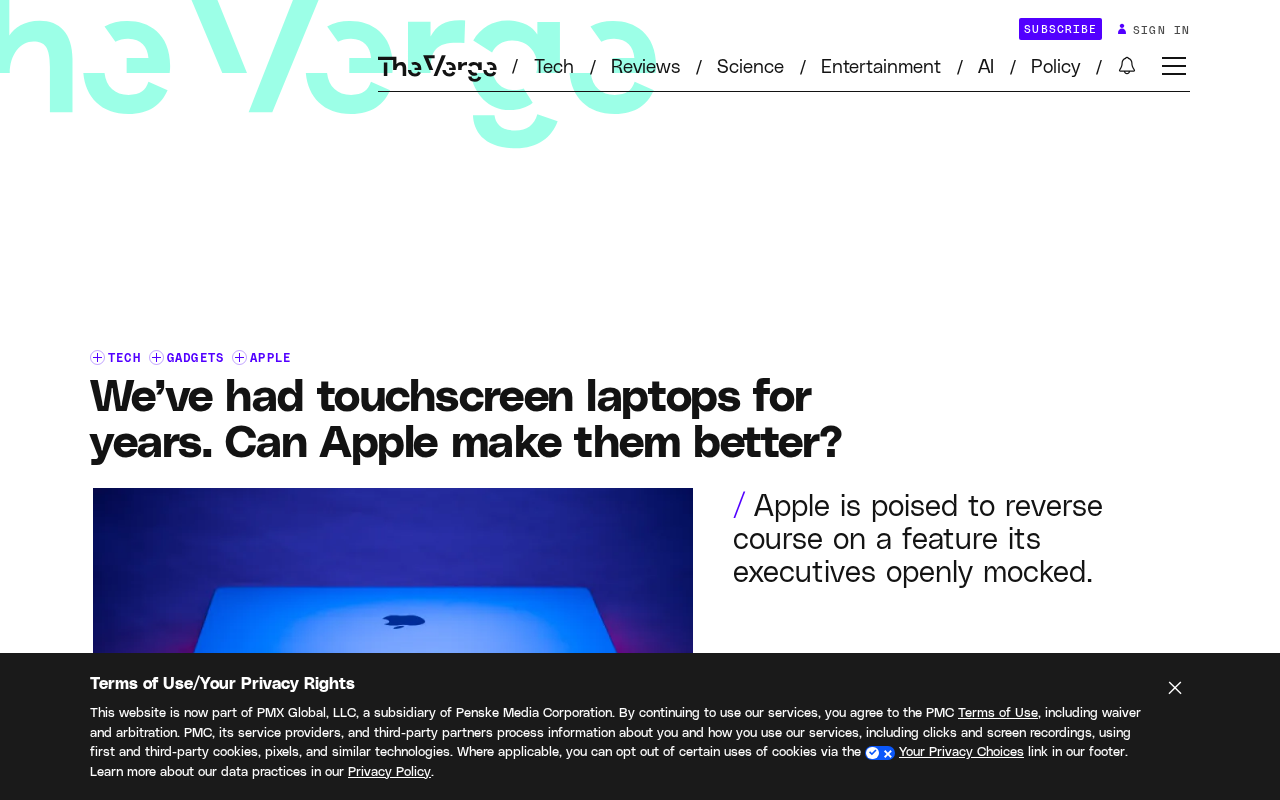
Apple is about to release a touchscreen MacBook? This news sounds like merging a refrigerator with a toaster—absurd yet about to come true. According to foreign media reports, Apple is expected to officially unveil a touchscreen MacBook at tomorrow's "Pro and Tell" event. Touchscreen laptops are nothing new—they've been on the market for years—but Apple's entry still makes the entire industry hold its breath.
The Awkward Status Quo of Touchscreen Laptops
Touchscreen laptops have existed in the Windows camp for a long time, almost becoming standard on mid-to-high-end thin-and-light models. However, the presence of this feature in actual use has always been low. Users are accustomed to using a mouse and keyboard for most tasks, and touchscreens are more of a bonus than a necessity.
Many manufacturers treat touchscreens as a selling point to pile on specs, but rarely redesign the system experience around touch interaction. Accidental taps, screens covered in fingerprints, and touch gestures overlapping with trackpad functions have reduced touchscreen laptops to a feature that "works but isn't good"—a white elephant.
Touchscreen laptops have long been in the awkward position of "better to have than not," largely related to Windows' interaction model. Although Windows has strengthened touch since Windows 8, traditional desktop software still prioritizes mouse and keyboard, requiring constant switching between touch gestures and precise clicks. Meanwhile, the trackpad on Macs handles core operations such as multi-finger gestures, scrolling, and dragging, and users have developed muscle memory. When the screen is also touch-enabled, the two interaction sets easily overlap in function, increasing cognitive load. In addition, screen touch is natural on vertical devices, but on horizontal laptops it requires reaching forward, which easily causes fatigue during prolonged operation—one reason touchscreens struggle to become high-frequency operations on laptops.
Why Apple Is Entering Now
Apple is known for "not being first, but being the best." From smartphones to smartwatches to wireless earbuds, Apple often redefines experiences through software-hardware integration after a category matures.
The significance of a touchscreen MacBook isn't whether the screen can be touched, but whether macOS will be deeply adapted for touch. iPadOS has accumulated rich touch interaction experience. If Apple can migrate this experience to the Mac while retaining the precise operation of desktop-grade professional software, the touchscreen MacBook might break out of the shallow logic of "tapping the screen with a finger" and create a truly integrated interaction.
Apple has historically maintained a clear reservation about Mac touch. Steve Jobs once said that "touchscreen laptops are not ergonomic," believing vertical touchscreens would tire the arms. But in recent years, iPadOS touch interaction, precise input with Apple Pencil, and features like Sidecar and Universal Control have given Apple extensive cross-device input experience. Meanwhile, the Mac product line has completed its migration to Apple Silicon, and the unified chip architecture lowers the cost of trial and error for system-level touch adaptation. If the "Pro and Tell" event reported by foreign media is true, it also fits Apple's recent rhythm of announcing products via press releases or short videos. It's worth noting that rumors of a touchscreen MacBook are not new; whether Apple truly breaks its existing stance still depends on official announcements.
The Real Challenge Is in the Software Ecosystem
At the hardware level, adding a touchscreen to a MacBook isn't difficult. Apple's challenge is: how to get professional users to accept finger operation in software like Photoshop and Final Cut Pro? How to balance the efficiency differences between touch and keyboard/mouse? How to avoid forcing developers to maintain two sets of interaction logic for the same app?
There are no standard answers to these questions. Microsoft's Surface series has explored for years, and the touch experience is still iterating. If Apple wants to prove that the touchscreen MacBook isn't just following the trend, it must deliver system-level and ecosystem-level solutions, not simply add a touchable screen.
Although macOS and iPadOS share the underlying Darwin kernel and some frameworks, their interaction paradigms differ greatly: macOS relies on a precise cursor, menu bar, multiple windows, and keyboard shortcuts, while iPadOS is designed around direct touch, gestures, and single-task/split-screen use. To make the same app adapt to both inputs, developers need dual adaptations in interface control sizes, hover states, context menus, and drag-and-drop logic. Apple can draw on iPadOS's Pointer Interaction, UIKit touch optimizations, and Mac Catalyst cross-platform porting experience, but these solutions are still insufficient for professional software. A more realistic path might be "touch-enhanced" rather than "touch-first": keeping keyboard and mouse as primary and touch as auxiliary, reducing developers' adaptation costs through system-level gestures and context menus.
Can a Late Innovation Win From Behind?
The market's expectation for Apple's touchscreen MacBook is essentially a new answer to the question: "How should touchscreen laptops actually be used?" If Apple merely copies what the Windows camp has done, the product is destined for mediocrity; if Apple can redefine laptop touch interaction as it redefined phone interaction years ago, it still has a chance to win from behind.
We'll find out tomorrow.
Related articles

Why Does Self-Play AI Always Get Crushed by Cheap Units? An RTS Developer's Account of the Dilemma
An independent developer trained an RTS commander AI with pure self-play, only to find it dominated historical versions but was crushed by human players using cheap tier-1 units. This article analyzes the causes of self-play strategy collapse, explores solutions such as exploiters, diversity rewards, and reward design, and introduces the open Bot Kit and AI league plan.

Which Multi-Agent Platform Wins? A Small Team's Battle Scars and Selection Considerations
A 27-person startup's ops lead tried two multi-agent platforms in four months and both failed. This article analyzes why small-team deployments break down, and offers selection guidance on integration depth, observability, and progressive rollout.

Thrive Holdings Takes ADT Private in $7.6 Billion Deal
Thrive Holdings acquires ADT for $7.6 billion in an all-cash take-private deal expected to close in Q1 2027. Analysis of the deal structure, ADT's asset value, and impact on the smart home security industry.